
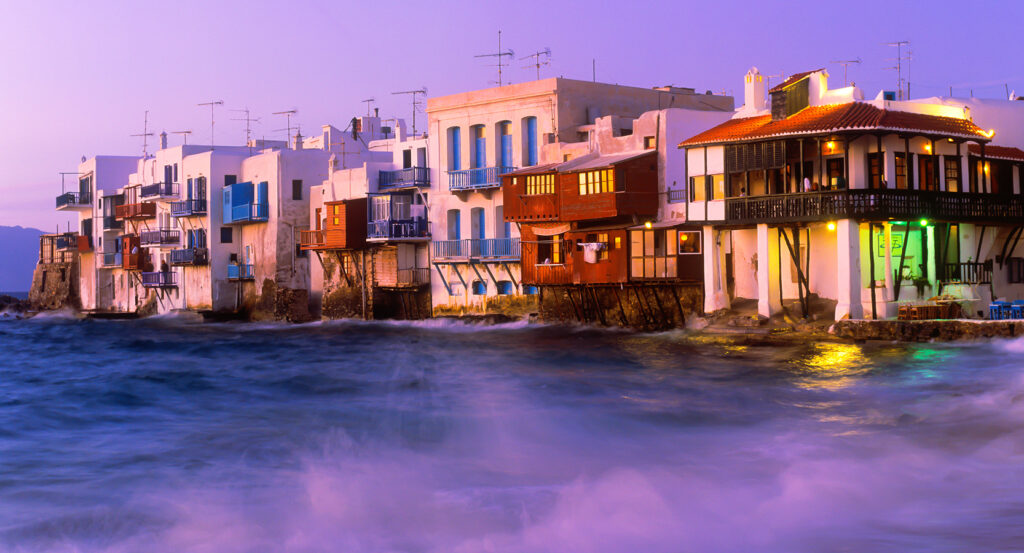
Why Little Venice, Mykonos matters.
Little Venice is a scenic waterfront enclave where Mykonos Town's Cycladic maritime heritage meets the seafaring prosperity of the island's merchant families and the distinctive eighteenth-century houses whose painted balconies project directly above the Aegean Sea.
Set along the western waterfront of Chora between Alefkandra and the approaches to the Old Port, the historic quarter occupies a narrow coastal frontage where tightly arranged houses face the sea, with inland lanes connecting its waterside terraces to the churches, shops and residential courtyards of Mykonos Town. Two- and three-story buildings rise directly above the water, their wooden balconies and painted shutters creating a distinctive contrast with whitewashed masonry. Narrow passages open unexpectedly onto the shoreline, where waves reach the foundations of former maritime residences. Small terraces and waterside establishments occupy spaces historically associated with domestic entrances and commercial activity. The result is a compact coastal neighborhood whose overhanging architecture, irregular shoreline and intimate relationship with the sea preserve the physical character of Mykonos's mercantile past.
What defines Little Venice.
Little Venice is best known for its waterfront houses, constructed principally during the eighteenth and nineteenth centuries when Mykonos developed substantial maritime commercial activity across the Aegean. The settlement's prosperity grew through shipping, trade and the participation of local merchants in commercial networks connecting the Cyclades with mainland Greece and the eastern Mediterranean. Mykonos benefited from its position along established maritime routes, supporting a community of shipowners, sailors, merchants and craftsmen. The island's commercial development accelerated during the eighteenth century as Greek shipping interests expanded within the Ottoman Empire's maritime economy. Local shipowners accumulated wealth through the transportation of agricultural products, manufactured goods and other commodities between Mediterranean ports. The western waterfront of Chora became associated with prosperous maritime households whose residences incorporated direct access to the sea. Buildings developed along the exposed shoreline, taking advantage of limited coastal space and the practical requirements of maritime commerce. Their arrangement incorporated upper residential floors and lower spaces associated with storage, service activities and access to boats. The Greek War of Independence beginning in 1821 brought Mykonos into the struggle against Ottoman rule, with local shipping resources contributing to the revolutionary effort. Manto Mavrogenous, a prominent figure associated with the island, devoted substantial personal resources to the independence movement and became an important representative of Greek revolutionary patriotism. The establishment of the modern Greek state altered the commercial environment of the Cyclades, although maritime activity continued to shape the island's economy during the nineteenth century. Steam navigation and changing trade routes subsequently reduced the relative importance of traditional sailing fleets, contributing to economic difficulties across several Aegean islands. Mykonos experienced significant emigration during the late nineteenth and early twentieth centuries as residents sought employment beyond the island. The development of tourism during the twentieth century introduced a different economic foundation, drawing increasing attention to Chora's historic architecture and coastal setting. The waterfront houses gradually acquired new commercial functions, including restaurants, cafés and hospitality establishments. Their architectural survival preserved an important connection with the island's earlier seafaring prosperity. The name Little Venice became associated with the unusual arrangement of buildings rising directly above the water, establishing a geographical comparison with the Italian lagoon city. The district subsequently became one of Mykonos's most recognizable architectural settings, preserving the relationship between historic maritime residences and the island's contemporary waterfront economy.
Alefkandra's waterfront architecture developed through practical adaptations to the exposed Aegean shoreline and the spatial constraints of Mykonos Town. The houses incorporate substantial stone masonry covered with lime plaster, creating protective exterior surfaces suited to the island's coastal environment. Wooden balconies project from upper floors above the sea, extending domestic living spaces beyond the narrow building footprints. Their painted railings and shutters introduce vivid colors against the whitewashed facades characteristic of Cycladic settlements. The buildings' irregular arrangement follows the natural coastline, producing a sequence of adjoining structures whose elevations vary according to the underlying terrain. Lower floors historically accommodated service functions associated with maritime households, including storage and access to the waterfront. Upper rooms provided residential accommodation, with windows positioned to capture natural light and ventilation from the prevailing Aegean winds. The proximity of the sea exposed these structures to salt spray and winter storms, requiring repeated maintenance of exterior plaster, timber and masonry. Narrow pedestrian lanes behind the waterfront connect the houses with the wider settlement, preserving the compact circulation pattern characteristic of traditional Cycladic towns. Small churches and domestic courtyards occupy spaces between residential buildings, demonstrating the close relationship between religious institutions and neighborhood life. The district's architectural character also incorporates later modifications associated with the growth of restaurants and hospitality businesses. Waterside terraces occupy former domestic and commercial spaces, establishing direct visual connections with the surrounding sea. The western orientation provides expansive views toward the horizon, particularly during the late afternoon when sunlight illuminates the projecting balconies and surrounding masonry. The waterfront's architectural arrangement creates an unusually close relationship between built structures and the movement of the sea. Its surviving houses preserve the construction methods, domestic organization and coastal adaptations associated with Mykonos's historical merchant community.
How Little Venice fits.
Little Venice works as the architectural anchor for a Mykonos outing connecting the island's maritime technology, its religious heritage and the archaeological history of the Cyclades through three complementary destinations.
Begin at Kato Mili Windmills, the historic group of windmills standing on an exposed ridge immediately south of the waterfront quarter. Their cylindrical whitewashed towers and conical roofs preserve the machinery and architectural forms associated with grain milling in the Cyclades. Mykonos developed numerous windmills to exploit the island's persistent winds, processing grain brought by ships and serving local agricultural and commercial needs. The surviving structures demonstrate the practical importance of wind power within the island's preindustrial economy. Their elevated position provides extensive views across Chora and the surrounding Aegean, connecting the historic milling industry with the maritime routes that supplied its raw materials. Continue to Panagia Paraportiani, the distinctive church complex situated near the western edge of Mykonos Town. Its architectural composition developed through the combination of five individual churches constructed across several centuries, producing an irregular arrangement of whitewashed walls, curved surfaces and interconnected chapels. The oldest elements date to the medieval period, and subsequent additions created the sculptural exterior visible in the present building. The church's name refers to its historical association with a secondary entrance to the former fortified settlement. Its compact arrangement preserves the relationship between religious construction and the defensive geography of medieval Chora. Conclude at the Archaeological Museum of Mykonos, located near the island's Old Port. Established in the early twentieth century, the museum houses archaeological objects associated with Mykonos and the neighboring island of Rheneia. Its collections include ancient pottery, funerary sculpture and artifacts connected with the religious and commercial networks of the Cyclades. An important exhibit is a large seventh-century BCE storage jar decorated with scenes associated with the Trojan War, including the capture of Troy. The museum's holdings establish a broader historical context for the maritime communities that developed across the surrounding islands. The progression moves from Kato Mili Windmills' commercial infrastructure through Panagia Paraportiani's religious architecture and culminates at the Archaeological Museum of Mykonos's ancient collections, connecting Little Venice with the economic and cultural history of the Cyclades.
Where your story begins.
Foresyte Travel reveals places that feel extraordinary long before you arrive.
Enjoy editorial crafted for luxury travelers.
Foresyte may earn a commission when you book.




















































































































