
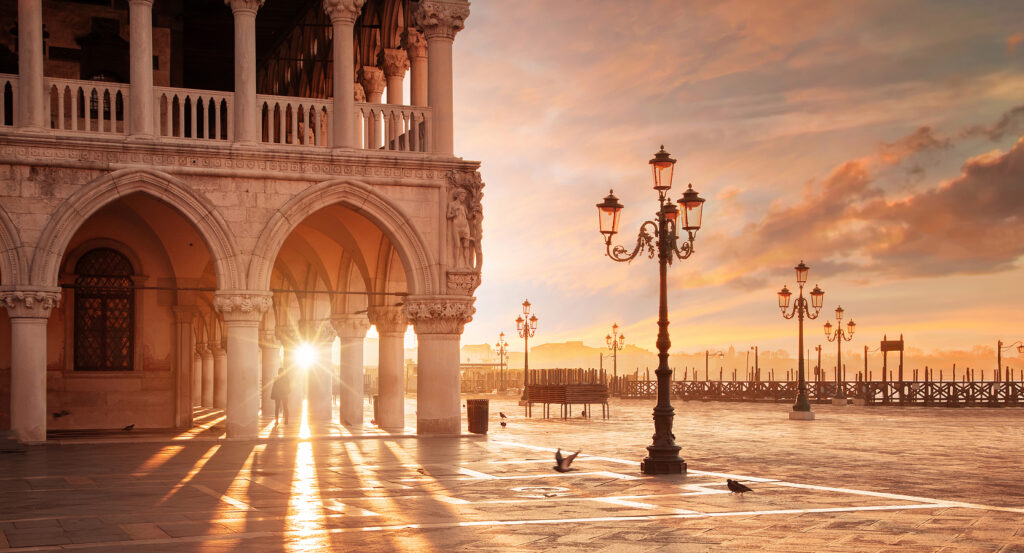
Why Piazza San Marco matters.
Piazza San Marco is a medieval ceremonial square where San Marco's maritime heritage meets the political institutions of the Venetian Republic, the architectural patronage of its doges and the religious authority of the city's patron saint.
Occupying the principal open space of Venice's historic center, the square extends westward from Basilica di San Marco between the arcaded Procuratie Vecchie and Procuratie Nuove, with its eastern end opening toward the Piazzetta and the waterfront of the Bacino di San Marco. Its trapezoidal plan widens toward the basilica, creating a measured approach to the principal religious buildings. Continuous arcades shelter commercial premises beneath the former administrative residences of Venetian officials. Istrian stone paving organizes the pedestrian surface through geometric bands and rectangular fields. The result is a civic enclosure whose spatial arrangement preserves the ceremonial relationship between Venice's republican government, ecclesiastical institutions and maritime commerce.
What defines Piazza San Marco.
Piazza San Marco is best known for serving as the principal ceremonial and political square of the Venetian Republic for nearly a millennium. Its origins followed the arrival of the relics of Saint Mark from Alexandria in 828, an event that strengthened Venice's religious standing and established the evangelist as the republic's patron saint. A chapel constructed to house the relics became the nucleus of an ecclesiastical precinct adjoining the seat of ducal government. During the ninth century, the square occupied a smaller area divided by the Rio Batario, a canal crossing the developing settlement. The construction of a larger church during the eleventh century accompanied Venice's increasing commercial power in the eastern Mediterranean. In 1172, Doge Sebastiano Ziani initiated a substantial reorganization of the precinct, filling the canal and extending the square westward. This intervention created a larger ceremonial enclosure suited to processions, public assemblies and diplomatic receptions. The republic subsequently developed administrative residences for the procurators of Saint Mark, officials responsible for the basilica's property and important charitable responsibilities. During the sixteenth century, the rebuilding of the northern Procuratie introduced a more regular Renaissance architectural composition. Jacopo Sansovino contributed to the transformation of the adjoining civic precinct through commissions associated with the republic's cultural and administrative ambitions. Religious processions, including ceremonies associated with the Feast of Saint Mark, connected the square with the authority of the doge and the city's ecclesiastical institutions. The Venetian Republic ended in 1797 following Napoleon Bonaparte's military campaign, bringing the square's republican ceremonial functions to a close. During French rule, alterations to its western end introduced a new architectural wing linking the existing administrative ranges. Nineteenth-century Austrian administration maintained the square's importance within Venice's civic life, and its cafés became gathering places for residents, writers and political figures. The square subsequently developed into a central site for public ceremonies, cultural events and the preservation of Venetian architectural heritage.
Andrea Tirali's eighteenth-century pavement design established the geometric arrangement that organizes movement across the square's broad stone surface. Its intersecting bands create a visual relationship between the basilica, the surrounding arcades and the western architectural enclosure. The Procuratie Vecchie occupy the northern side, where a long sequence of arches and windows forms a continuous façade associated with the republic's senior administrative officers. The Procuratie Nuove extend along the southern side, incorporating Renaissance architectural principles developed through successive building campaigns. Vincenzo Scamozzi contributed to the design of this southern range, whose classical orders and repeated bays establish a measured counterpart to the northern buildings. The Napoleonic Wing closes the western end, completing the architectural enclosure through a nineteenth-century intervention. Beneath the arcades, Caffè Florian opened in 1720 and became associated with Venice's literary, political and artistic society. Its decorated rooms preserve nineteenth-century interiors incorporating painted panels, mirrors and gilded furnishings. Across the square, Caffè Quadri developed a separate history of Venetian café society, occupying premises associated with the city's public social life. The Torre dell'Orologio stands at the northeastern entrance, where its astronomical clock displays the hours, zodiac signs and phases of the moon. Completed during the late fifteenth century, the tower incorporates an expansive clock face beneath sculptural figures and a winged lion of Saint Mark. Bronze figures above the clock strike a bell to mark the hours, connecting mechanical timekeeping with the square's public ceremonies. The Campanile di San Marco rises independently near the southeastern corner, preserving the position of a bell tower whose medieval origins were associated with maritime observation and civic communication. The original tower collapsed in 1902 and was reconstructed on its historic site, reopening in 1912. Its brick shaft, belfry and pyramidal spire establish the principal vertical element of the square's architectural composition. These structures preserve the relationship between Venetian public administration, commercial exchange, religious observance and the ceremonial organization of urban space.
How Piazza San Marco fits.
Piazza San Marco works as the republican ceremonial centerpiece for a Venice outing connecting the city's maritime government, artistic patronage and commercial institutions through the historic buildings surrounding its principal civic precinct.
Begin at Basilica di San Marco, the cathedral whose architecture developed through Venice's political and commercial relationships with the Byzantine world. The present church was begun in 1063 and incorporates a Greek-cross plan crowned by five domes. Its exterior contains marble revetments, sculpted portals and mosaics assembled through successive campaigns of decoration. The interior preserves extensive gold-ground mosaics depicting biblical subjects and religious figures. The Pala d'Oro, a Byzantine gold altarpiece enriched with enamel and gemstones, represents the republic's connections with eastern Mediterranean craftsmanship. Continue to Palazzo Ducale, the former residence of the doge and headquarters of the Venetian Republic's governing institutions. Its Gothic exterior incorporates pointed arches, a two-level arcade and an upper wall faced with patterned stone. The palace developed through major construction campaigns during the fourteenth and fifteenth centuries, accommodating the Great Council, Senate and judicial offices. Interior decoration includes paintings by Tintoretto and Paolo Veronese associated with the republic's political and religious traditions. The Bridge of Sighs connects the palace's judicial chambers with the former prison complex across the Rio di Palazzo. Conclude at Museo Correr, the museum occupying the western architectural range of the square. Its collections originated with the bequest of Teodoro Correr, whose holdings of paintings, manuscripts, antiquities and historical objects formed the basis of a civic museum. The galleries preserve materials associated with Venetian government, navigation, commerce and urban life. Neoclassical rooms designed during the Napoleonic period provide an architectural setting for sculpture and decorative arts. The museum's collections connect the political institutions of the republic with the artistic production and maritime economy that supported Venice's historical development. The progression moves from the city's patronal basilica through the governing chambers of the republic and culminates in the civic collections of Museo Correr, connecting Piazza San Marco with the religious, political and artistic institutions of Venice.
Where your story begins.
Foresyte Travel reveals places that feel extraordinary long before you arrive.
Enjoy editorial crafted for luxury travelers.
Foresyte may earn a commission when you book.




















































































































