Why Torcello matters.
Torcello Island isn't the Venice you know, it's the Venice that time forgot.
Set in the northern reaches of the Venetian Lagoon, this quiet, hauntingly beautiful island feels worlds away from the grandeur and crowds of St. Mark's Square. As the vaporetto glides across still waters, the noise of the city fades, replaced by the call of seabirds and the soft slap of waves against the hull. When you step onto Torcello's worn stone path, you enter a living echo of history, an island that once rivaled Venice itself in power and prestige, now reduced to a few scattered buildings, whispering ruins, and an otherworldly calm. The walk from the small pier to the island's heart is lined with reeds and willows swaying in the salt breeze, punctuated by rustic trattorias and mossy bridges that seem untouched by centuries. Ahead rises the Cathedral of Santa Maria Assunta, its Byzantine mosaics glowing gold even under gray skies. There's a serenity here that no other Venetian island can match, a sense that you've stumbled into the soul of the lagoon itself.
What defines Torcello Island.
Long before Venice became a city of marble and canals, Torcello was the cradle of it all, the first true settlement in the lagoon.
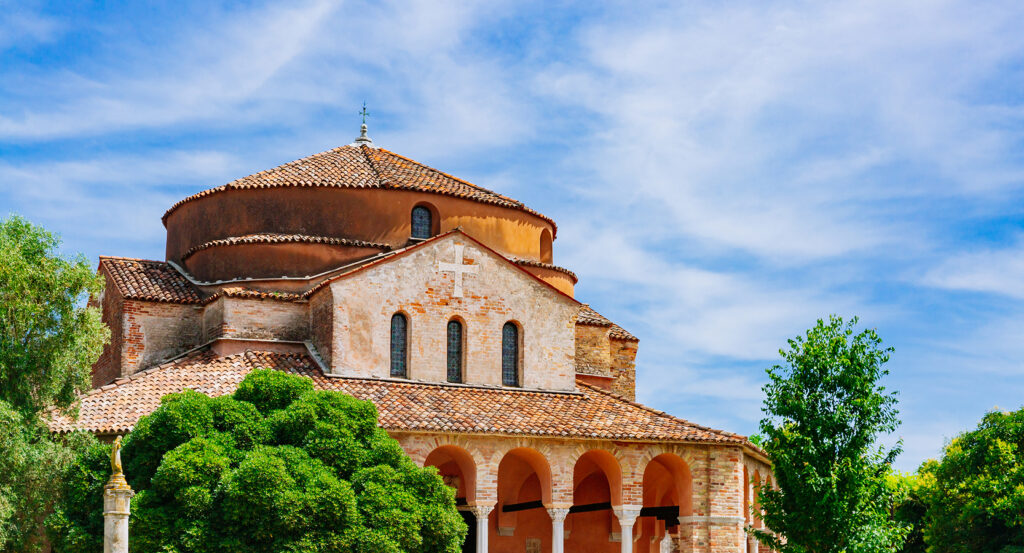
Founded in the 5th century by mainland refugees fleeing Attila the Hun's invasions, the island blossomed into a thriving trade center during the early Middle Ages. At its peak, Torcello was home to as many as 20,000 residents, merchants, artisans, and nobles who built palaces, churches, and ports that connected the lagoon to the Byzantine world. But as the centuries passed, the lagoon silted up and malaria spread through the marshes, driving people away toward what would become Venice. Today, fewer than 20 inhabitants remain. Yet the traces of that lost civilization endure, most notably in the Cathedral of Santa Maria Assunta, founded in 639 AD and still crowned with some of the most breathtaking Byzantine mosaics outside Ravenna. The glittering Last Judgment scene inside the apse is a masterpiece of both artistry and theology, shimmering gold against deep blues and reds that seem to flicker like candlelight. Beside it stands the Church of Santa Fosca, an elegant Greek-cross structure that merges Eastern and Western architecture in perfect harmony. And near the ancient stone bridge known as the Ponte del Diavolo, the Devil's Bridge, legends still whisper of a pact between a young Venetian and a demon to bring back his lost love. Every corner of Torcello carries layers of myth, memory, and melancholy, making it among the most quietly profound places in the Venetian Lagoon.
How Torcello Island fits.
A visit to Torcello in Venice is an invitation to slow down, to breathe in the silence of history and rediscover what Venice was before it became a performance.
Begin your journey from Fondamente Nove or Burano, boarding the vaporetto that traces the quiet northern canals before arriving at Torcello's modest dock. The island's magic unfolds in its simplicity: a long stone path leading toward the heart of civilization past fields of wild grass and brackish canals shimmering under the sun. Stop at Trattoria al Trono di Attila or Locanda Cipriani, the latter famously beloved by Hemingway, for a glass of Prosecco and a dish of lagoon-caught seafood before continuing toward the cathedral square. Once there, take time to sit on the Stone Throne of Attila, a relic of legend, a bishop's seat, that stands as a reminder of the island's regal past. Inside the cathedral, allow your eyes to adjust to the dim glow and lose yourself in the shimmer of the mosaics; it's one of the rare moments in travel where you can feel history breathing around you. Climb the campanile for sweeping views of the lagoon, where the water merges into sky, and you'll understand why this island inspired poets and painters alike. Afterward, wander through the quiet gardens and overgrown ruins that line the canals, stopping to watch egrets wade through the reeds. Visit in the late afternoon, when the crowds have thinned and the light turns amber, that's when Torcello feels most ethereal, caught between dream and memory. When you finally depart, the skyline of Venice reappears on the horizon, glittering like a mirage, and you'll carry with you the quiet revelation that sometimes, the heart of a city lies not in its grandeur, but in its ghosts.
Where your story begins.
Foresyte Travel reveals places that feel extraordinary long before you arrive.
Enjoy editorial crafted for luxury travelers.
Foresyte may earn a commission when you book.