
Why Ristorante Quadri matters.
Ristorante Quadri is a MICHELIN-starred Venetian fine-dining restaurant where San Marco's centuries-old tradition of civic ceremony meets the Alajmo family's gastronomic achievements, the historic grandeur of one of Venice's celebrated coffeehouses and a contemporary interpretation of the lagoon's culinary heritage.
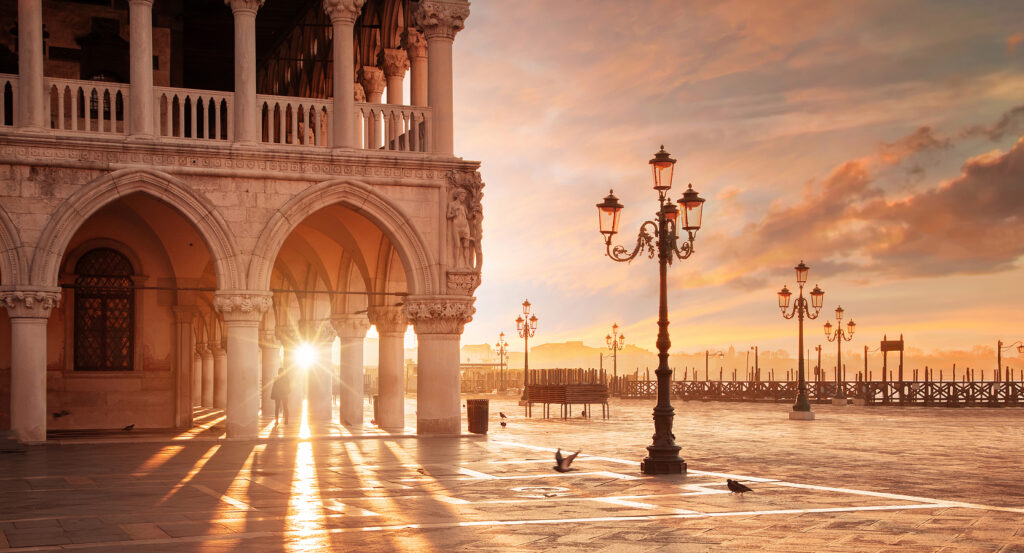
Positioned on the northern side of Piazza San Marco, the restaurant occupies the upper floor of Gran Caffè Quadri, overlooking the expansive square from premises historically associated with the governing institutions of the Venetian Republic. Its location places it between the Procuratie Vecchie, the Torre dell'Orologio and the western approaches to the Basilica di San Marco, within the architectural ensemble that has defined Venice's ceremonial center for centuries. The dining rooms retain the proportions of a historic Venetian interior, enriched by decorative textiles, elaborate chandeliers and carefully restored architectural details. Windows overlooking the piazza establish an exceptional relationship between the dining room and the surrounding monuments, introducing a distinctive perspective on the city's public life. The arrangement accommodates intimate tables within richly decorated rooms, combining the ceremonial character of the building with the precision of contemporary fine dining. The result is an extraordinary restaurant setting whose architectural heritage and privileged position overlooking Piazza San Marco establish a direct connection between Venice's historic institutions and its contemporary gastronomic culture.
What defines Ristorante Quadri.
Ristorante Quadri is best known for transforming a historic Venetian dining institution into an internationally recognized restaurant under the leadership of Massimiliano and Raffaele Alajmo. The establishment's origins reach back to 1638, when a business called Il Rimedio occupied the premises and specialized in Malvasia wine, a product associated with Venice's extensive Mediterranean trading connections. On May 28, 1775, Giorgio Quadri and his wife Naxina, who had arrived from Corfu, acquired the establishment and introduced Turkish-style coffee, developing the enterprise that would become Gran Caffè Quadri. Their investment reflected the growing importance of coffeehouses within Venetian commercial and social life, connecting the business with the city's longstanding exchanges with the eastern Mediterranean. In 1830, the Vaerini brothers assumed management and expanded the premises into the upper floor, establishing a restaurant within rooms formerly associated with the procurators of the Venetian Republic. The development introduced a more substantial dining operation to an establishment already associated with fashionable hospitality and the social life of the piazza. During the nineteenth and twentieth centuries, the wider coffeehouse became a gathering place for international literary and cultural figures, including Stendhal, Lord Byron, Alexandre Dumas, Richard Wagner and Marcel Proust. Its reputation developed through the combination of an exceptional location, distinguished hospitality and longstanding associations with Venice's intellectual and artistic circles. The Alajmo family acquired the business in December 2010, introducing a new chapter under brothers Massimiliano, the chef, and Raffaele, the hospitality group's chief executive. Their professional achievements had already established the family among Italy's most influential restaurateurs through Le Calandre in Rubano, near Padua, which holds three MICHELIN stars. Massimiliano became the youngest chef to receive three MICHELIN stars in 2002, establishing an international reputation for imaginative Italian cooking grounded in exceptional ingredients and technical precision. The brothers brought this culinary expertise to Venice, developing the upper-floor restaurant as a contemporary expression of the city's gastronomic traditions. Ristorante Quadri received its first MICHELIN star in 2012, establishing its position within the international fine-dining community. The family subsequently undertook an extensive restoration in 2018, commissioning French designer Philippe Starck and architect Marino Folin to oversee the transformation. The project involved Venetian artisans specializing in historic textiles, glassmaking, metalwork and decorative restoration, preserving the building's accumulated architectural character. Tessitura Bevilacqua produced specially designed wall coverings, and Murano glassmakers contributed elaborate decorative elements, connecting the renovation with Venice's traditional craft industries. The restoration also incorporated contemporary interventions that introduced a restrained surrealist character to the historic rooms, extending the creative collaboration between Starck and the Alajmo brothers. The restaurant subsequently developed a distinct position within the family's international hospitality enterprise, alongside Gran Caffè Quadri and the more informal Bistrot Quadrino. Giovanni Alajmo, Raffaele's son, and Michele Pozzani now oversee the wider establishment, continuing the family's involvement in its development. Chef Sergio Preziosa leads Ristorante Quadri's contemporary culinary program, supported by head sommelier Giacomo Lorato and restaurant manager Marco Cicchelli. Its membership in Les Grandes Tables du Monde and Relais & Châteaux reinforces its international standing, connecting the restaurant's Venetian heritage with a distinguished network of independent gastronomic institutions.
Sergio Preziosa's cooking develops through the relationship between Venice's maritime environment, the agricultural resources of the surrounding islands and contemporary techniques that reinterpret established regional preparations. His culinary direction concentrates on the lagoon as a place of exchange between land and water, emphasizing ingredients whose character reflects the city's distinctive geography. Fresh fish from the Rialto market provides an important foundation, introducing species associated with the shallow waters of the northern Adriatic and the traditional fishing communities of the lagoon. Seasonal shellfish contribute contrasting textures and natural salinity, allowing the kitchen to explore the delicate relationship between marine ingredients and carefully controlled cooking. Vegetables from Sant'Erasmo, the island historically associated with supplying Venice's markets, introduce an agricultural dimension through produce cultivated in the lagoon's distinctive soils. Their seasonal availability establishes a close connection between the restaurant's menu and the changing conditions of the surrounding environment. Preziosa's Confini project develops these relationships through the meeting of contrasting ingredients, textures and culinary traditions, exploring the transformation of familiar Venetian flavors through contemporary preparation. The approach incorporates elements of Italian cooking beyond the Veneto, reflecting the historical importance of Venice as a center of commercial exchange and cultural contact. Seasonal game introduces a complementary expression of the region's terrestrial ingredients, extending the repertoire through preparations grounded in the broader agricultural landscape of northeastern Italy. Sauces and accompaniments concentrate the natural character of individual products, establishing balance through acidity, aromatic freshness and carefully developed richness. The restaurant's menu accommodates different approaches to dining, allowing guests to select a shorter sequence of courses or pursue a more extensive exploration of the kitchen's repertoire. Its wine collection extends across established Italian regions and distinctive international producers, with particular attention to bottles that complement the contrasting requirements of seafood, vegetables and substantial savory preparations. The selection includes less familiar appellations, introducing wines whose mineral character, acidity and aromatic complexity contribute to the sequence of the meal. Giacomo Lorato's work connects these selections with the kitchen's evolving compositions, developing pairings that emphasize the relationship between regional ingredients and individual wines. Ristorante Quadri's culinary distinction emerges from this integration of Venetian maritime traditions, accomplished contemporary technique and an adventurous wine program, preserving the character of the lagoon within an internationally recognized fine-dining institution.
How Ristorante Quadri fits.
Ristorante Quadri works as the dining culmination of an exploration connecting Venice's Renaissance engineering achievements, the preservation of its civic collections and the architectural legacy of the republic's political institutions, placing the restaurant within the historical and cultural landscape of Piazza San Marco.
Begin at Torre dell'Orologio, the expansive Renaissance clock tower constructed at the eastern end of the square between 1496 and 1499. The Venetian Senate commissioned the clockmakers Gian Paolo and Gian Carlo Rainieri to create a sophisticated public timekeeping mechanism, establishing a prominent symbol of the republic's technological achievements. Inaugurated on February 1, 1499, the tower incorporates an elaborate astronomical dial displaying the position of the sun, the phases of the moon and the signs of the zodiac. Its upper terrace supports the celebrated bronze figures known as the Moors, whose mechanical striking of the bell established an enduring feature of Venetian public life. The tower's position above the entrance to the Mercerie also connects the ceremonial square with the commercial streets leading toward the Rialto. Continue to Museo Correr, the civic museum whose collections originated with the extraordinary bequest of Venetian nobleman Teodoro Correr. Following his death in 1830, Correr left his extensive holdings of paintings, sculptures, manuscripts, historical objects and antiquities to the city, establishing the foundation of Venice's municipal museum collections. The institution relocated to its present premises in 1922, occupying the Napoleonic Wing and sections of the Procuratie Nuove. Its galleries preserve important material associated with the political, artistic and social development of the Venetian Republic, alongside significant examples of Neoclassical sculpture and painting. The surrounding architectural spaces retain decorative elements associated with the Napoleonic and Habsburg periods, reflecting the transformations that followed the republic's dissolution in 1797. Conclude at Palazzo Ducale, the expansive Gothic palace that served as the political and administrative center of the Venetian Republic. Its present architectural character developed substantially during the fourteenth and fifteenth centuries, combining elaborate stone tracery, pointed arches and richly decorated ceremonial interiors. The palace accommodated the doge's residence, the principal governing councils and judicial institutions responsible for administering the republic's extensive territories. Its artistic program includes major works by Tintoretto, Veronese and other Venetian masters, reflecting the close relationship between political authority and artistic patronage. The adjoining Bridge of Sighs connects the palace with the historic prisons, preserving a distinctive architectural expression of the republic's judicial institutions. The progression connects Venice's achievements in Renaissance engineering with the preservation of its civic collections and concludes at the former center of republican government, establishing the broader historical setting surrounding Ristorante Quadri.
Where your story begins.
Foresyte Travel reveals places that feel extraordinary long before you arrive.
Enjoy editorial crafted for luxury travelers.
Foresyte may earn a commission when you book.




















































































































