Why Murano matters.
Murano is a luminous Venetian Lagoon neighborhood where centuries of master glassmaking, island craftsmanship, artistic innovation, and the enduring legacy of the Serenissima have shaped one of the world's most celebrated creative communities.
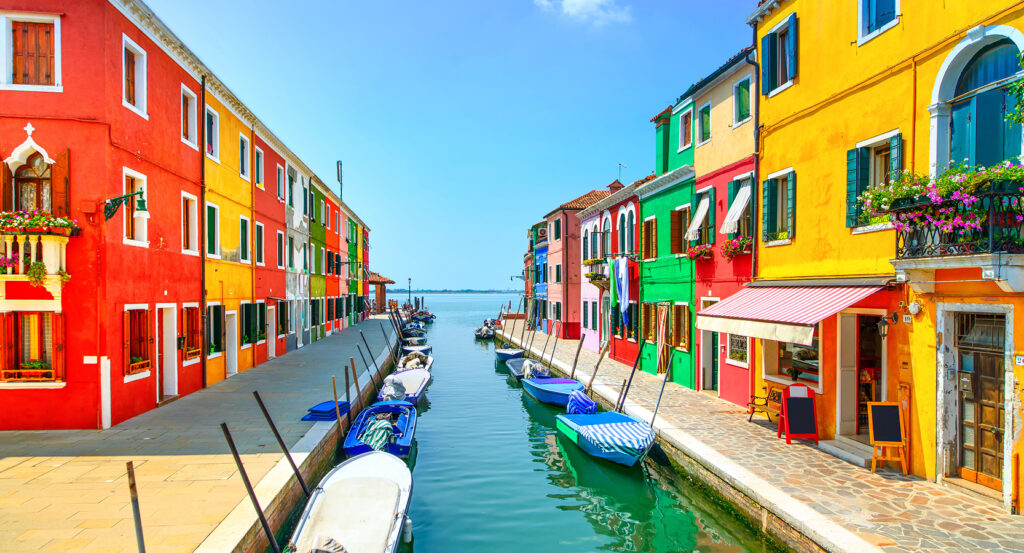
Positioned between Sacca Serenella and San Michele, this canal-woven island ensemble unfolds across a constellation of bridges, historic furnaces, quiet fondamenta, and elegant campos where generations of glass artisans transformed fire, sand, and imagination into objects admired across the globe. Gothic palaces, Renaissance churches, family-run workshops, and shimmering canals reveal an atmosphere where everyday life remains inseparable from a craft refined over more than seven centuries. Creative tradition continues flowing through every courtyard, furnace, and waterfront as Murano preserves one of humanity's most enduring artistic legacies.
What defines Murano.
Murano is best known for becoming the world's foremost center of artistic glassmaking after the Venetian Republic ordered its furnaces transferred from Venice to Murano in 1291, protecting the city's densely built urban fabric from catastrophic fires while concentrating generations of master artisans whose innovations transformed European luxury, science, and decorative arts through revolutionary techniques including cristallo, lattimo, filigree, aventurine, millefiori, and intricately worked glass mirrors, chandeliers, beads, and sculpture. Protected by strict laws that prohibited master glassmakers from permanently leaving the republic in order to preserve valuable commercial secrets, Murano developed into one of Venice's most closely guarded industrial and artistic centers, with elite glassmaking families receiving unusual legal privileges while their technical expertise generated immense wealth for the Serenissima through international trade. Angelo Barovier's fifteenth-century development of exceptionally clear cristallo established a new global standard for luxury glass, while subsequent innovations including enamel decoration, diamond-point engraving, reticello, calcedonio, and elaborate blown forms elevated Murano workshops into Europe's leading producers of artistic glass for royal courts, churches, merchants, and collectors. The island preserves exceptional cultural institutions including the Museo del Vetro, housed within the Palazzo Giustinian, where collections spanning Roman antiquity through contemporary studio glass document more than two millennia of glassmaking history. Historic churches including Basilica dei Santi Maria e Donato preserve extraordinary Byzantine mosaic pavements and medieval architecture that reflect Murano's importance beyond its furnaces, while internationally respected contemporary studios continue advancing artistic expression through collaborations with leading designers, architects, sculptors, and glass artists. Recognition within the UNESCO World Heritage Site of Venice and its Lagoon, together with continuing conservation, apprenticeship traditions, and internationally protected Murano trademarks, reinforces the island's enduring status as the global capital of artistic glassmaking.
Historic furnaces continue transforming molten glass through techniques requiring extraordinary dexterity as glowing gathers are blown, stretched, engraved, sculpted, and assembled into objects that preserve centuries of accumulated knowledge. Museum collections, working studios, canal-side workshops, and artisan showrooms reveal the remarkable continuity between medieval craftsmanship and contemporary artistic innovation while demonstrating how Murano's economy and character remain inseparable from glass. Continuing research, conservation, international exhibitions, and family traditions ensure that one of humanity's greatest artisanal achievements continues evolving. Fire, craftsmanship, artistic vision, and cultural continuity combine to establish one of Italy's most extraordinary creative communities.
How Murano fits.
Murano works as an exploration of Venice's extraordinary artistic craftsmanship and island heritage.
Begin at Museo del Vetro, where masterpieces spanning centuries introduce the artistic evolution that established Murano as the world's foremost glassmaking center before exploring the surrounding workshops and canals. Continue to Basilica dei Santi Maria e Donato, whose Byzantine mosaics and medieval architecture reveal the island's rich religious and artistic heritage beyond its furnaces. Conclude at Faro di Murano, where expansive lagoon views provide a memorable finale celebrating the maritime setting that connected Murano's master artisans with trading networks stretching across Europe and beyond. The progression moves naturally from artistic mastery to sacred history before concluding beside the lagoon that carried Murano glass to the world, revealing why Murano remains one of Venice's most culturally significant islands.
Where your story begins.
Foresyte Travel reveals places that feel extraordinary long before you arrive.
Enjoy editorial crafted for luxury travelers.
Foresyte may earn a commission when you book.