
Why Grand Canal matters.
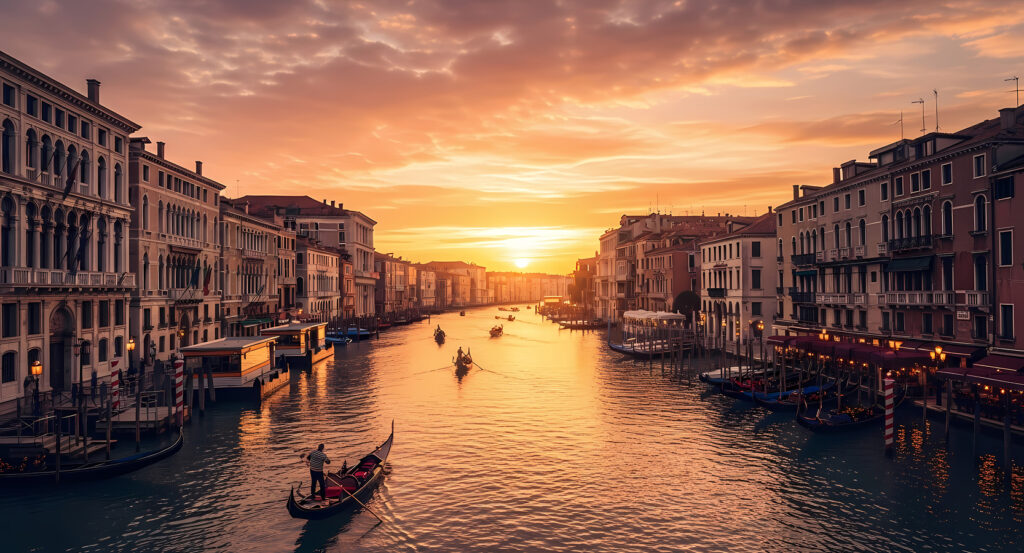
Grand Canal is a historic tidal waterway where Venice's maritime heritage meets the mercantile wealth of the Venetian Republic, the architectural patronage of its ruling families and the transportation network that shaped the lagoon city's urban development.
Winding through Venice's historic center from the Santa Lucia railway precinct to the Bacino di San Marco, the canal follows a broad reverse-S course between the city's principal islands, separating districts whose waterfront palaces, churches and former commercial buildings face directly onto its navigable channel. Its banks contain successive concentrations of Byzantine, Gothic, Renaissance and Baroque architecture. Stone landing stages and water entrances connect individual buildings with the canal's boat traffic. Public transport stops occupy designated positions along the waterway, maintaining its function as a principal urban route. The result is a maritime thoroughfare whose architecture and circulation preserve the commercial organization of historic Venice.
What defines Grand Canal.
Grand Canal is best known as Venice's principal navigable artery and the setting for an extensive concentration of palaces constructed by the republic's merchant aristocracy. Its origins lie in the natural tidal channels of the Venetian Lagoon, whose waterways shaped the settlement patterns of the islands that developed into the city. During the early medieval period, communities established residences, workshops and trading facilities along navigable channels connecting the lagoon with the Adriatic Sea. The consolidation of Venetian political authority around Rialto during the ninth century increased the importance of the central waterway as a route for transporting merchandise and people. As maritime commerce expanded, merchant families acquired waterfront properties that provided direct access to cargo boats and commercial vessels. By the twelfth century, the canal had become an organizing element of the city's trading economy, connecting warehouses, markets and residential compounds. The growth of Venetian commerce with Constantinople and the eastern Mediterranean brought substantial wealth into the republic, supporting increasingly elaborate domestic architecture. During the thirteenth and fourteenth centuries, merchant residences developed architectural forms combining waterfront storage facilities with ceremonial apartments on the upper floors. The Venetian Gothic palace became an important building type, incorporating pointed windows, loggias and richly decorated façades facing the water. Renaissance architects subsequently introduced classical orders, symmetrical compositions and expansive entrance arrangements to prominent waterfront properties. The sixteenth century brought substantial architectural commissions from patrician families whose political positions and commercial holdings supported major construction projects. During the seventeenth and eighteenth centuries, Baroque palaces and religious buildings added domes, sculptural decoration and ceremonial façades to the canal's architectural sequence. The republic's political dissolution in 1797 altered the economic circumstances of many aristocratic households, contributing to changes in palace ownership and use. Nineteenth-century transport developments strengthened connections between the canal and the expanding railway network, bringing new movement patterns into the historic city. Motorized water transport subsequently supplemented traditional rowing vessels, establishing the canal's importance within Venice's modern public transportation system. Its waterfront architecture and navigational functions preserve the relationship between maritime trade, aristocratic residence and the urban development of the Venetian Republic.
Baldassare Longhena's Ca' Pesaro demonstrates the development of Baroque palace architecture through a substantial waterfront façade incorporating classical columns, sculptural ornament and projecting architectural elements. Construction began during the seventeenth century for the Pesaro family, whose wealth and political standing supported the commission. The building's lower level establishes a substantial masonry base, with upper floors organized through repeated window bays and elaborate decorative treatment. Its interiors subsequently became associated with Venice's civic art collections, accommodating the International Gallery of Modern Art. Ca' d'Oro presents an earlier architectural tradition through its fifteenth-century Venetian Gothic façade, distinguished by pointed arches, delicate tracery and an asymmetrical arrangement of open loggias. The palace was commissioned by Marino Contarini and developed through the work of Venetian craftsmen associated with the Bon architectural workshop. Its original decorative program incorporated gilding and colored surfaces, contributing to the building's historic name. Palazzo Grassi, designed by Giorgio Massari during the eighteenth century, introduces a more restrained classical composition with an expansive waterfront entrance and regularly arranged windows. The building subsequently became an exhibition institution associated with contemporary art. Palazzo Barbarigo preserves a nineteenth-century mosaic façade overlooking the canal, incorporating decorative compositions associated with the Venetian tradition of glass craftsmanship. The canal's architectural sequence also includes former warehouses and trading establishments whose broad water entrances accommodated the movement of merchandise. The Fondaco dei Turchi, a medieval building subsequently adapted for Ottoman merchants, preserves the relationship between foreign trading communities and Venice's commercial institutions. Its waterfront arcade and upper gallery establish an architectural arrangement associated with the accommodation and regulation of international merchants. Vaporetto services follow the canal's principal route, connecting landing stages beside historic residential and commercial districts. Gondolas and private boats share the waterway with public transport, maintaining a transportation pattern organized around the lagoon's navigable channels. The canal's architectural character develops through these distinct waterfront buildings, preserving the relationship between commercial access, aristocratic patronage and the evolution of Venetian palace design.
How Grand Canal fits.
Grand Canal works as the maritime architecture centerpiece for a Venice outing connecting the republic's historic trading institutions, Renaissance religious patronage and civic collections along its principal waterway.
Begin at Ponte degli Scalzi, the stone bridge spanning the canal near Venezia Santa Lucia railway station. The surviving structure was designed by Eugenio Miozzi and completed in 1934, replacing an earlier iron bridge constructed during the nineteenth century. Its single arch accommodates water traffic beneath a pedestrian crossing connecting the districts of Cannaregio and Santa Croce. The bridge's stone construction and elevated steps establish a direct relationship between the canal's transport functions and the streets surrounding the railway terminal. Its position provides views along the waterway toward historic palaces and commercial buildings. Continue to Chiesa di San Stae, the Baroque church occupying a waterfront position in Santa Croce. Its principal façade was designed by Domenico Rossi during the early eighteenth century, incorporating classical columns, sculptural figures and a substantial central entrance facing the canal. The church's interior contains paintings by Venetian artists associated with the late Baroque period, including works by Giovanni Battista Tiepolo and Sebastiano Ricci. Its dedication to Saint Eustace connects the building with religious traditions maintained by the surrounding parish community. The waterfront entrance preserves the importance of boat access within Venetian ecclesiastical architecture. Conclude at Gallerie dell'Accademia, the art museum occupying historic buildings associated with the former Scuola Grande della Carità and adjoining religious institutions. The museum developed from the Accademia di Belle Arti, established during the eighteenth century to support artistic education in Venice. Its collections contain major works by Giovanni Bellini, Vittore Carpaccio, Giorgione, Titian and Paolo Veronese. The galleries preserve Venetian painting from the medieval period through the eighteenth century, including substantial religious commissions and civic decorative cycles. Its position near the southern section of the canal connects the republic's artistic heritage with the architecture of Dorsoduro. The progression moves from twentieth-century bridge engineering through Baroque waterfront patronage and culminates at the Accademia's collections of Venetian painting, connecting Grand Canal with the transportation, religious and artistic institutions of the historic city.
Where your story begins.
Foresyte Travel reveals places that feel extraordinary long before you arrive.
Enjoy editorial crafted for luxury travelers.
Foresyte may earn a commission when you book.




















































































































