
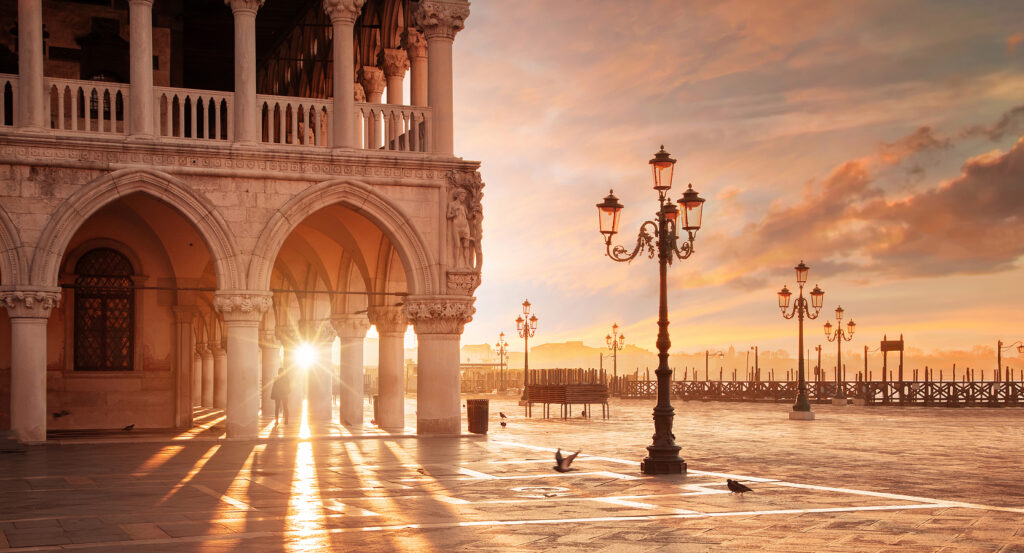
Why Caffè Florian matters.
Caffè Florian is a historic Venetian coffeehouse where San Marco's ceremonial grandeur meets three centuries of European intellectual life, the decorative achievements of nineteenth-century Venetian artists and the enduring traditions of Italy's oldest continuously operating café.
Positioned beneath the Procuratie Nuove on the southern side of Piazza San Marco, the establishment occupies an exceptional setting between the square's expansive arcades, the Campanile di San Marco and the passageways leading toward the Piazzetta and the Venetian waterfront. Its entrance opens into a succession of richly decorated salons, each distinguished by its own artistic program and historical character. Gilded frames, painted ceilings, marble surfaces and upholstered seating establish the atmosphere of a nineteenth-century European grand café. The Sala del Senato features elaborate allegorical paintings, and the adjoining Chinese and Oriental rooms introduce decorative compositions inspired by European interpretations of Asian art. Additional salons incorporate portraits of distinguished Venetians, representations of the seasons and early twentieth-century decorative furnishings. Outside, rows of tables extend beneath the arcades and into the square, where a café orchestra provides a musical accompaniment during scheduled performances. The result is an exceptionally preserved coffeehouse whose interiors and prominent public setting connect Venice's historic culture of sociability with the architectural magnificence of Piazza San Marco.
What defines Caffè Florian.
Caffè Florian is best known for its extraordinary continuity as a gathering place for European artists, writers, political figures and travelers across more than three centuries of Venetian history. Floriano Francesconi established the coffeehouse on December 29, 1720, under the name Alla Venezia Trionfante, expressing the civic pride of a republic whose political influence had already begun to diminish. Francesconi leased premises beneath the Procuratie Nuove from the Procurators of St. Mark, initially operating from two modestly furnished rooms. His customers soon adopted the familiar Venetian expression Andemo da Florian, gradually replacing the original name with a reference to its proprietor. The establishment developed an unusually inclusive social character, welcoming women alongside the merchants, aristocrats and intellectuals who frequented the square. Giacomo Casanova became associated with its cosmopolitan clientele, and the coffeehouse subsequently attracted literary figures including Johann Wolfgang von Goethe, Lord Byron and Charles Dickens. Its significance extended into journalism when Count Gasparo Gozzi conceived the Gazzetta Veneta there in 1760, contributing to the development of Venetian periodical culture. The coffeehouse also became a witness to the political upheavals that transformed the Republic of Venice, including its collapse in 1797 and the subsequent periods of French and Austrian administration. During the revolutionary disturbances of 1848, its rooms accommodated wounded participants in the uprising against Austrian rule. A major commercial transition followed in the nineteenth century when the Francesconi family sold the business to Vincenzo Porta, Giovanni Pardelli and Pietro Baccanello. The new proprietors commissioned architect Lodovico Cadorin to undertake an extensive renovation in 1858, establishing much of the decorative character preserved today. Cadorin coordinated a group of Venetian painters whose work transformed the expanded premises into a sequence of distinctive artistic environments. Giacomo Casa decorated the Senate Room with allegorical compositions celebrating the arts and sciences, and Antonio Pascuti developed the exotic decorative programs of the Chinese and Oriental rooms. Giulio Carlini contributed portraits of prominent Venetian figures, and Cesare Rota created representations of the four seasons. The renovation established a sophisticated architectural setting for the coffeehouse's continuing role in Venetian cultural life. Another consequential development occurred in 1893, when Mayor Riccardo Selvatico and a group of intellectuals conceived an international art exhibition during discussions in the Senate Room. Their initiative led to the establishment of the Venice Biennale in 1895, connecting the coffeehouse directly with one of the world's most influential recurring exhibitions of contemporary art. The institution subsequently maintained relationships with writers, composers and artists including Gabriele d'Annunzio, Richard Wagner and Ernest Hemingway. Its cultural program continued through contemporary art exhibitions and installations, extending its historical association with artistic patronage into the modern period. Restoration campaigns completed in 2012 preserved the decorative achievements of its historic salons, reinforcing the establishment's significance as an architectural and cultural institution. Caffè Florian's importance emerges from this sustained convergence of commerce, politics, literature and visual art, establishing an exceptional record of European public life within a continuously operating Venetian establishment.
Caffè Florian's culinary repertoire preserves the traditions of the European grand café through an extensive selection of coffee, chocolate, tea, pastries and carefully prepared savory dishes. Its hospitality program develops around the Italian custom of taking refreshments in an elegant public setting, supported by attentive table service and a distinctive presentation associated with historic Venetian coffeehouses. Espresso provides the most concentrated expression of the café's coffee tradition, introducing the familiar balance of aroma, body and carefully controlled extraction. Cappuccino develops a softer preparation through the combination of espresso and steamed milk, establishing a complementary choice for breakfast or afternoon refreshments. Hot chocolate occupies a particularly important position within the Venetian tradition, reflecting the historical popularity of cacao among European aristocratic and commercial circles. The establishment's Cioccolata Casanova develops this association through a house specialty connected with the celebrated Venetian adventurer. Its richness establishes a contrasting accompaniment to the lighter pastries prepared by the café's confectionery laboratory. The Colazione Casanova introduces a more substantial breakfast presentation, extending the establishment's historic associations into its contemporary menu. Cakes, semifreddos and individual desserts provide an extensive selection for afternoon service, with preparations including tiramisù semifreddo and gianduiotto-inspired chocolate specialties. Their presentation emphasizes classical confectionery techniques and the relationship between carefully prepared sweets and traditional Italian coffee. Savory selections extend the repertoire through sandwiches, small snacks and dishes suited to a longer visit. The club sandwich provides a recognizable international preparation within the café's extensive daytime menu, reflecting the establishment's longstanding relationship with travelers from across Europe and beyond. Afternoon tea introduces another expression of its cosmopolitan hospitality, combining carefully selected teas with sweet and savory accompaniments. The bar program incorporates wines, sparkling wines and cocktails, establishing a complementary setting for aperitifs and evening refreshments. Service on silver trays preserves a distinctive element of the establishment's historic presentation, reinforcing the ceremonial character of a visit. Caffè Florian's culinary distinction rests on this continuity of traditional European café preparations, accomplished confectionery and attentive hospitality, preserving the customs of an institution whose cultural significance extends far beyond its refreshments.
How Caffè Florian fits.
Caffè Florian works as the central stop of an exploration connecting Venice's transformation from an independent republic into a modern European city, the preservation of its artistic collections and the architectural achievements of Renaissance civic patronage, placing the coffeehouse within the expansive landscape of San Marco.
Begin at Museo Correr, the civic museum whose collections originated with the Venetian aristocrat Teodoro Correr. During the final decades of the Republic and the subsequent periods of foreign administration, Correr assembled an extensive collection of paintings, manuscripts, sculptures, coins and historical objects. His death in 1830 transferred the collection and his family residence to the city, establishing the foundation of Venice's municipal museum system. The museum opened to the public in 1836 and subsequently expanded through donations and acquisitions before moving to its present premises in 1922. Its galleries occupy the Napoleonic Wing and part of the Procuratie Nuove, preserving Neoclassical interiors associated with the French and Austrian administrations alongside collections illustrating the political and artistic development of Venice. Continue to Negozio Olivetti, the modernist showroom created by architect Carlo Scarpa for industrialist Adriano Olivetti. Commissioned during the late 1950s, the project transformed a narrow commercial space beneath the Procuratie Vecchie into an exceptional example of twentieth-century Italian interior architecture. Scarpa developed a carefully coordinated arrangement of stone, glass, timber and metal, integrating the display of Olivetti typewriters with an architectural composition of unusual precision. A distinctive staircase and carefully articulated flooring demonstrate his attention to craftsmanship, material transitions and spatial proportion. Preserved under the stewardship of the Fondo per l'Ambiente Italiano, the showroom provides a concentrated encounter with modern Italian design within Venice's historic commercial center. Conclude at Biblioteca Nazionale Marciana, the expansive Renaissance library developed to preserve the manuscript collection donated to Venice by Cardinal Bessarion in 1468. Construction began in 1537 under Jacopo Sansovino, whose architectural program introduced a classical facade that transformed the relationship between the Piazzetta and the surrounding civic buildings. Its Doric and Ionic arcades, sculptural ornamentation and carefully proportioned elevations established one of the most influential architectural compositions of Renaissance Venice. Vincenzo Scamozzi subsequently completed the building, extending the original design toward the waterfront. The historic interiors preserve the relationship between the Republic's intellectual ambitions, its exceptional manuscript collections and the artistic patronage of its governing institutions. The progression connects Venice's civic collections with a distinguished achievement of modern Italian design and concludes at a Renaissance monument to scholarship, establishing the broader cultural setting surrounding Caffè Florian.
Where your story begins.
Foresyte Travel reveals places that feel extraordinary long before you arrive.
Enjoy editorial crafted for luxury travelers.
Foresyte may earn a commission when you book.




















































































































