
Why River Liffey matters.
River Liffey is the spine of Dublin, a ribbon of silver and shadow that divides and unites the city in equal measure.
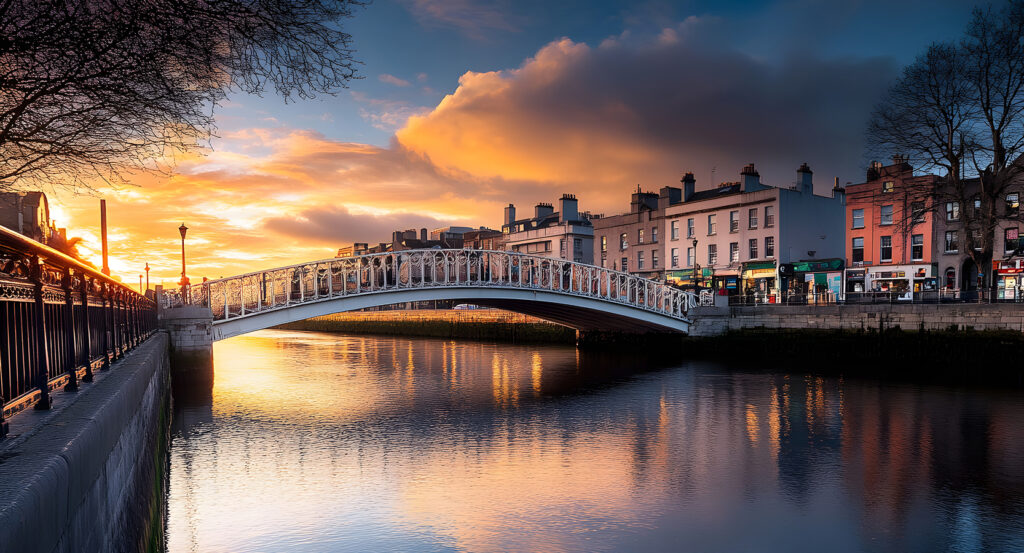
Its pedestrian crossings, from the famed Ha'penny Bridge to the sleek Samuel Beckett Bridge, offer far more than convenience, they are windows into Dublin's soul. Each footbridge carries its own rhythm, its own conversation between old and new. The Ha'penny glows with 19th-century romance, the Millennium Bridge hums with modern simplicity, and the Rosie Hackett Bridge anchors the river's working-class legacy. Crossing on foot lets you feel the pulse of the city, the mist off the water, the echo of footsteps, the laughter spilling from nearby pubs. Every crossing is a pause between moments, where history and humanity brush shoulders. Whether you walk at dawn when the river steams under pale light or at night when it mirrors the city's constellation of lamps, Dublin's pedestrian bridges turn ordinary movement into poetry.
What defines River Liffey.
Each Liffey footbridge tells a story, not of engineering alone, but of identity.
The Ha'penny Bridge, built in 1816, was Dublin's first dedicated pedestrian span, and its original ironwork was cast in Shropshire, shipped in pieces, and assembled on site by hand. For over a century, Dubliners paid a half-penny toll to cross, an act so ingrained in memory that even now, the bridge seems to hum with invisible coins. To the west, the Millennium Bridge, opened in 1999, represents rebirth, built to mark Ireland's step into a new era. Its clean steel form arches over the water with elegant restraint, designed to complement rather than compete with its historic neighbor. Further downstream, the Sean O'Casey Bridge celebrates Dublin's docklands renaissance, its swing arms opening like wings to let ships pass. And finally, the Samuel Beckett Bridge, designed by Santiago Calatrava, captures a masterstroke of symbolism: its sweeping white cable-stayed curve mirrors an Irish harp, the national emblem. Together, these crossings chart the evolution of Dublin's design language, from hand-forged heritage to visionary modernity. What most don't realize is that each bridge also reflects the cultural mood of its time: resilience, hope, and creative reinvention. The Liffey doesn't divide Dublin; it mirrors it, carrying stories from one shore to the next.
How River Liffey fits.
To walk Dublin's River Liffey is to trace the city's timeline in reverse, one step at a time.
Begin at the Samuel Beckett Bridge, where the white cables glow against the sky like strings of a celestial instrument. Cross slowly toward the north side, feeling the wind rise from the port. Then follow the quays westward, moving through eras: the sleek curve of the Sean O'Casey Bridge, the quiet intimacy of the Millennium Bridge, and finally, the romance of the Ha'penny Bridge, where buskers and streetlights shape Dublin's heartbeat. Stop mid-span to look east, the river unfolds like a film reel, capturing reflections of cranes, cathedrals, and clouds. From here, you can continue to Grattan Bridge for one last view of the water curling toward the sea. Visit at sunrise for solitude or at twilight when the bridges illuminate in sequence, transforming the river into a corridor of light. Grab a takeaway coffee or a pint from nearby Merchant's Arch and linger; the real beauty of Dublin's crossings lies in their simplicity, a handful of graceful steps over centuries of history.
Where your story begins.
Foresyte Travel reveals places that feel extraordinary long before you arrive.
Enjoy editorial crafted for luxury travelers.
Foresyte may earn a commission when you book.














































































































