
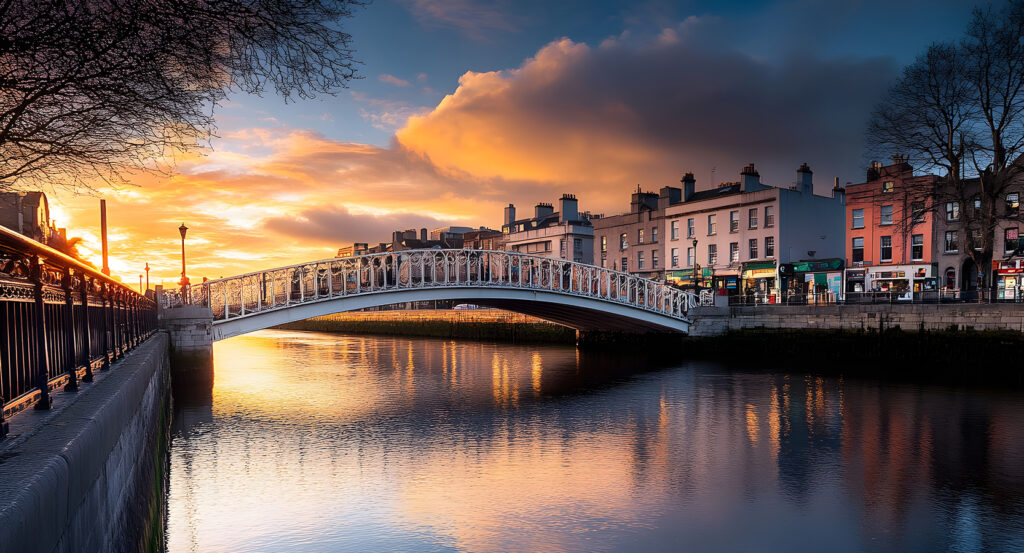
Why Trinity College Dublin matters.
Trinity College Dublin is a sixteenth-century university where Dublin's Georgian architectural heritage meets Elizabeth I's educational ambitions, Ireland's manuscript scholarship and the scientific and literary achievements of the country's oldest university.
Standing on College Green at the eastern edge of Dublin's historic center, the university occupies a walled campus between Dame Street, Nassau Street and Pearse Street, where interconnected quadrangles, eighteenth-century academic buildings and landscaped squares form a distinct precinct within the surrounding commercial streets. Its principal western entrance opens into Parliament Square beneath a classical stone façade. Academic buildings surround cobbled courtyards and lawns, creating a sequence of enclosed spaces beyond the street frontage. The campus extends eastward through successive architectural additions, incorporating libraries, teaching facilities and gardens. The result is an academic precinct preserving four centuries of university construction within the changing urban fabric of Central Dublin.
What defines Trinity College Dublin.
Trinity College Dublin is best known for its foundation in 1592, its historic library collections and its association with major figures in Irish literature, science and political history. Queen Elizabeth I granted the royal charter establishing the College of the Holy and Undivided Trinity near Dublin on 3 March 1592. The institution occupied the former site of the Augustinian Priory of All Hallows, which had been dissolved during the Tudor Reformation. Its establishment formed part of the English Crown's efforts to strengthen Protestant higher education and administrative institutions in Ireland. The first provost, Adam Loftus, Archbishop of Dublin, helped secure the foundation and its initial endowment. Teaching began in 1594, introducing a curriculum centered on classical languages, theology and the liberal arts. During the seventeenth century, the university expanded its library holdings through donations, acquisitions and the collection of scholarly works. The Restoration period brought renewed institutional development following disruptions associated with the Confederate Wars and Cromwellian conquest. Eighteenth-century construction replaced substantial portions of the original campus with Georgian academic buildings. The university developed mathematical and scientific scholarship through figures including George Berkeley, who entered Trinity in 1700 and subsequently became a fellow. William Rowan Hamilton studied at Trinity during the nineteenth century and became associated with major advances in mathematics and theoretical physics. The institution's graduates included Oscar Wilde, Bram Stoker and Samuel Beckett, connecting its academic history with successive generations of Irish literary achievement. Restrictions affecting Catholic participation changed during the nineteenth century as religious and political reforms altered access to university education. Women were admitted as full students in 1904, marking a substantial expansion of the institution's academic community. Following Irish independence, Trinity continued as a university within the Irish state, developing its teaching and research across the humanities, sciences and professional disciplines.
Thomas Burgh's design for the Old Library, completed in 1732, established one of the campus's principal architectural structures. The building's Long Room extends 65 meters beneath a barrel-vaulted ceiling introduced during nineteenth-century alterations. Its oak bookcases contain substantial portions of the university's historic printed collections, organized along a central passage lined with marble busts. The busts commemorate writers, philosophers and scholars associated with European intellectual history. The Library of Trinity College Dublin holds the Book of Kells, an illuminated Gospel manuscript produced around the year 800. Its decorated pages incorporate intricate interlace, human figures, animals and Christian symbols associated with early medieval manuscript illumination. The manuscript contains the four Gospels in Latin and belongs to the artistic traditions of monastic communities in Ireland and Britain. The exhibition devoted to the manuscript examines the preparation of parchment, the production of pigments and the techniques employed by medieval scribes. The Old Library also preserves historic collections associated with the university's role as a legal-deposit library. Parliament Square contains the Campanile, a freestanding bell tower designed by Sir Charles Lanyon and completed in 1853. Its classical composition incorporates a domed upper section supported above an arched base. The Examination Hall and Chapel, designed by Sir William Chambers, face one another across the square, preserving the ceremonial organization of the Georgian campus. The Museum Building, completed in 1857, incorporates Venetian Gothic architectural features and decorative stonework associated with nineteenth-century scientific education. Its carved capitals depict botanical forms and animals, connecting architectural ornament with natural history. The university's collections and buildings preserve the relationship between manuscript scholarship, academic ceremony and the development of scientific instruction in Dublin.
How Trinity College Dublin fits.
Trinity College Dublin works as the academic heritage centerpiece for a Dublin outing connecting Ireland's eighteenth-century parliamentary architecture, national collections and the literary institutions of the historic city center.
Begin at the Bank of Ireland on College Green, the former Irish Palace of Westminster designed principally by Edward Lovett Pearce during the eighteenth century. Construction began in 1729, creating a purpose-built parliamentary complex distinguished by a curved colonnaded façade and substantial ceremonial interiors. The building accommodated the Irish Parliament until the Act of Union abolished the institution in 1801. The Bank of Ireland acquired the property in 1803 and adapted portions of the complex for financial use. The surviving House of Lords chamber preserves decorative features associated with the former parliamentary institution, including its architectural proportions and historic furnishings. Continue to the National Library of Ireland on Kildare Street, the national institution devoted to preserving Ireland's documentary and literary heritage. Its principal building was designed by Thomas Newenham Deane and completed in 1890. The reading room contains a substantial domed ceiling and architectural detailing associated with late nineteenth-century public scholarship. The collections include manuscripts, newspapers, photographs and personal papers connected with Irish political and cultural history. The library holds important material associated with W. B. Yeats, including manuscripts and correspondence that illuminate the development of his poetry and involvement in the Irish Literary Revival. Conclude at the National Museum of Ireland - Archaeology, housed in the purpose-built museum on Kildare Street. Designed by Thomas Newenham Deane and Thomas Manly Deane, the building opened in 1890 and incorporates a central rotunda with decorative mosaics and classical architectural details. Its collections include prehistoric goldwork, early medieval metalwork and objects recovered from Ireland's archaeological sites. The Ardagh Chalice and Tara Brooch preserve exceptional examples of early medieval craftsmanship through intricate metalworking and decorative ornament. The museum's exhibitions connect material culture with the development of Irish societies across prehistoric and medieval periods. The progression moves from eighteenth-century parliamentary government through national literary preservation and culminates in Ireland's archaeological collections, connecting Trinity College Dublin with the civic and scholarly institutions of the capital.
Where your story begins.
Foresyte Travel reveals places that feel extraordinary long before you arrive.
Enjoy editorial crafted for luxury travelers.
Foresyte may earn a commission when you book.














































































































