
Why Dallas Arts District matters.
Dallas Arts District is a distinguished cultural enclave where Downtown's architectural ambition meets internationally significant art collections, pioneering performance institutions, and one of the largest concentrations of major cultural buildings in the United States.
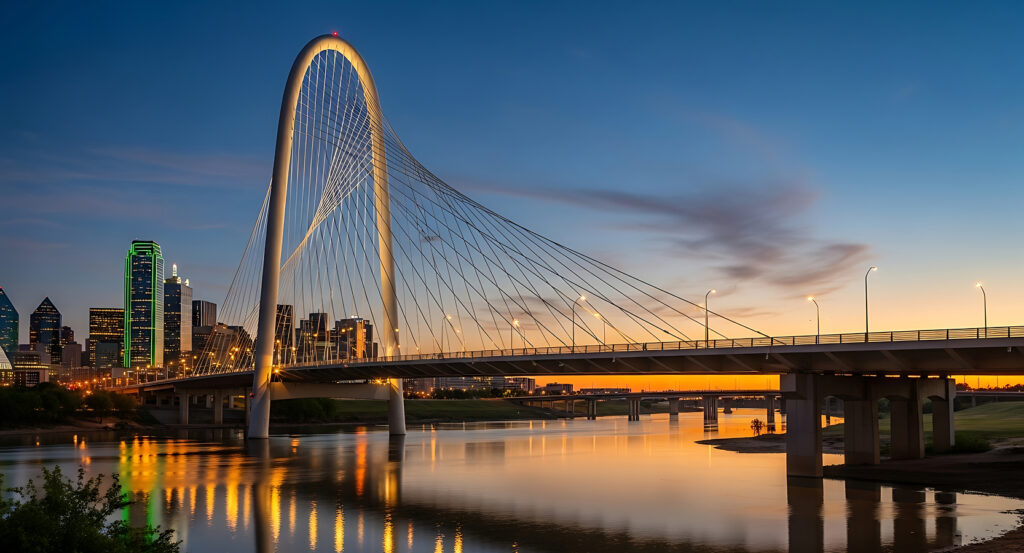
Positioned between Uptown, the West End Historic District, and the Main Street District, the neighborhood occupies the northeastern edge of Downtown, extending along Flora Street and Ross Avenue between Pearl Street and the Woodall Rodgers Freeway, where museums, concert halls, and landscaped civic spaces establish a concentrated cultural corridor. Expansive limestone façades, glass-walled performance buildings, and carefully landscaped plazas create a distinctive architectural landscape shaped by internationally recognized designers. Wide pedestrian promenades connect museums, theaters, and outdoor gathering spaces, establishing a neighborhood organized around public cultural institutions. Contemporary residential towers and commercial buildings frame the district's major venues, reinforcing its position within the expanding downtown skyline. The result is a cultural quarter where architecture, visual art, and live performance occupy an unusually cohesive urban setting.
What defines Dallas Arts District.
Dallas Arts District is best known for the deliberate concentration of major cultural institutions within a downtown neighborhood developed through decades of coordinated civic planning and architectural investment. Dallas's cultural organizations initially operated from locations distributed across the city, reflecting the expansion of museums, orchestras, and performing arts groups during the twentieth century. Civic leaders began pursuing a consolidated arts district during the 1970s, envisioning a dedicated downtown area capable of accommodating major cultural buildings and strengthening the city's metropolitan standing. The Dallas City Council formally designated the Arts District in 1983, establishing a structure for concentrating cultural institutions along the northeastern edge of downtown. The plan emphasized architectural quality, pedestrian access, and the creation of public spaces connecting institutions with different artistic disciplines. Major construction projects subsequently brought internationally recognized architects to Dallas, establishing a collection of buildings representing contrasting approaches to modern cultural design. The district's development required substantial philanthropic support, reflecting the influence of private donors and civic organizations on Dallas's cultural infrastructure. The Dallas Arts District Foundation emerged as an important coordinating organization, supporting the district's growth and public programming. Successive museum and performance projects expanded the neighborhood's institutional concentration, introducing new facilities for visual art, orchestral music, theater, opera, and dance. The resulting architectural collection became a defining feature of the district, with individual buildings contributing distinct formal approaches to the surrounding urban landscape. Public plazas and landscaped corridors strengthened pedestrian connections among institutions, creating opportunities for cultural activity beyond interior exhibition and performance spaces. The district eventually encompassed 68 acres, establishing one of the largest contiguous urban arts districts in the country. Its development transformed a formerly fragmented section of downtown into a coordinated cultural destination, demonstrating the scale of Dallas's investment in the arts.
The Crow Museum of Asian Art contributed an important international dimension to the district's cultural development through a collection established by Dallas philanthropists Trammell and Margaret Crow. The museum opened in 1998, presenting artworks from China, Japan, India, and Southeast Asia within a dedicated downtown institution. Its collection includes sculpture, decorative arts, textiles, and historical objects representing diverse Asian artistic traditions. The institution subsequently expanded its educational programming and exhibition activities, connecting historical collections with contemporary cultural exchange. The Annette Strauss Square introduced another dimension through an outdoor performance environment designed to accommodate concerts and public events within the district's landscaped setting. Named for former Dallas mayor Annette Strauss, the venue became an important component of the city's performing arts infrastructure, extending cultural programming into open-air civic space. The Booker T. Washington High School for the Performing and Visual Arts established a particularly consequential relationship between professional cultural institutions and arts education. The school traces its origins to Dallas's historic educational system and developed into a specialized institution supporting young musicians, dancers, actors, and visual artists. Its graduates include internationally recognized performers, demonstrating the significance of arts education within the city's broader creative community. The school's presence connects the district's major cultural organizations with the training of emerging artists, introducing a daily educational dimension to an area dominated by museums and performance venues. Public programming across the district further strengthens that relationship through concerts, exhibitions, festivals, and community events that bring different audiences into shared civic spaces. Dallas Arts District's cultural significance emerges from this combination of international collections, public performance, arts education, and sustained institutional investment.
How Dallas Arts District fits.
Dallas Arts District works as the anchor for an outing connecting an encyclopedic art museum, an internationally significant sculpture collection, and a concert hall celebrated for its architectural and acoustic design.
Begin at the Dallas Museum of Art, the institution founded in 1903 and developed into one of the largest art museums in the United States. Its collection encompasses more than 25,000 works representing artistic traditions across thousands of years, including major holdings in European painting, American art, contemporary sculpture, and the arts of Africa, Asia, and the Americas. The museum's present building, designed by architect Edward Larrabee Barnes and opened in 1984, established a major architectural foundation for the surrounding cultural district. Its galleries connect historical collections with changing exhibitions, providing a broad introduction to the city's visual arts institutions. Continue to the Nasher Sculpture Center, the museum founded by collectors Raymond and Patsy Nasher and opened in 2003 to present their internationally significant collection of modern and contemporary sculpture. Architect Renzo Piano designed the building, with landscape architect Peter Walker developing its adjoining sculpture garden. The collection includes works by major twentieth-century artists such as Auguste Rodin, Pablo Picasso, Henry Moore, and Alberto Giacometti, connecting different approaches to figurative and abstract sculpture. Its combination of interior galleries and landscaped outdoor spaces allows sculpture to be encountered under contrasting architectural and natural lighting conditions. Conclude at the Morton H. Meyerson Symphony Center, the concert hall designed by architect I. M. Pei and opened in 1989 as the principal home of the Dallas Symphony Orchestra. Acoustician Russell Johnson collaborated on the auditorium's design, developing a performance environment centered on the acoustic requirements of symphonic music. The hall incorporates adjustable acoustic elements that support different musical configurations, allowing the orchestra to perform within a carefully controlled sound environment. Its architectural composition combines an expansive exterior with an auditorium organized around the relationship between performers and listeners. The progression moves from the Dallas Museum of Art's encyclopedic collections through the Nasher Sculpture Center's concentrated exploration of modern sculpture and culminates at the Morton H. Meyerson Symphony Center's orchestral performances, connecting three major institutions that define the Dallas Arts District.
Where your story begins.
Foresyte Travel reveals places that feel extraordinary long before you arrive.
Enjoy editorial crafted for luxury travelers.
Foresyte may earn a commission when you book.














































































































