Why Worth Avenue matters.
Worth Avenue is a Mediterranean Revival shopping corridor where Midtown Palm Beach's resort architecture meets Addison Mizner's commercial courtyards, the international fashion trade and the transformation of a residential street into one of Florida's most architecturally distinctive retail districts.
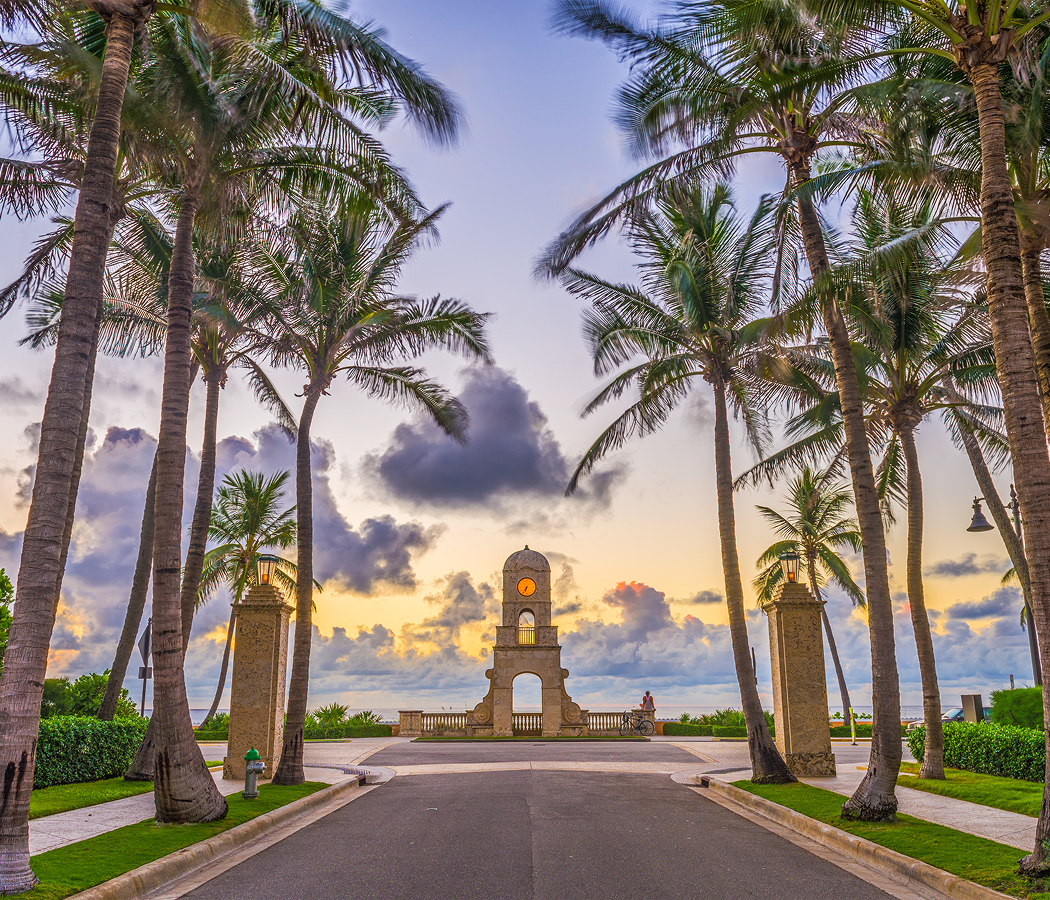
Running through Midtown Palm Beach between the Atlantic Ocean and the Lake Worth Lagoon, the corridor follows Worth Avenue west from South Ocean Boulevard toward Cocoanut Row, crossing South County Road and connecting oceanfront streets with Mediterranean Revival commercial courtyards. Stucco façades, clay-tile roofs and ornamental balconies establish a consistent architectural character across successive blocks. Narrow pedestrian passages extend northward into enclosed gardens, arcaded shopping courts and buildings containing retail premises beneath upper-floor residences. Coconut palms, decorative fountains and shaded terraces soften the relationship between the commercial buildings and the subtropical landscape. The result is a compact shopping district whose architecture and street plan preserve the influence of Palm Beach's early resort developers on its commercial geography.
What defines Worth Avenue.
Worth Avenue is best known for its Mediterranean Revival architecture, concentration of international luxury retailers and historical association with architect Addison Mizner and developer Paris Singer. The street received its name in 1913 in honor of Major General William Jenkins Worth, whose military career included service during the Second Seminole War. Its original subdivision contained 178 residential parcels measuring 25 by 125 feet, reflecting plans for a neighborhood of small private villas. The development of Palm Beach as a winter resort had accelerated following Henry Flagler's arrival and the expansion of his Florida East Coast Railway during the 1890s. By the early twentieth century, seasonal residents had established a substantial market for imported merchandise, fashionable clothing and specialized household goods. Commercial activity initially concentrated in other sections of the island, leaving much of the avenue occupied by undeveloped parcels and scattered residences. During the 1920s, increasing rents at established shopping premises encouraged merchants to relocate toward the developing street. The Florida land boom supported construction of commercial buildings that accommodated shops, offices and apartments within compact urban blocks. Fashion retailers benefited from the seasonal concentration of wealthy American and international residents, establishing commercial relationships with designers and manufacturers in New York and Europe. The Worth Avenue Association was founded in 1938 to coordinate the interests of merchants and property owners. Subsequent decades brought established international fashion houses, jewelers and specialty retailers into the district, strengthening its position within the luxury retail industry. In 1991, the Town of Palm Beach commissioned architectural design guidelines to protect the avenue's historical character during commercial redevelopment. A major streetscape improvement program completed in 2010 introduced new pedestrian surfaces, landscaping and public gathering areas while preserving the architectural character of the historic shopping district.
How Worth Avenue fits.
Worth Avenue works as the commercial centerpiece for a Palm Beach itinerary connecting the island's early resort institutions, Mediterranean Revival architectural development and preservation of its historic residential and cultural properties.
Begin at Everglades Club, the private social institution occupying the western end of the avenue. Paris Singer commissioned the complex in 1918 as a convalescent facility for American military officers returning from the First World War. The Armistice altered its intended purpose, and the property opened as a private club in 1919. Its Spanish-influenced architecture incorporates cloistered passages, decorative tilework and a chapel tower. The club subsequently developed recreational facilities and became an important institution within Palm Beach's seasonal social community. Its construction helped establish the architectural direction followed by subsequent resort developments. Continue to Via Mizner, the historic pedestrian complex connecting Worth Avenue with Peruvian Avenue. Developed beginning in 1923, the property combines arcaded commercial passages, interior courtyards and upper-floor residential accommodation. Its architectural details include wrought-iron balconies, stained glass, ornamental stonework and roof terraces. Villa Mizner, the architect's former residence within the complex, preserves an important association with his personal and professional life. The passage was added to the National Register of Historic Places in 1993. Its compact arrangement demonstrates the adaptation of Mediterranean courtyard planning to American resort commerce. Conclude at The Society of the Four Arts, the cultural institution situated north of the shopping district on Royal Palm Way. Founded in 1936, the organization developed educational and cultural programming devoted to art, literature, music and drama. Its campus contains exhibition facilities, a library, performance spaces and landscaped gardens. The Philip Hulitar Sculpture Garden incorporates works displayed among formal planting beds and pedestrian paths. The adjacent botanical garden contains cultivated areas representing different horticultural traditions. The institution's establishment broadened the island's cultural activities beyond the seasonal social calendar. The progression moves from the development of private resort institutions through Mediterranean commercial architecture and culminates in Palm Beach's organized cultural patronage.
Where your story begins.
Foresyte Travel reveals places that feel extraordinary long before you arrive.
Enjoy editorial crafted for luxury travelers.