
Why Four Seasons Hotel Seoul matters.
Four Seasons Hotel Seoul is a Gwanghwamun luxury hotel where Seoul's royal center meets contemporary Korean design, international dining, Four Seasons service and a 2015 opening that placed a global hospitality address at the city's political and cultural heart.
Set along Saemunan-ro near Sejong-daero and just steps from Sejong Center for the Performing Arts, the hotel occupies Gwanghwamun's civic core between Jongno's administrative avenues, the Cheonggyecheon corridor and the northern mountain skyline. The physical setting is distinctive because glass office towers, government buildings, cultural institutions and traditional neighborhoods converge within the historic center of Seoul. The hotel is encountered through a sequence of street-facing arrivals, art-filled public spaces, elevated restaurants, guestrooms, suites and a three-story spa and fitness complex. Korean materials, skyline views, porcelain references and geometric forms create a constant relationship between contemporary urban life and older local design traditions. The result is a hotel whose Gwanghwamun position, Korean aesthetic language and vertical social program place Four Seasons hospitality inside Seoul's most layered civic district.
What defines Four Seasons Hotel Seoul.
Four Seasons Hotel Seoul is best known for bringing the Four Seasons brand to Korea through a 2015 opening, 317 accommodations and a design program that combines contemporary Seoul with traditional Korean aesthetics. The property contains 285 guestrooms and 32 specialized suites, creating one of the city's largest luxury accommodation programs. LTW Designworks shaped the guestrooms, public spaces and lobby restaurant around clean contemporary lines, Korean references and carefully framed views of the city. Floor-to-ceiling windows place Seoul's skyline, palace district and mountain horizon directly into the rooms. The guestrooms range from 41 to 45 square metres, giving the standard accommodation categories an unusually generous scale for a central city hotel. Four Seasons beds, spa-like bathrooms, high-tech controls and customizable mattress toppers connect the rooms to the brand's global sleep system. Nicolai Bergmann created floral installations throughout the hotel, adding a recognizable botanical element to the lobby and public spaces. A curated art collection extends across guestrooms and circulation areas, placing contemporary visual culture inside the hotel's daily movement. The property's three-story spa and fitness complex gives wellness a major vertical presence within the building. Seven restaurants and bars make the hotel a complete dining destination rather than a property dependent on the surrounding city for food and nightlife. Four Seasons Hotel Seoul developed as an urban hospitality complex in which rooms, Korean design, art, wellness and restaurants operate within one connected address. Its significance rests on the meeting between Four Seasons service and Seoul's historical center rather than on a single decorative gesture.
Yu Yuan gives the hotel its most formal culinary character through Cantonese cuisine, Shanghai-inspired interiors and a MICHELIN-starred dining program. Traditional Beijing duck, dim sum, seafood and seasonal Korean ingredients connect the restaurant's Chinese culinary foundation with Seoul's wider food culture. Akira Back shifts the hotel's dining language toward contemporary Japanese cooking through sushi, sashimi, seafood, hanwoo and signature dishes associated with chef Akira Back. Boccalino adds Italian cuisine through Sicilian tasting menus, handmade pasta, seafood and a restaurant setting shaped around the character of a modern trattoria. The Market Kitchen provides an international buffet program with live preparation, Korean ingredients and a broad all-day format. Maru brings Korean heritage into afternoon tea through traditional flavors, local ingredients and a menu arranged around nine savory and sweet pieces. Charles H. creates an intimate cocktail environment through an eight-seat H. Bar hidden within the larger bar, using course-style drinks and curated pairings. OUL develops a contemporary Korean bar character through cocktails shaped by Seoul's nightlife and younger drinking culture. Nicolai Bergmann's floral work gives the dining sequence a recurring visual language that moves from the lobby into restaurants and bars. The three-story spa adds Korean-style sauna facilities, treatment rooms, pools and fitness areas to the hotel's culinary program. Four Seasons Hotel Seoul builds its social character through a progression from Cantonese and Japanese dining to Italian cuisine, Korean tea, course-format cocktails and contemporary Seoul nightlife. The hotel's public life is defined by this culinary range, with each restaurant and bar presenting a distinct cultural register inside one Gwanghwamun address.
How Four Seasons Hotel Seoul fits.
Four Seasons Hotel Seoul works as a refined base for a culturally coherent day that begins with the founding palace of the Joseon dynasty, continues through Seoul's preserved hanok residential district and concludes with the institution that narrates Korea's national history from prehistory to the modern era.
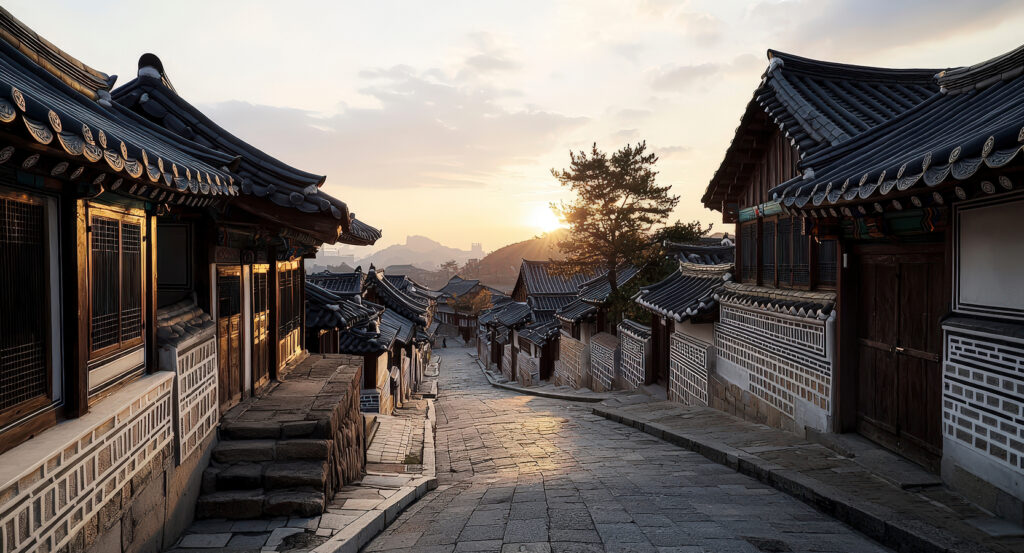
Begin at Gyeongbokgung Palace, founded in 1395 by King Taejo as the principal palace of the Joseon dynasty. The palace served as the royal center of government, ceremony and court life during the early formation of Joseon Seoul. Gwanghwamun, Geunjeongjeon and Gyeonghoeru organize the complex around gates, ceremonial courtyards, throne halls and reception architecture. Heungseon Daewongun led a major reconstruction beginning in 1867, restoring the palace after destruction during the Japanese invasions of Korea. The palace's surviving and reconstructed buildings express the spatial order of Joseon monarchy through axial planning, rooflines, painted timber and controlled movement between public and private courts. Gyeongbokgung Palace opens the itinerary through the political architecture that established Seoul as the capital of a long-lived Korean dynasty. Continue to Bukchon Hanok Village, whose position between Gyeongbokgung Palace, Changdeokgung Palace and Jongmyo Shrine preserves a residential district with six centuries of urban history. Bukchon developed as an area for high-ranking officials and aristocratic families during the Joseon period. Its hanok use timber frames, tiled roofs, courtyards, paper doors and sloped lanes to adapt traditional Korean housing to a dense hillside neighborhood. The district also contains sites connected to the Japanese occupation, Korean language activism and twentieth-century urban change. Bukchon advances the itinerary from royal ceremony into the domestic architecture, social hierarchy and everyday life that surrounded Seoul's palace center. Conclude at National Museum of Korean History, whose galleries extend from early Korean civilization through the Joseon period, Japanese colonial rule, liberation, the Korean War and the formation of modern South Korea. The museum places political events, social movements, industry, education and daily life within one national narrative. Objects, photographs, documents, household materials and reconstruction environments turn modern history into a physical sequence. Its position near Gwanghwamun links national memory with the civic district surrounding the hotel and the palace complex. The progression moves from Gyeongbokgung Palace's Joseon political architecture through Bukchon Hanok Village's residential history and concludes at National Museum of Korean History's modern national narrative, revealing how Seoul developed through royal authority, domestic life and the contested formation of contemporary Korea.
Where your story begins.
Foresyte Travel reveals places that feel extraordinary long before you arrive.
Enjoy editorial crafted for luxury travelers.
Foresyte may earn a commission when you book.

















































































































