
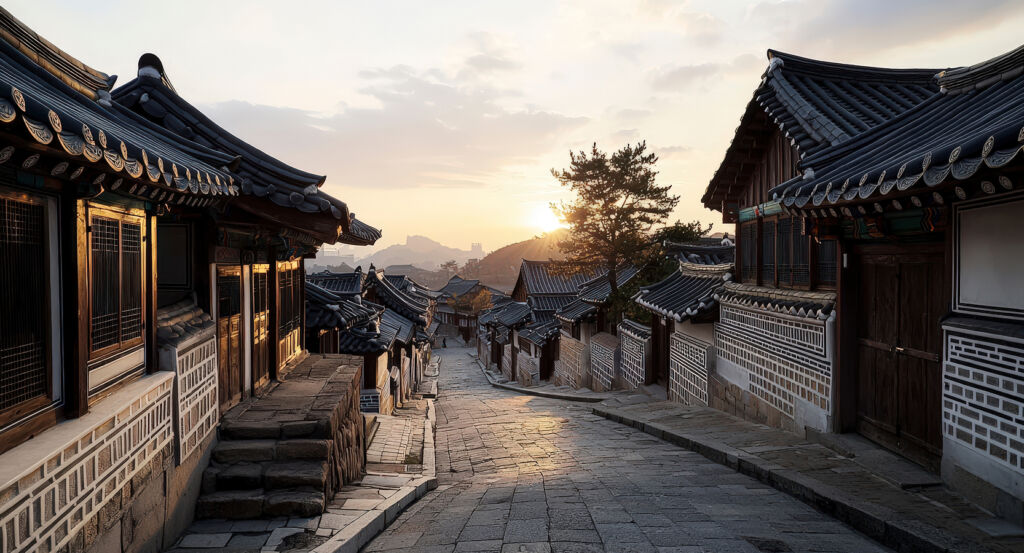
Why Gyeongbokgung Palace matters.
Gyeongbokgung Palace is a royal Joseon palace where Jongno's dynastic heritage meets the founding of Seoul as Korea's capital, the ceremonial authority of five centuries of monarchy and the restoration of an architectural complex profoundly altered by war and Japanese colonial rule.
Set along Sajik-ro near Sejong-ro and directly north of Gwanghwamun Square, the palace occupies a substantial walled compound at the foot of Bugaksan, between the historic government district of Central Seoul and the residential neighborhoods extending toward the northern foothills. Its principal entrance establishes a north-south ceremonial axis leading through successive courtyards toward the royal throne hall. Tiled roofs, painted timber structures and stone platforms define the palace's architectural composition. Mountain ridges rise behind the compound, framing its northern boundary against the surrounding urban landscape. The result is a royal complex whose architecture and geographical position preserve the political organization and ceremonial traditions of Korea's longest-ruling dynasty.
What defines Gyeongbokgung Palace.
Gyeongbokgung Palace is best known for its role as the principal palace of the Joseon dynasty, its expansive ceremonial architecture and its reconstruction following successive periods of destruction. King Taejo founded the Joseon dynasty in 1392 and transferred the royal capital to Hanyang, the predecessor of Seoul, in 1394. Construction of Gyeongbokgung began that year, and the palace was completed in 1395 as the central residence and administrative seat of the new monarchy. The name Gyeongbokgung, meaning Palace Greatly Blessed by Heaven, expressed the dynasty's aspirations for stable government and enduring royal authority. Jeong Do-jeon, a principal architect of the early Joseon state, contributed to the planning and naming of the palace's principal buildings. Its original arrangement incorporated ceremonial halls, administrative offices and residential quarters organized through principles associated with Confucian government. The palace became an important setting for royal audiences, official appointments and ceremonies that reinforced the authority of the monarchy. During the Japanese invasions of Korea beginning in 1592, the complex was destroyed by fire, ending its continuous occupation as the principal royal residence. The royal court subsequently relied upon other palaces in Seoul, leaving Gyeongbokgung largely abandoned for more than two centuries. In 1865, Heungseon Daewongun initiated a substantial reconstruction program during the reign of his son, King Gojong, seeking to restore the palace's ceremonial importance. Reconstruction introduced extensive residential and administrative buildings, creating a complex containing hundreds of structures by the late nineteenth century. The assassination of Empress Myeongseong in 1895 within the palace grounds contributed to the political instability surrounding the monarchy during the final years of the dynasty. Following Japan's annexation of Korea in 1910, colonial authorities demolished substantial portions of the complex and constructed the Government-General Building directly in front of the principal throne hall. The colonial administrative building was removed in 1995, allowing the restoration of the palace's central ceremonial axis. Subsequent reconstruction programs have restored major gates, halls and residential compounds, preserving Gyeongbokgung as a principal architectural expression of Joseon royal government.
How Gyeongbokgung Palace fits.
Gyeongbokgung Palace works as the royal centerpiece for a Jongno itinerary connecting Joseon court culture, traditional Korean residential architecture and the preservation of Seoul's historic urban neighborhoods.
Begin at National Palace Museum of Korea, the institution situated beside the palace's southwestern entrance. Opened in 2005, the museum preserves collections associated with the royal households of the Joseon dynasty and the Korean Empire. Its exhibitions contain ceremonial garments, royal seals, paintings, scientific instruments and objects used in court rituals. The collection includes artifacts associated with royal weddings, funerary ceremonies and the administrative functions of the monarchy. Displays examine the relationship between Confucian government, court craftsmanship and the ceremonial responsibilities of the royal household. The museum provides historical context for the architectural functions of Korea's principal royal residences. Continue to Bukchon Hanok Village, the historic residential district situated northeast of the palace between the former royal compounds of Central Seoul. Its narrow streets contain traditional Korean houses developed during successive periods of the Joseon dynasty and the early twentieth century. Hanok architecture incorporates timber frames, tiled roofs, enclosed courtyards and floor-heating systems associated with Korean domestic construction. The neighborhood historically accommodated officials, scholars and families connected with the royal administration. Its preserved residential streets demonstrate the relationship between traditional domestic architecture and the topography of Seoul's northern hills. The district's conservation has maintained substantial elements of the capital's historical residential character. Conclude at Changdeokgung Palace, the royal complex situated east of Bukchon. Constructed in 1405 under King Taejong, the palace developed as an important secondary residence of the Joseon monarchy. Its architectural arrangement follows the surrounding terrain, with principal buildings distributed among wooded slopes and landscaped courtyards. The complex became the principal royal residence following the destruction of Gyeongbokgung during the Japanese invasions of the late sixteenth century. Its Huwon, or Rear Garden, contains ponds, pavilions and wooded paths associated with royal recreation and scholarly activities. Changdeokgung was inscribed on the UNESCO World Heritage List in 1997 for its architectural and landscape significance. The progression moves from royal ceremonial collections through traditional residential architecture and culminates in a palace landscape adapted to natural topography, connecting Gyeongbokgung Palace with the political and architectural history of Joseon Seoul.
Where your story begins.
Foresyte Travel reveals places that feel extraordinary long before you arrive.
Enjoy editorial crafted for luxury travelers.

















































































































