
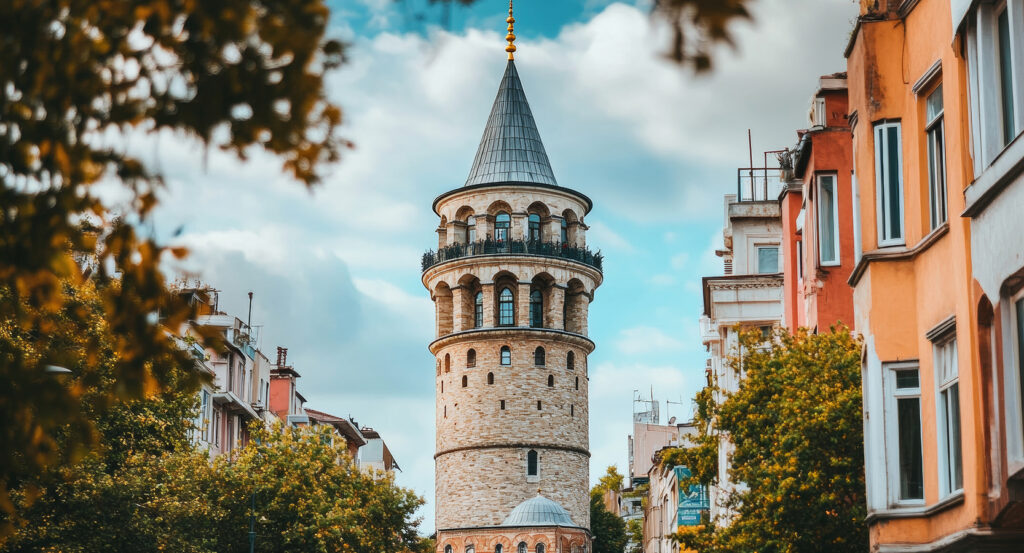
Why Galata Tower matters.
Galata Tower is a soaring medieval tower where Galata's mercantile heritage, Genoese engineering, panoramic cityscapes, and centuries of Istanbul's urban evolution rise above the northern shore of the Golden Horn.
Set along Büyük Hendek Street near Galip Dede Street and just steps from Galata Square, this cylindrical stone tower ascends through historic masonry, panoramic observation levels, restored interiors, and commanding viewing platforms where the Bosphorus, Golden Horn, Historic Peninsula, and sprawling skyline unfold in every direction. Thick defensive walls, elegant arcades, and sweeping vistas reveal how medieval engineering continues shaping one of Istanbul's most recognizable silhouettes. History, architecture, and perspective define every level of the ascent.
What defines Galata Tower.
Galata Tower is best known for being constructed in 1348 by the Genoese community as the Tower of Christ during the expansion of the fortified colony of Galata, creating a defensive watchtower that today rises 66.9 meters above ground level with walls 3.75 meters thick and a diameter of 16.5 meters while remaining one of the finest surviving examples of medieval military architecture in the eastern Mediterranean. Built at the highest point of the Genoese settlement overlooking the Golden Horn, the tower formed the principal component of an extensive defensive system protecting one of the Byzantine Empire's most important commercial ports, where merchants from Genoa, Venice, and across the Mediterranean conducted international trade. Following the Ottoman conquest of Constantinople in 1453, the structure served successively as a military observation post, prison, fire watchtower, and astronomical observation site while undergoing numerous repairs after earthquakes and fires. During the reign of Sultan Murad IV, the seventeenth-century polymath Hezarfen Ahmed Çelebi was famously said by Ottoman traveler Evliya Çelebi to have launched from the tower using artificial wings before gliding across the Bosphorus to Üsküdar, creating one of the most enduring stories in Ottoman history. Major restoration campaigns undertaken during the nineteenth century introduced the tower's distinctive conical roof before twentieth- and twenty-first-century conservation projects strengthened its masonry, restored historic interiors, upgraded visitor facilities, and reopened the monument as the Galata Tower Museum in 2020. Today the museum presents exhibitions exploring Byzantine Constantinople, the Genoese colony, Ottoman Istanbul, architectural conservation, and the tower's evolving civic role while preserving one of the city's most significant medieval structures within Istanbul's UNESCO World Heritage buffer zone.
Centuries of defensive engineering, careful restoration, and evolving civic functions reveal how a medieval watchtower adapted to changing military, commercial, and urban needs across nearly seven hundred years of Istanbul's history. Massive stone walls, timber roof structures, interpretive exhibitions, panoramic galleries, and uninterrupted views across the Bosphorus, Golden Horn, Historic Peninsula, and Asian shoreline demonstrate the tower's continuing importance as both an architectural achievement and an enduring symbol of Galata. Ongoing structural conservation, seismic monitoring, archaeological research, and museum interpretation ensure the building remains among Türkiye's most significant medieval monuments. Medieval engineering, urban history, and panoramic discovery combine to create one of Istanbul's defining historic experiences.
How Galata Tower fits.
Galata Tower works as the centerpiece of an exploration through Galata's historic streets and waterfront.
Begin at Galata Bridge, where panoramic views across the Golden Horn establish the historical relationship between the old city and Galata before ascending Galata Tower. Continue to İstiklal Avenue, whose nineteenth-century architecture and energetic cultural life deepen appreciation for Beyoğlu's evolution through successive generations. Conclude at Galata Mevlevi Lodge Museum, where Ottoman spiritual heritage provides a memorable finale celebrating another defining chapter of the district's history. The progression moves naturally from the waterfront to medieval architecture before concluding through centuries of cultural tradition, revealing why Galata remains one of Istanbul's most historically layered neighborhoods.
Where your story begins.
Foresyte Travel reveals places that feel extraordinary long before you arrive.
Enjoy editorial crafted for luxury travelers.
Foresyte may earn a commission when you book.





































































































