
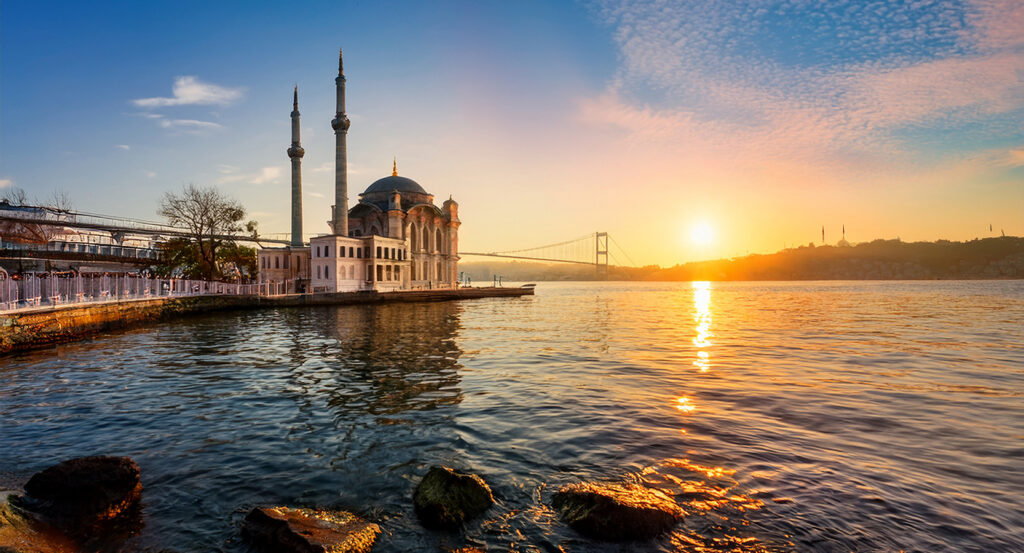
Why Bosphorus matters.
Few places on Earth carry the same magnetic tension between continents, cultures, and centuries as the Bosphorus Strait.
This narrow ribbon of sapphire water divides Europe and Asia while binding them together, a living, breathing artery through the heart of Istanbul. Cruising its gentle waves feels like gliding through history: grand Ottoman palaces, Byzantine fortresses, and sleek modern villas line its shores in seamless dialogue. As your ferry hums across the current, seagulls dance in the salt air, and the skyline stretches in both directions, minarets on one side, skyscrapers on the other. The Bosphorus is not just a geographical marvel but a mirror of Istanbul's soul, reflecting the city's contradictions and harmony alike. It's where fishermen cast their lines at dawn, couples watch the sunset from wooden piers, and tankers silently drift between two worlds. Whether viewed from the deck of a cruise or a hilltop café in Ortaköy, the strait radiates a cinematic calm that slows the pulse and sharpens the senses.
What defines Bosphorus.
Spanning 31 kilometers, the Bosphorus connects the Black Sea to the Sea of Marmara, forming one of the world's most strategically vital waterways, but its significance extends far beyond geopolitics.
For centuries, empires have risen and fallen along its banks, from the Byzantines and Ottomans to modern-day Turkey, each leaving architectural and cultural fingerprints visible from the water. Beneath its shimmering surface, ancient myths swirl, from Jason and the Argonauts sailing in search of the Golden Fleece to the tale of Hero and Leander, whose love story unfolded across its depths. The name “Bosphorus” comes from Greek roots meaning “cow passage,” tied to the legend of Io, who swam across in her transformation from mortal to goddess. But the most remarkable fact lies in its subtle, invisible flow: the Bosphorus carries two separate currents, a surface current flowing south toward the Marmara, and an undercurrent pushing north from the Mediterranean, creating an aquatic choreography few ever notice. At night, when the bridges light up in waves of color and the skyline glitters against the dark, the strait transforms into a living constellation, humming softly between two continents.
How Bosphorus fits.
The best way to experience the Bosphorus is to move with it, slowly, deliberately, allowing the city to unfold from its waters.
Begin your journey at Eminönü or Beşiktaş, where ferries depart regularly, and choose either a short cruise or the full-length voyage to the mouth of the Black Sea. Opt for the slower boats if you can, they glide closer to the shore, giving you time to trace the story of Istanbul's evolution through its waterfront: the Dolmabahçe Palace, Rumeli Fortress, Ortaköy Mosque, and countless mansions, each revealing another era of splendor. As you sail beneath the Bosphorus Bridge, pause to appreciate what it represents, the delicate thread connecting two continents, two ways of life. For a more intimate view, dine at a seafood restaurant in Arnavutköy or Bebek, where the waves brush against the edge of your table and the city's rhythm softens into something timeless. And if you rise early, watch the sunrise from the Asian side at Üsküdar or Çengelköy; few sights rival the moment when the first light touches the domes and spires across the strait. However you approach it, the Bosphorus isn't just a crossing, it's a communion between worlds, a liquid threshold where Istanbul breathes, dreams, and endures.
Where your story begins.
Foresyte Travel reveals places that feel extraordinary long before you arrive.
Enjoy editorial crafted for luxury travelers.
Foresyte may earn a commission when you book.





































































































