
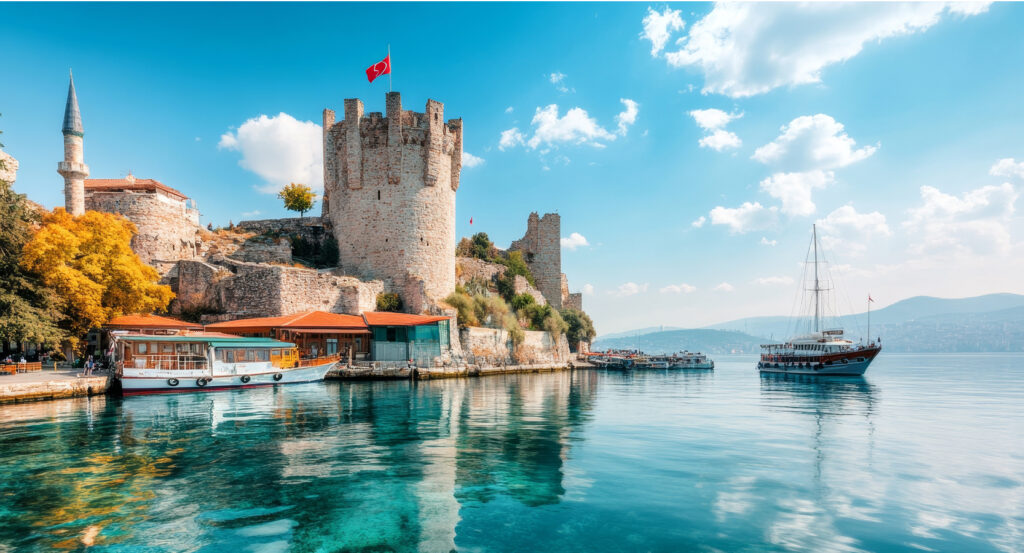
Why Rumeli Fortress matters.
Rumeli Fortress is a formidable Ottoman fortress where Rumelihisarı's strategic shoreline, military engineering, imperial ambition, and the conquest of Constantinople shaped one of the Bosphorus's defining strongholds.
Set along Yahya Kemal Street near Baltalimanı Hisar Caddesi and just steps from the Bosphorus shoreline, this commanding fortress unfolds through soaring defensive towers, crenellated curtain walls, steep stone stairways, and elevated battlements where sweeping views across the Bosphorus reveal the narrow waterway once controlled by one of the Ottoman Empire's greatest military achievements. Massive masonry, rugged terrain, and carefully restored fortifications immerse visitors within a structure designed for absolute strategic dominance. Military ingenuity, architectural precision, and imperial history define every ascent through the fortress.
What defines Rumeli Fortress.
Rumeli Fortress is best known for being commissioned by Sultan Mehmed II in 1452 and completed in just four months before the Ottoman conquest of Constantinople, creating a powerful defensive fortress occupying the Bosphorus's narrowest point opposite Anadolu Fortress to establish complete military control over maritime traffic while preparing for one of history's most consequential sieges. Constructed under the direct supervision of Sultan Mehmed II, the fortress employed thousands of laborers, stonemasons, craftsmen, and military engineers working simultaneously across multiple sections of the site. Three principal towers were entrusted to Grand Viziers Çandarlı Halil Pasha, Zağanos Pasha, and Sarıca Pasha, whose names remain associated with the fortress today, while thirteen smaller watchtowers strengthened defensive coverage along walls extending 250 meters from north to south. Covering 31,250 square meters, the complex incorporates curtain walls rising more than 20 meters in places and towers reaching 28 meters in height, creating one of the fifteenth century's most sophisticated coastal fortifications. Positioned opposite Anadolu Fortress across a Bosphorus channel measuring only 660 meters wide, Rumeli Fortress enabled Ottoman artillery to regulate shipping between the Black Sea and Constantinople, cutting Byzantine supply lines before the decisive siege of 1453. Following the conquest, the fortress served successively as a customs checkpoint, military garrison, prison, and defensive installation before sustaining damage during the 1509 earthquake and later fires. Comprehensive restoration directed between 1953 and 1958 stabilized the masonry, reconstructed damaged sections using historical documentation, and prepared the fortress for public access. Today the site functions as a museum administered by the Turkish Ministry of Culture and Tourism while its historic open-air amphitheater continues hosting seasonal concerts and cultural performances within one of the Ottoman Empire's most influential military structures.
Sophisticated military planning, carefully engineered defensive systems, and commanding topography demonstrate how Ottoman architects adapted medieval fortification principles to the emerging age of gunpowder warfare. Towering bastions, interconnected ramparts, fortified gateways, arrow slits, artillery positions, and panoramic Bosphorus views demonstrate the strategic calculations that transformed a narrow waterway into the decisive front line preceding the fall of Constantinople. Continuing structural conservation, archaeological research, masonry stabilization, and historical interpretation preserve one of the finest surviving examples of fifteenth-century Ottoman military architecture while expanding understanding of the empire's rapid rise during the reign of Mehmed II. Strategic engineering, imperial history, and architectural achievement combine to create one of Istanbul's most compelling historical sites.
How Rumeli Fortress fits.
Rumeli Fortress works as the centerpiece of an exploration through Rumelihisarı's Bosphorus shoreline.
Begin at Rumeli Hisarı Pier, where sweeping Bosphorus views establish the strategic geography before exploring Rumeli Fortress. Continue to Aşiyan Museum, whose preserved residence of poet Tevfik Fikret deepens appreciation for the district's cultural heritage overlooking the water. Conclude at Emirgan Park, where landscaped gardens and seasonal floral displays provide a memorable finale celebrating one of the Bosphorus's most celebrated green spaces. The progression moves naturally from the waterfront to Ottoman military history before concluding through one of Istanbul's finest public parks, revealing why Rumelihisarı remains one of the Bosphorus's most historically significant neighborhoods.
Where your story begins.
Foresyte Travel reveals places that feel extraordinary long before you arrive.
Enjoy editorial crafted for luxury travelers.
Foresyte may earn a commission when you book.





































































































