
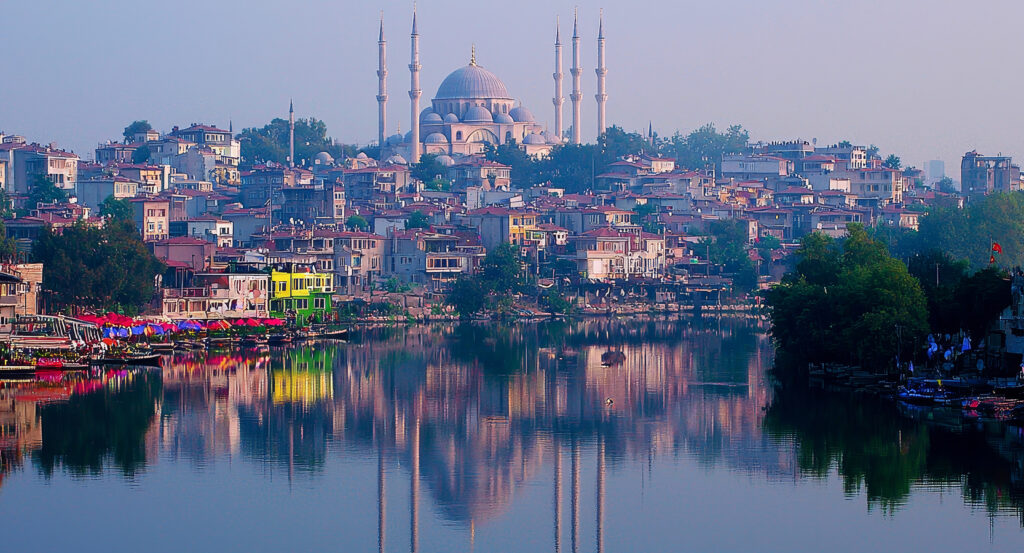
Why Suleymaniye Mosque matters.
Suleymaniye Mosque in Istanbul is not just a house of worship, it's an architectural symphony, a soaring declaration of faith that crowns the city's skyline with serenity and strength.
Perched high on Istanbul's Third Hill, overlooking the shimmering waters of the Golden Horn, this grand masterpiece by Mimar Sinan stands as both monument and meditation. Built in the mid-16th century for Sultan Süleyman the Magnificent, the mosque encapsulates the soul of the Ottoman Empire at its cultural and artistic peak. Its silhouette, the central dome flanked by slender minarets, defines the rhythm of the city's horizon, but it's within its walls that the real majesty unfolds. Step through the courtyard and time slows. The marble arcades gleam softly beneath the light, their symmetry and proportion so precise they feel like geometry made divine. Inside, the vast prayer hall glows in hues of gold and sapphire, sunlight filtering through stained glass and bouncing across the Iznik tiles like whispers of heaven. The acoustics are flawless, Sinan's genius ensured that a single spoken word carries naturally through the domed chamber, a marvel of both faith and engineering. Yet for all its grandeur, the mosque radiates peace. You feel it in the air, a stillness that quiets even the noisiest thoughts. Outside, the courtyard frames one of the most sweeping panoramas of Istanbul, where the Bosphorus glints below and domes and spires unfold in endless layers. To stand here is to witness the balance of earth and sky, strength and grace, a vision of Islam not only as devotion, but as beauty incarnate.
What defines Suleymaniye Mosque.
Behind its serenity, Suleymaniye Mosque carries centuries of symbolism, ambition, and quiet mastery.
Commissioned in 1550, it took Sinan seven years to complete what he would later call his “journeyman's work”, the precursor to his final masterpiece, the Selimiye Mosque in Edirne. Yet many scholars argue that Suleymaniye remains his most perfect creation, an ideal fusion of mathematical precision, spiritual purpose, and architectural poetry. The design draws inspiration from Hagia Sophia, yet refines it into something distinctly Ottoman, lighter, more balanced, and profoundly human. The mosque complex once formed a self-sufficient world: schools, a library, a hospital, a hammam, kitchens for the poor, and even a caravanserai for travelers, a city within a city, mirroring the empire's order and generosity. The kitchen alone fed over a thousand people daily, embodying Süleyman's title as “The Lawgiver” and his vision of benevolence. In the courtyard lies the tomb of Sultan Süleyman himself, alongside that of his beloved wife Hürrem Sultan, known in the West as Roxelana, whose influence shaped both his reign and Ottoman politics. The simplicity of their resting place contrasts deeply with their renowned lives, the stonework quiet and dignified beneath the shadow of the dome. Even the smallest details hold wonder: the stained-glass windows were crafted by master artist İbrahim the Glazier, the calligraphy inside by the famed Hasan Çelebi, and the domes are engineered with hidden clay jugs to perfect the acoustics. It's also said that Sinan concealed hundreds of ostrich eggs in the chandeliers to repel spiders and preserve the purity of the space, a detail as humble as it is ingenious. For centuries, Suleymaniye has withstood earthquakes and wars, its structure so perfectly balanced that it flexes rather than fractures, a literal and symbolic resilience that mirrors the faith it represents.
How Suleymaniye Mosque fits.
Visiting Suleymaniye Mosque is not a simple stop, it's a pilgrimage through the essence of Istanbul itself.
Arrive in the early morning, when the first call to prayer echoes softly over the city and the light paints the marble courtyard in shades of rose and gold. Enter through the grand northern gate and take your time crossing the courtyard, pausing to admire the cascade of domes and the elegant fountains that once served worshippers before prayer. Step inside, and let the cool stillness envelop you. Sit quietly beneath the main dome, 53 meters high, and look upward, tracing the calligraphy that circles its rim like a prayer written in light. You'll notice how every sound, footsteps, whispers, even breath, blends harmoniously into the air, as though the architecture itself were alive. After exploring the mosque's interior, wander through its gardens to the terrace behind, where one of the most striking views in Istanbul unfolds: the Bosphorus stretching toward the horizon, the Galata Tower rising across the water, and minarets piercing the sky. This vantage point alone is worth the journey. When you step outside, explore the surrounding neighborhood of Suleymaniye, a timeless district of cobblestone alleys, teahouses, and small bookshops tucked between centuries-old wooden homes. Stop at the nearby Ali Baba Pilavcısı, a humble eatery famous for its rice and chickpeas, or sip Turkish tea as the call to prayer drifts across the hills. Suleymaniye Mosque isn't just a destination, it's an experience of harmony, where art and faith become one. To stand beneath its dome is to feel the heartbeat of Istanbul itself, steady, sacred, and eternal.
Where your story begins.
Foresyte Travel reveals places that feel extraordinary long before you arrive.
Enjoy editorial crafted for luxury travelers.
Foresyte may earn a commission when you book.





































































































