Why Basilica of Santa Maria Novella matters.
Basilica of Santa Maria Novella is a masterwork of Renaissance sacred architecture where Santa Maria Novella's Dominican heritage, artistic genius, theological scholarship, and Florentine craftsmanship culminate in one of Italy's greatest ecclesiastical treasures.
Set along Piazza di Santa Maria Novella near Via degli Avelli and just steps from Florence Santa Maria Novella Railway Station, this extraordinary basilica unfolds through harmonious marble façades, soaring Gothic vaults, luminous frescoes, elegant cloisters, and centuries of artistic achievement that transformed a Dominican church into one of Florence's defining cultural monuments. Every chapel, arcade, and vaulted gallery reveals another chapter in the evolution of Renaissance art as painting, sculpture, geometry, architecture, and religious devotion merge within spaces created by many of Italy's greatest masters. Delicately proportioned interiors, richly decorated chapels, and tranquil monastic courtyards continually deepen appreciation for the extraordinary creative ambition that shaped Florence during one of history's greatest artistic eras. The experience ultimately unites architectural brilliance, artistic innovation, and spiritual tradition into one of Tuscany's most profound cultural experiences.
What defines Basilica of Santa Maria Novella.
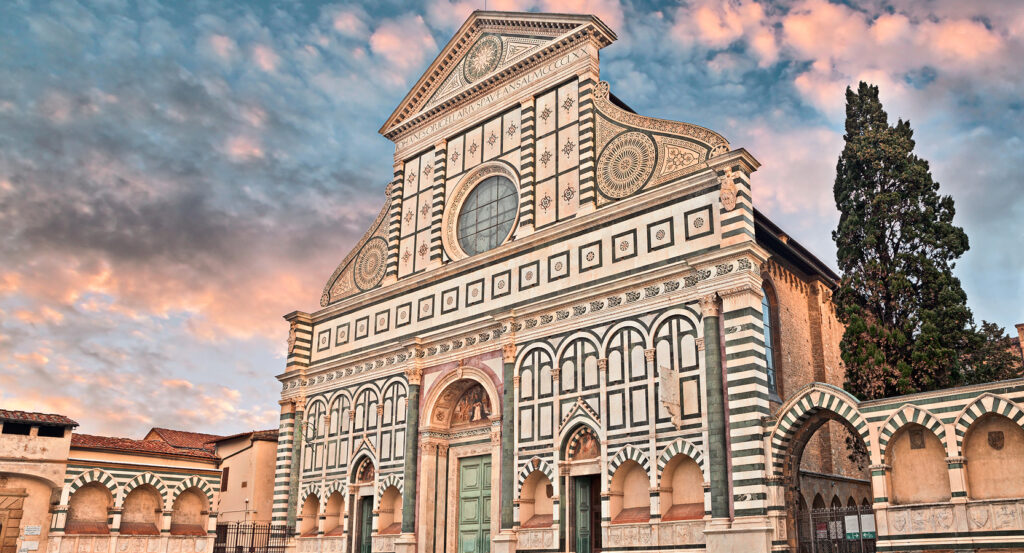
Basilica of Santa Maria Novella is best known for preserving one of the world's greatest concentrations of early Renaissance art within a Dominican church begun 1279 by friars Fra Sisto Fiorentino and Fra Ristoro da Campi, whose Gothic structure was later crowned by Leon Battista Alberti's revolutionary marble façade, completed between 1456 and 1470 under the patronage of Giovanni Rucellai, establishing one of the defining masterpieces of Renaissance architectural proportion. Alberti ingeniously reconciled the wide Gothic lower church with a narrower upper nave through mathematically balanced geometric forms, grand volutes, classical pilasters, colored marble inlays, and harmonic ratios inspired by ancient Roman architecture, producing one of the earliest and most influential Renaissance church façades ever constructed. The basilica safeguards Masaccio's Holy Trinity, painted 1427 and celebrated as one of the first grand applications of linear perspective in Western art, alongside Domenico Ghirlandaio's grand Tornabuoni Chapel fresco cycle completed between 1485 and 1490, Filippino Lippi's Strozzi Chapel, Giotto's great painted Crucifix dating to 1290, Brunelleschi's wooden crucifix, and Giorgio Vasari's later interventions that collectively document more than three centuries of Florentine artistic achievement. The adjoining convent preserves the Green Cloister adorned with Paolo Uccello's pioneering monochromatic frescoes, the Spanish Chapel completed during the fourteenth century with Andrea di Bonaiuto's extraordinary Dominican allegories, historic refectories, chapter houses, monastic libraries, and cloistered gardens that together formed one of medieval Europe's foremost Dominican intellectual centers. Throughout the Renaissance the monastery became an influential center for theology, philosophy, astronomy, mathematics, and humanist scholarship while welcoming figures including Saint Antoninus, Cosimo de' Medici, and generations of artists, scholars, and religious leaders whose contributions profoundly shaped Florence's intellectual and cultural development.
Artistic innovation permeates every space as successive generations of painters, architects, sculptors, mathematicians, and theologians transformed the complex into a living record of the transition from medieval craftsmanship to Renaissance humanism. Alberti's façade became a foundational model for Renaissance architecture across Europe, while Masaccio's revolutionary mastery of perspective permanently altered the course of Western painting by introducing convincing three-dimensional illusion grounded in mathematical precision. Monumental chapels, intricately carved funerary monuments, stained glass, sculpted altars, choir stalls, and meticulously preserved fresco cycles reveal the extraordinary collaboration between powerful Florentine families, Dominican patrons, and many of Italy's greatest creative minds. Every chapel, cloister, and architectural detail demonstrates how artistic genius, scientific discovery, religious devotion, and architectural innovation converged within one of Florence's most influential sacred institutions.
How Basilica of Santa Maria Novella fits.
Basilica of Santa Maria Novella works as the centerpiece of an exploration through Florence's extraordinary Renaissance heritage and artistic landmarks.
Begin at Piazza di Santa Maria Novella, where the basilica's celebrated marble façade immediately establishes the artistic significance of the neighborhood before exploring its grand interior. Continue to Museo Novecento, whose distinguished collection of twentieth-century Italian art provides a compelling discussion between Renaissance innovation and modern creativity. Conclude at Palazzo Strozzi, where internationally acclaimed exhibitions inside one of Florence's greatest Renaissance palaces provide a fitting finale celebrating centuries of artistic excellence. The progression moves naturally from sacred architecture to modern artistic expression before concluding within one of Florence's defining Renaissance masterpieces, revealing how creativity continues shaping the cultural character of Santa Maria Novella.
Where your story begins.
Foresyte Travel reveals places that feel extraordinary long before you arrive.
Enjoy editorial crafted for luxury travelers.
Foresyte may earn a commission when you book.