
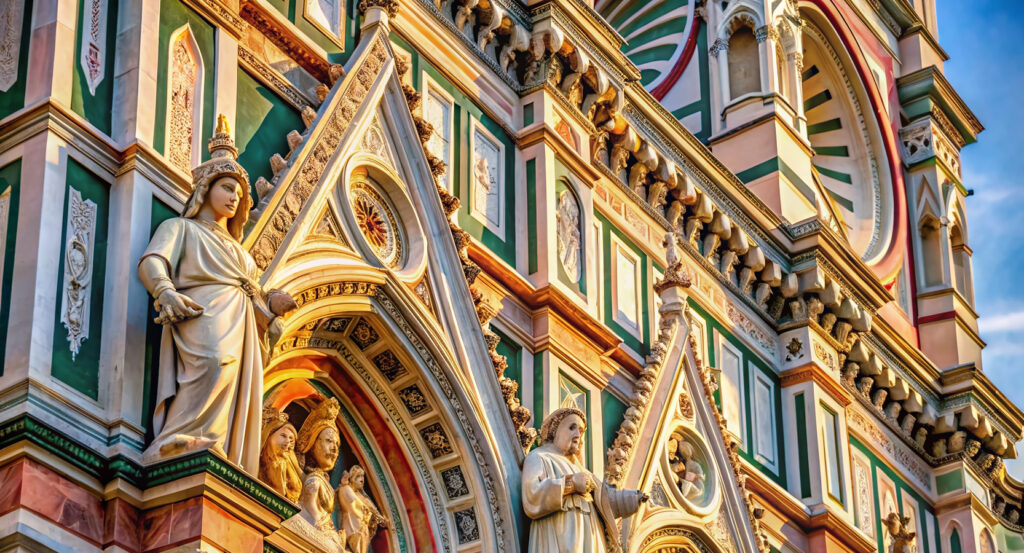
Why you should experience Basilica of Santa Croce in Florence, Italy.
Basilica of Santa Croce is a profound Franciscan church where Santa Croce's spiritual heritage, Renaissance artistry, Florentine history, and the legacy of Italy's greatest minds endure within one of the nation's most revered sacred spaces.
Set along Piazza di Santa Croce near Via Magliabechi and just steps from Museo dell'Opera di Santa Croce, this expansive basilica unfolds through soaring Gothic vaults, luminous frescoes, sculpted chapels, elegant cloisters, and centuries of artistic achievement that transformed a humble Franciscan foundation into Florence's enduring temple of national memory. Every nave, chapel, and cloister reveals another chapter in the evolution of Italian art as painting, sculpture, architecture, and religious devotion converge beneath one of Tuscany's most celebrated ecclesiastical interiors. Monumental funerary monuments, richly decorated chapels, and harmonious Gothic proportions continually reinforce the extraordinary cultural influence that radiated from Florence across Europe. The experience ultimately unites artistic excellence, historical legacy, and spiritual tradition into one of Italy's most meaningful cultural experiences.
What you should know about Basilica of Santa Croce.
Basilica of Santa Croce is best known for preserving the tombs and memorials of many of Italy's greatest historical figures inside the principal Franciscan church of Florence, begun in 1294 and traditionally attributed to Arnolfo di Cambio, creating the nation's most celebrated pantheon where Michelangelo, Galileo Galilei, Niccolò Machiavelli, Gioachino Rossini, Vittorio Alfieri, Ugo Foscolo, Guglielmo Marconi, and numerous other luminaries are commemorated beneath one of the largest Franciscan churches ever constructed. Commissioned as Florence's principal Franciscan basilica during the city's extraordinary medieval expansion, the church stretches 115 meters in length while its vast Gothic interior, completed over successive generations before the façade designed by Niccolò Matas was added between 1857 and 1863, reflects centuries of architectural evolution spanning the medieval and modern eras. The basilica preserves Giotto's celebrated fresco cycles in the Bardi and Peruzzi Chapels, executed during the early fourteenth century and representing milestones in the development of naturalistic Renaissance painting, alongside masterpieces by Taddeo Gaddi, Agnolo Gaddi, Donatello, Benedetto da Maiano, Giorgio Vasari, Bronzino, Antonio Canova, and many of Florence's greatest artists. The adjoining convent safeguards the grand Pazzi Chapel, designed by Filippo Brunelleschi from the 1440s onward as one of the purest expressions of Renaissance architectural harmony, together with historic cloisters, refectories, libraries, and the Museo dell'Opera di Santa Croce, whose collections preserve sculptures, paintings, liturgical treasures, and architectural fragments spanning more than seven centuries. Following the devastating Arno flood of 1966, among the twentieth century's largest art conservation campaigns mobilized international experts to rescue thousands of damaged artworks, manuscripts, crucifixes, frescoes, and sculptures, transforming Santa Croce into a global symbol of cultural preservation while advancing modern conservation science. Today the basilica remains both an active Franciscan church and one of Italy's most significant repositories of Renaissance art, architecture, religious history, and national memory.
Centuries of artistic innovation unfold through grand chapels, luminous stained glass, intricately carved funerary monuments, painted crucifixes, sculpted altars, and harmonious Gothic architecture that collectively narrate the emergence of Renaissance Florence. Giotto's revolutionary frescoes introduced new standards of resonant realism and spatial storytelling, while Brunelleschi's Pazzi Chapel established architectural principles that profoundly influenced Renaissance design throughout Europe. Ongoing conservation, scholarly research, and meticulous restoration continue safeguarding masterpieces created across seven centuries while preserving the profound relationship between Franciscan spirituality, artistic patronage, and Florentine civic identity. Every chapel, cloister, and monument demonstrates how faith, artistic genius, humanist thought, and historical remembrance combined to create one of Italy's most influential sacred institutions.
How to fold Basilica of Santa Croce into your trip.
Basilica of Santa Croce works as the centerpiece of an exploration through Santa Croce's extraordinary artistic and historical heritage.
Begin at Museo dell'Opera di Santa Croce, where sculptures, frescoes, and centuries of ecclesiastical treasures establish the rich artistic legacy surrounding the basilica before exploring its grand interior. Continue to Casa Buonarroti, where the history of Michelangelo and his family naturally extends the story of one of the basilica's most celebrated figures. Conclude at Piazza Santa Croce, whose expansive civic setting, historic palazzi, and energetic atmosphere provide a memorable finale celebrating the enduring relationship between Florentine public life, artistic achievement, and sacred tradition. The progression moves naturally from artistic preservation to one of Christianity's great churches before concluding within the historic square that has anchored Santa Croce for centuries, revealing why the neighborhood remains one of Florence's foremost cultural destinations.
Where your story begins.
Foresyte Travel reveals places that feel extraordinary long before you arrive.
Experience premium editorial crafted for luxury travelers.




















































































































