Why Arnolfo di Cambio matters.
Arnolfo di Cambio at Santa Trinita in Florence stands as one of the earliest expressions of Gothic architecture's arrival in Tuscany, a stone threshold where medieval solemnity meets human grace.
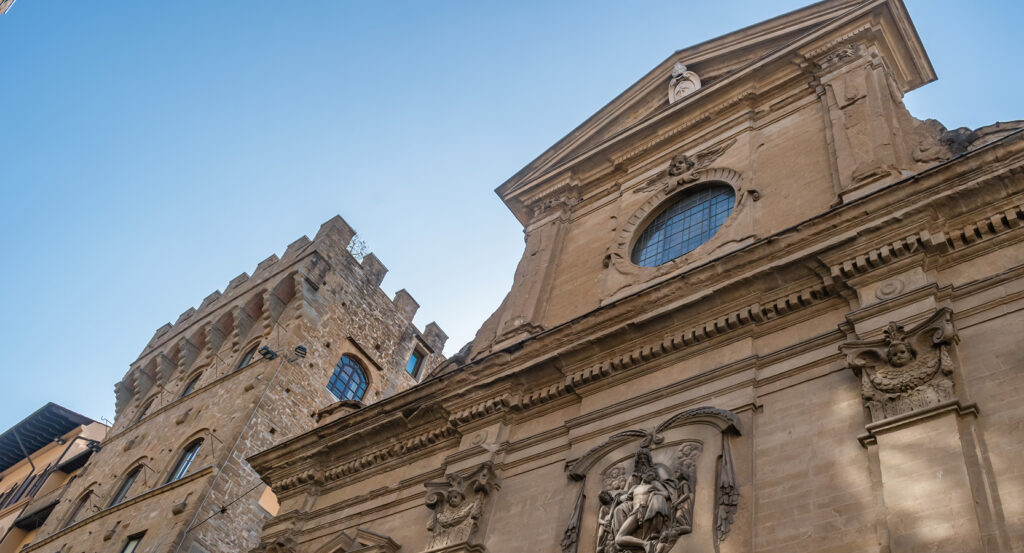
Created around the late 13th century by Arnolfo di Cambio, the architect-sculptor responsible for some of Florence's most enduring monuments, the portal captures the transition from Romanesque solidity to Gothic refinement. Its pointed arch, framed by slender colonnettes and deeply carved moldings, directs the gaze upward, as if the geometry of faith were guiding one toward heaven. Step closer, and you'll see how Arnolfo infused the stone with subtle movement, figures and motifs that hint at the spiritual vitality of a new age. The portal's quiet grandeur marks not only the entrance to Santa Trinita but also a pivotal moment in Florence's artistic evolution, when architecture became an act of devotion sculpted in light and shadow.
What defines Arnolfo di Cambio.
Arnolfo di Cambio reveals the hand of a master who would go on to shape Florence's architectural destiny.
Before designing the city's cathedral and Palazzo Vecchio, Arnolfo honed his vision here, testing proportions, decorative programs, and the delicate balance between structure and symbolism. The portal's columns rest upon stylized capitals carved with foliage, angels, and abstract motifs that bridge Byzantine inheritance with early Gothic rhythm. Its archivolt, though simple in form, once shimmered with traces of polychrome, red and blue pigments that transformed the stone into a radiant gateway during feast days. The sculptural program, though partially eroded, depicted saints of the Vallombrosan order who founded the church, blending local monastic heritage with universal Christian narrative. Arnolfo's decision to adopt the pointed arch was revolutionary for Florence at the time, marking a clear departure from the rounded Romanesque portals of neighboring churches. In its restrained beauty, the portal prefigures the city's embrace of architectural spirituality, where geometry, light, and meaning intertwine.
How Arnolfo di Cambio fits.
When visiting Santa Trinita, make Arnolfo di Cambio your first moment of reflection before stepping inside.
Approach from the Piazza Santa Trinita, letting your eyes trace the vertical lines of the façade until they meet at the portal's graceful apex. Stand directly before it to feel the rhythm of its carved patterns and the cool texture of centuries-old stone, this was the threshold crossed by Florentine merchants, nobles, and monks for over seven hundred years. Visit in the morning when sunlight brushes the façade, accentuating the depth of its carvings, or in the evening when shadow pools within the arch, evoking its original, candlelit solemnity. As you step through, imagine the transformation it once symbolized: from the thriving square of Renaissance commerce to the sacred stillness of divine order. After the visit, linger a moment in the piazza and look back, Arnolfo di Cambio frames not only an entrance but an era, a doorway through which Florence itself first began to imagine the heights of beauty it would one day achieve.
Where your story begins.
Foresyte Travel reveals places that feel extraordinary long before you arrive.
Enjoy editorial crafted for luxury travelers.
Foresyte may earn a commission when you book.