Why Piazza della Signoria matters.
Piazza della Signoria is Florence's historic civic heart where Santa Croce's republican legacy, Renaissance artistry, political power, and centuries of public life converge within one of Europe's most influential urban squares.
Set along Via dei Calzaiuoli near Via Vacchereccia and just steps from Palazzo Vecchio, this expansive piazza surrounds visitors with Renaissance palaces, celebrated sculptures, graceful arcades, grand fountains, and architectural masterpieces that together embody the civic ambition of Florence at the height of its cultural ascendancy. Every corner reveals another expression of artistic and political achievement as open-air sculpture, harmonious urban planning, and centuries of public ceremony transform the square into a living chronicle of the Renaissance. Marble statues, commanding façades, and uninterrupted sightlines continually reinforce the extraordinary discussion between government, art, and civic character that shaped one of history's greatest city-states. The experience ultimately unites artistic excellence, democratic tradition, and Florentine history into one of Italy's most significant public spaces.
What defines Piazza della Signoria.
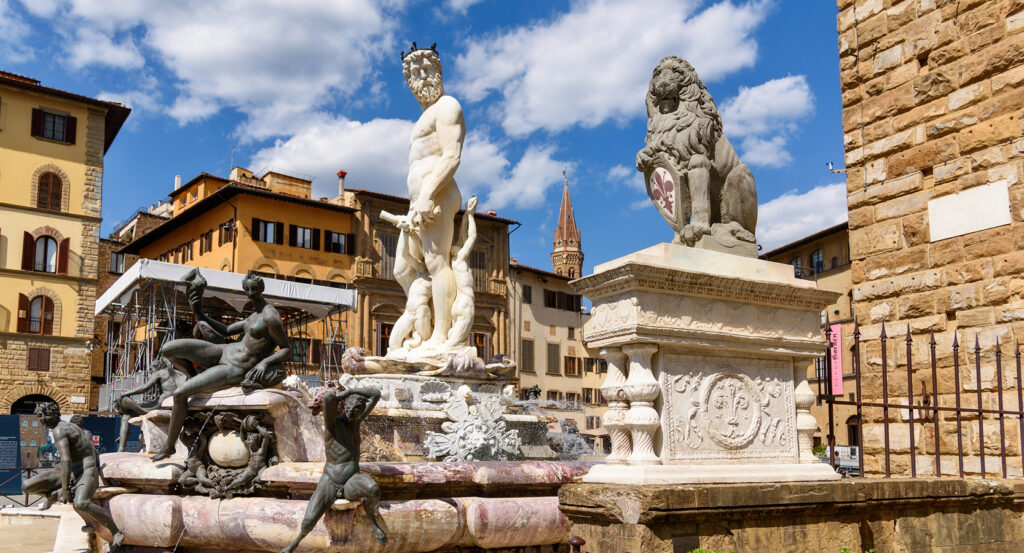
Piazza della Signoria is best known for serving as the political center of the Florentine Republic from the late thirteenth century onward after the construction of Palazzo Vecchio began in 1299 under Arnolfo di Cambio, establishing the square as the seat of the Signoria, the republic's governing body, where civic ceremonies, diplomatic receptions, public assemblies, triumphal celebrations, judicial proceedings, and some of Florence's most consequential historical events unfolded for more than seven centuries. The piazza assumed its present form following the Guelph victory over the Ghibellines, when demolished noble residences created the expansive civic space that became the symbolic heart of republican Florence before later serving the Medici Grand Duchy and eventually unified Italy. Among its artistic treasures are Bartolomeo Ammannati's Fountain of Neptune, unveiled in 1575 to commemorate Cosimo I de' Medici's naval ambitions and marriage to Joanna of Austria; Benvenuto Cellini's bronze masterpiece Perseus with the Head of Medusa, completed in 1554 for the Loggia dei Lanzi after nearly a decade of technically demanding bronze casting; Giambologna's Equestrian Monument of Cosimo I erected in 1594; and numerous classical and Renaissance sculptures housed within the Loggia dei Lanzi, including Giambologna's Rape of the Sabine Women and the celebrated ancient Roman Medici Lions. Michelangelo's David originally stood before Palazzo Vecchio from 1504 until its relocation to the Accademia in 1873, with the current replica preserving the sculpture's historic civic setting as a symbol of republican liberty. The square also witnessed the dramatic rise and fall of Dominican reformer Girolamo Savonarola, who organized the Bonfire of the Vanities here in 1497 before being tried, hanged, and burned in the piazza the following year, an event commemorated today by a circular marble plaque embedded in the pavement. Together, with the adjoining Uffizi Galleries and the Vasari Corridor completed in 1565, the piazza formed the political, artistic, and ceremonial nucleus of Medici Florence while continuing to function as one of Europe's most complete surviving Renaissance civic ensembles.
Architectural harmony defines the square through the carefully balanced relationship between Palazzo Vecchio, the open-air Loggia dei Lanzi, richly ornamented palaces, sculptural programs, and expansive public space that established enduring principles of Renaissance urban design. Every sculpture was intentionally positioned to communicate civic virtue, military strength, justice, and republican ideals while reinforcing Florence's character as one of Europe's foremost centers of artistic patronage and political innovation. Continual preservation, archaeological study, and conservation ensure that masterpieces by Cellini, Giambologna, Ammannati, and countless other artists remain integrated within the historic setting for which they were originally conceived. Every façade, sculpture, fountain, and ceremonial space demonstrates how artistic genius, political vision, urban planning, and civic life combined to create one of the world's most influential public squares.
How Piazza della Signoria fits.
Piazza della Signoria works as the centerpiece of an exploration through Santa Croce's extraordinary civic and artistic heritage.
Begin at Palazzo Vecchio, where centuries of republican government immediately establish the political significance of Florence before stepping into Piazza della Signoria to experience one of Europe's greatest civic spaces. Continue to Loggia dei Lanzi, whose extraordinary open-air sculpture gallery deepens appreciation for the artistic achievements surrounding the piazza. Conclude at Uffizi Galleries, where the world's greatest collection of Renaissance painting provides a fitting finale celebrating the artistic genius that flourished around Florence's historic seat of government. The progression moves naturally from civic leadership to grand public space before concluding through unparalleled artistic achievement, revealing why Santa Croce remains inseparable from Florence's enduring cultural legacy.
Where your story begins.
Foresyte Travel reveals places that feel extraordinary long before you arrive.
Enjoy editorial crafted for luxury travelers.
Foresyte may earn a commission when you book.