Why Palazzo Pitti matters.
Palazzo Pitti is an imposing Renaissance palace where Oltrarno's dynastic grandeur, Medici patronage, artistic magnificence, and the ambitions of Europe's ruling families transformed a merchant's residence into the greatest royal palace in Florence.
Set along Piazza de' Pitti near Via Guicciardini and just steps from Boboli Gardens, this immense palace unfolds through opulent royal apartments, richly decorated galleries, ceremonial halls, and extraordinary museum collections that reveal centuries of political authority, artistic patronage, and courtly life. Monumental stone façades give way to lavish interiors where Renaissance paintings, Baroque decoration, gilded furnishings, tapestries, and priceless collections demonstrate how successive dynasties reshaped the residence to reflect changing ideals of power and prestige. Expansive state rooms, refined architectural symmetry, and centuries of artistic commissions immerse visitors within the private world of grand dukes, kings, emperors, and queens who governed Tuscany from one of Italy's most influential royal residences. The experience ultimately unites political history, artistic excellence, and aristocratic splendor into Florence's most comprehensive palace complex.
What defines Palazzo Pitti.
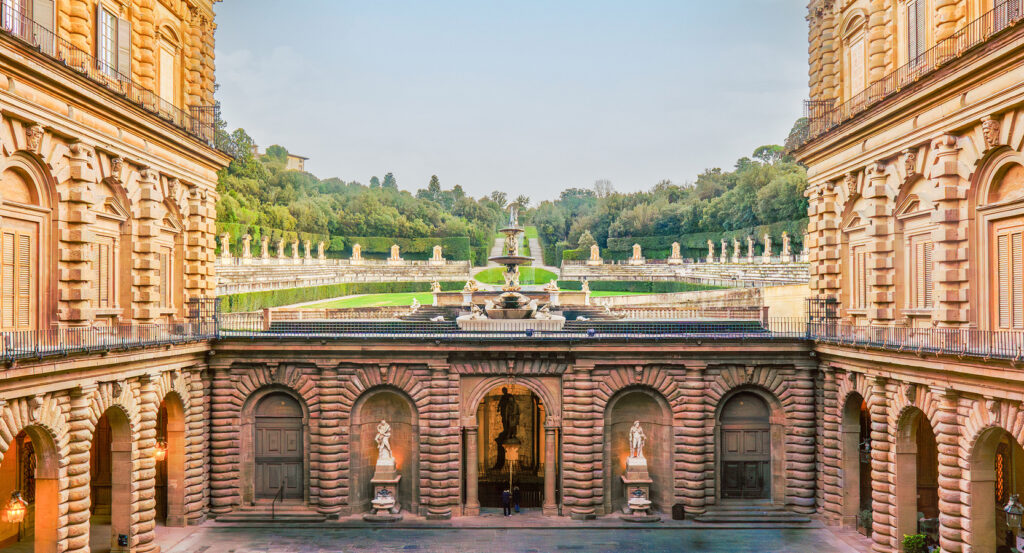
Palazzo Pitti is best known for evolving from the ambitious residence commissioned by wealthy Florentine banker Luca Pitti 1458 into the principal home of the Medici Grand Dukes after Eleonora di Toledo purchased the palace for Cosimo I de' Medici in 1549, transforming the complex into the political, cultural, and ceremonial heart of the Grand Duchy of Tuscany for more than two centuries before later serving the House of Lorraine, Napoleon Bonaparte's administration, and the House of Savoy following Italian unification. Although the palace has traditionally been attributed to Filippo Brunelleschi, modern scholarship more commonly associates its original design with Luca Fancelli, among Brunelleschi's leading pupils, whose austere rusticated façade established one of the defining architectural models of the Italian Renaissance. Successive expansions directed by Bartolomeo Ammannati dramatically enlarged the residence while creating the grand courtyard that seamlessly connects the palace to Boboli Gardens, itself among Europe's most influential formal gardens and the prototype for generations of royal landscapes. Today the palace houses the Palatine Gallery, where masterpieces by Raphael, Titian, Rubens, Andrea del Sarto, Pietro da Cortona, and numerous other masters remain displayed within their historic Baroque interiors rather than conventional chronological museum installations, alongside the Royal Apartments, Gallery of Modern Art, Museum of Costume and Fashion, Treasury of the Grand Dukes, Museum of Russian Icons, and the Imperial and Royal Apartments. During the nineteenth century Palazzo Pitti briefly became the royal residence of King Victor Emmanuel II when Florence served as the capital of unified Italy between 1865 and 1871, adding another chapter to nearly six centuries of continuous political and cultural significance. The palace today preserves one of Europe's most complete ensembles of Renaissance architecture, royal collections, decorative arts, and courtly interiors while illustrating the extraordinary evolution of Florentine, Medici, and Italian statecraft across successive dynasties.
Lavishly decorated reception rooms preserve the ceremonial sequence through which ambassadors, nobles, artists, and political leaders experienced the authority of Tuscany's ruling families, while frescoed ceilings, grand canvases, carved furnishings, precious stonework, and elaborate decorative programs demonstrate the immense resources devoted to projecting dynastic prestige. Baroque interiors designed by Pietro da Cortona and later court artists transform entire suites into immersive artistic environments where painting, sculpture, architecture, and decoration function as a unified expression of political authority. Continuous conservation preserves not only exceptional collections but also the authentic spatial relationships that distinguish Palazzo Pitti from conventional museums, allowing visitors to experience masterpieces within the royal settings for which they were intended. Palace, gallery, royal residence, and museum ultimately merge into one of Europe's finest surviving expressions of Renaissance and Baroque court culture.
How Palazzo Pitti fits.
Palazzo Pitti works as the centerpiece of an exploration through Oltrarno's extraordinary artistic and royal heritage.
Begin at Boboli Gardens, where the grand landscape commissioned by the Medici establishes the scale and ambition of the palace estate before entering Palazzo Pitti to experience Florence's greatest royal residence. Continue to Galleria Palatina, whose extraordinary collection of Renaissance and Baroque masterpieces deepens appreciation for the artistic patronage that flourished inside the palace. Conclude at Ponte Vecchio, where Florence's most celebrated bridge provides a memorable finale connecting the royal Oltrarno district with the historic heart of the Renaissance city. The progression moves naturally from formal gardens to dynastic splendor before concluding with one of Florence's defining historic crossings, revealing why Oltrarno remains inseparable from the city's artistic and political legacy.
Where your story begins.
Foresyte Travel reveals places that feel extraordinary long before you arrive.
Enjoy editorial crafted for luxury travelers.
Foresyte may earn a commission when you book.