
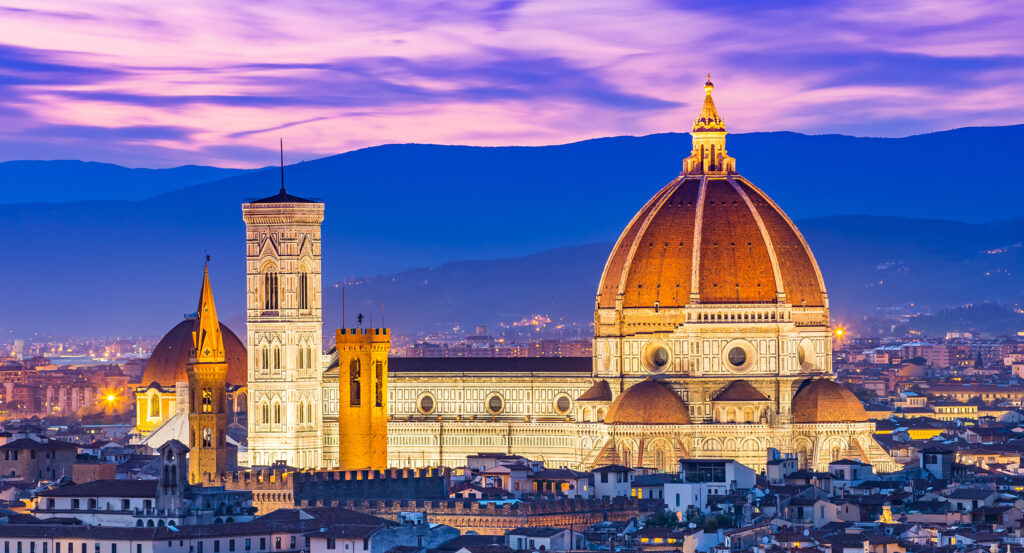
Why Florence Cathedral matters.
Florence Cathedral is an expansive Gothic cathedral where Historic Center meets the architectural genius of Filippo Brunelleschi, the religious ambitions of the medieval republic and the engineering achievement that transformed the skyline of Renaissance Italy.
Set along Piazza del Duomo near Via dei Calzaiuoli and just steps from the surrounding streets of San Giovanni, the cathedral occupies the center of Florence's historic religious district, where its immense marble-clad structure rises above tightly arranged medieval buildings and adjoining civic squares. Alternating panels of white Carrara, green Prato and pink Maremma marble establish the exterior's elaborate geometric decoration. Pointed arches, sculptural niches and intricate stone tracery extend across the facades, creating an exceptionally detailed architectural composition. The vast octagonal dome dominates the roofline, rising above the nave and surrounding chapels through a complex arrangement of masonry ribs and curved surfaces. The result is an extraordinary religious monument whose scale, decorative craftsmanship and structural innovation established Florence as a center of European architectural achievement.
What defines Florence Cathedral.
Florence Cathedral is best known for Filippo Brunelleschi's expansive dome, an engineering achievement that revolutionized Renaissance architecture and remains the largest masonry dome ever constructed. The cathedral's origins reach to 1296, when the Florentine republic commissioned architect Arnolfo di Cambio to design a new religious complex dedicated to Santa Maria del Fiore. Construction replaced the earlier church of Santa Reparata, whose remains survive beneath the present cathedral. The project developed during Florence's emergence as a major commercial and financial power, supported by the wealth of its merchant guilds and banking families. Arnolfo conceived an exceptionally ambitious Gothic structure intended to rival the great churches of medieval Europe. Following his death, successive architects continued the work, adapting the design as engineering requirements and artistic ambitions evolved. Francesco Talenti substantially enlarged the building during the fourteenth century, establishing the immense proportions of its nave and eastern termination. The cathedral's octagonal crossing presented an extraordinary structural challenge because its span exceeded the practical limits of conventional medieval construction techniques. In 1418, the Opera del Duomo organized a competition to determine how the enormous opening could be covered. Brunelleschi secured the commission, developing an unprecedented construction method that eliminated the need for a massive timber centering structure. Work began in 1420, employing a double-shell design, horizontal reinforcement systems and a distinctive herringbone arrangement of bricks. Brunelleschi also designed innovative hoisting machinery capable of lifting heavy materials to extraordinary heights. The dome was substantially completed in 1436, when Pope Eugene IV consecrated the cathedral during an elaborate religious ceremony. Its construction established a defining achievement of Renaissance engineering and transformed Florence's architectural prominence across Europe.
Giotto di Bondone became responsible for the cathedral's bell tower in 1334, introducing a freestanding campanile distinguished by elaborate marble decoration and carefully proportioned Gothic detailing. Andrea Pisano and Francesco Talenti subsequently continued its construction, completing the tower in 1359. Its sculptural program incorporates relief panels associated with human labor, knowledge and the development of civilization. The cathedral's vast interior presents a comparatively restrained architectural environment, with expansive stone piers supporting pointed arches and extensive vaulted ceilings. The patterned marble pavement incorporates geometric designs developed during successive phases of interior decoration. Giorgio Vasari began the immense fresco cycle decorating the dome's interior in 1572, creating an expansive representation of the Last Judgment. Federico Zuccari completed the project after Vasari's death, developing a complex composition of angels, saints and biblical figures across the curved surfaces. Paolo Uccello contributed the celebrated painted clock above the principal entrance, incorporating an unusual twenty-four-hour dial associated with the traditional Italian method of measuring time. The cathedral also contains Uccello's equestrian monument to the English mercenary commander John Hawkwood, painted in 1436 as a commemorative work. Andrea del Castagno produced a corresponding painted monument to the military commander Niccolò da Tolentino, extending the building's association with Florentine military history. The present western facade was completed during the nineteenth century under architect Emilio De Fabris, whose Gothic Revival design introduced elaborate marble ornamentation and sculptural decoration. Its construction concluded a centuries-long architectural development that had left the cathedral's principal entrance unfinished. The building's religious importance remains closely associated with the Archdiocese of Florence, whose ceremonial traditions continue within its expansive interior. Florence Cathedral's enduring distinction rests in the integration of medieval Gothic architecture, Renaissance engineering and artistic contributions developed across successive generations of Florentine craftsmen.
How Florence Cathedral fits.
Florence Cathedral works as the architectural anchor for a historic Florence outing connecting the city's medieval religious institutions, its Renaissance sculptural traditions and the preserved artistic collections of the cathedral complex.
Begin at Florence Baptistery, the celebrated octagonal religious building dedicated to Saint John the Baptist and positioned opposite the cathedral's western entrance. Its origins extend into the early medieval period, with the present structure developed primarily during the eleventh and twelfth centuries. Alternating white and green marble panels establish an exterior composition distinguished by classical proportions and Romanesque architectural detailing. The interior contains an elaborate mosaic ceiling depicting biblical scenes, including an expansive representation of Christ at the Last Judgment. Lorenzo Ghiberti created the celebrated eastern bronze doors during the fifteenth century, developing ten large relief panels depicting episodes from the Old Testament. Michelangelo later praised their extraordinary beauty, giving rise to the designation Gates of Paradise. Continue to Museo dell'Opera del Duomo, the museum devoted to the artistic and architectural history of Florence's cathedral complex. Its collections preserve original sculptures, architectural fragments and decorative objects removed from the religious buildings during successive restoration campaigns. The museum contains Michelangelo's unfinished Florentine Pietà, a powerful late sculpture associated with the artist's reflections on mortality and religious devotion. Donatello's Penitent Magdalene presents an intensely expressive wooden sculpture distinguished by its unconventional treatment of the biblical figure. The museum also preserves original panels from Ghiberti's bronze doors, allowing close examination of their elaborate narrative compositions and technical craftsmanship. Conclude at Basilica di San Lorenzo, the historic church associated with the Medici family and the architectural development of Renaissance Florence. Brunelleschi designed its principal interior during the fifteenth century, establishing a composition of classical columns, rounded arches and carefully proportioned spatial divisions. The adjoining Old Sacristy incorporates one of his most influential architectural designs, combining geometric clarity with restrained decorative detail. Donatello contributed sculptural decoration to the sacristy, developing an important artistic collaboration within the Medici patronage network. The basilica's associated chapels and library extend its historical significance through additional works commissioned by Florence's ruling families. The progression moves from Florence Baptistery's medieval mosaics and bronze sculpture through Museo dell'Opera del Duomo's cathedral collections and culminates at Basilica di San Lorenzo's Renaissance architecture, connecting three defining dimensions of Florence's religious and artistic development.
Where your story begins.
Foresyte Travel reveals places that feel extraordinary long before you arrive.
Enjoy editorial crafted for luxury travelers.
Foresyte may earn a commission when you book.




















































































































