Why Opera del Duomo Museum matters.
Opera del Duomo Museum is an immersive cathedral museum where Duomo's sacred architecture, Renaissance craftsmanship, the original masterpieces of Florence's cathedral complex, and the artistic ambition that transformed a medieval city into the birthplace of the Renaissance become one unforgettable experience.
Set along Piazza del Duomo near Via dello Studio and just steps from Cathedral of Santa Maria del Fiore, this immersive museum reveals the original sculptures, bronze masterpieces, grand façades, and sacred treasures that once crowned Florence's most celebrated religious monuments before centuries of preservation brought them together beneath a single roof. Towering galleries recreate the cathedral's original medieval façade at full scale, allowing visitors to encounter masterpieces within the architectural relationships for which they were conceived. Every gallery deepens the connection between sculpture, engineering, architecture, and faith as Michelangelo, Donatello, Ghiberti, Brunelleschi, Luca della Robbia, and generations of master craftsmen collectively demonstrate how Florence redefined the possibilities of artistic achievement. The experience ultimately reveals not simply what the Renaissance produced, but how one city imagined beauty on a scale that permanently reshaped Western civilization.
What defines Opera del Duomo Museum.
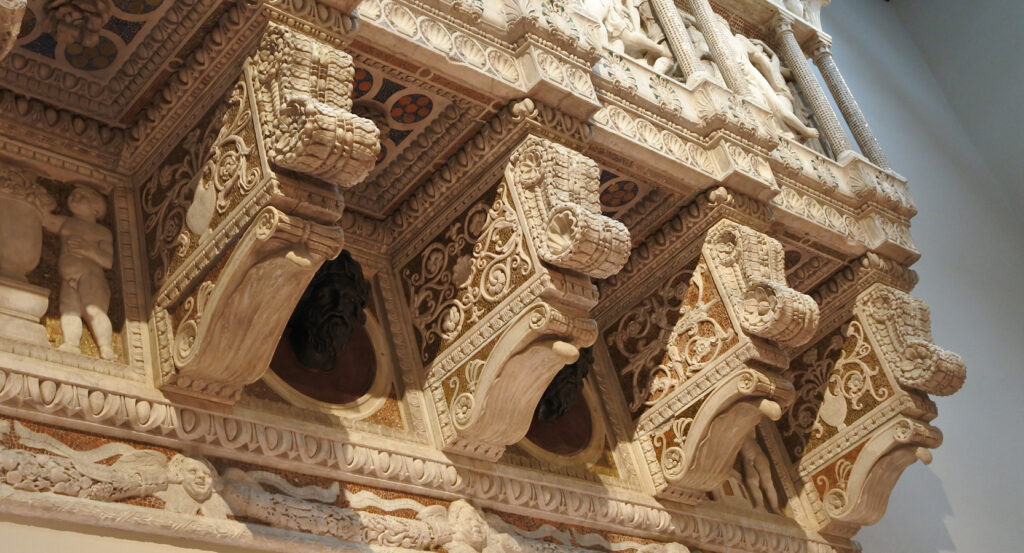
Opera del Duomo Museum is best known for preserving the original artistic and architectural masterpieces created for Cathedral of Santa Maria del Fiore, Battistero di San Giovanni, and Giotto's Campanile inside the historic headquarters of the Opera di Santa Maria del Fiore, the institution established in 1296 to oversee construction, decoration, and stewardship of Florence's cathedral complex throughout more than seven centuries of artistic innovation. Reopened following a transformative redevelopment completed in 2015, the museum now encompasses 6,000 square meters across twenty-eight galleries displaying more than 750 works, including Lorenzo Ghiberti's original Gates of Paradise, completed between 1425 and 1452 after nearly twenty-seven years of revolutionary bronze casting, Michelangelo's unfinished Florentine Pietà, carved between 1547 and 1555 for the artist's own intended tomb before he famously attempted to destroy it, Donatello's powerful Penitent Magdalene, the original marble choir lofts by Donatello and Luca della Robbia, and masterpieces by Arnolfo di Cambio, Andrea Pisano, Nanni di Banco, Andrea del Verrocchio, and numerous other artists whose work defined the transition from the Gothic world into the Renaissance. Among the museum's greatest achievements is the full-scale reconstruction of Arnolfo di Cambio's original cathedral façade, reuniting more than forty original sculptures within their intended architectural composition for the first time in centuries and allowing visitors to understand how sculpture, architecture, theology, and civic character functioned together as a single creative vision. The collections further preserve Brunelleschi's engineering models documenting construction of the revolutionary dome between 1420 and 1436 without traditional wooden centering, original stained glass cartoons, silver liturgical objects, reliquaries, carved furnishings, architectural fragments, marble reliefs, and workshop artifacts that collectively document one of the most ambitious artistic enterprises ever undertaken. Rather than presenting isolated masterpieces, the museum reconstructs the complete creative ecosystem that enabled Florence to become the artistic capital of Renaissance Europe, revealing how architects, sculptors, bronze founders, engineers, painters, and master craftsmen collaborated across generations to produce one of history's greatest cathedral complexes.
Every gallery restores the original discussion between architecture and sculpture, allowing visitors to experience works at the scale, elevation, and spatial relationships their creators intended centuries ago. Original bronze doors, grand marble figures, engineering studies, choir lofts, liturgical treasures, and architectural fragments collectively illuminate the extraordinary technical and artistic challenges overcome by Brunelleschi, Ghiberti, Donatello, Michelangelo, and their contemporaries. Continuous conservation, scholarly research, and meticulous exhibition design ensure these irreplaceable works continue revealing new insights into Renaissance creativity while preserving Florence's artistic inheritance for future generations. Every space demonstrates how engineering innovation, artistic brilliance, religious devotion, and civic ambition combined to create one of the world's greatest collections of Renaissance sacred art.
How Opera del Duomo Museum fits.
Opera del Duomo Museum works as the centerpiece of an exploration through Duomo's extraordinary cathedral complex and Renaissance masterpieces.
Begin at Cathedral of Santa Maria del Fiore, where Brunelleschi's revolutionary dome immediately establishes the architectural ambition that defines the neighborhood before continuing into Opera del Duomo Museum to encounter the original masterpieces created for the cathedral complex. Continue to Battistero di San Giovanni, whose celebrated bronze doors and centuries of Florentine history naturally deepen appreciation for the museum's extraordinary collections. Conclude at Giotto's Campanile, where one of the Renaissance's finest bell towers provides a fitting finale celebrating the sculpture, engineering, and architectural vision that transformed Florence into one of history's greatest artistic capitals. The progression moves naturally from cathedral to original masterpieces before concluding through two defining achievements of the cathedral complex, revealing why Duomo remains the spiritual and artistic heart of Florence.
Where your story begins.
Foresyte Travel reveals places that feel extraordinary long before you arrive.
Enjoy editorial crafted for luxury travelers.
Foresyte may earn a commission when you book.