Why Giotto's Bell Tower matters.
Giotto's Bell Tower is a soaring Gothic bell tower where Duomo's architectural ambition, Florentine devotion, revolutionary engineering, and the artistic vision that elevated the cathedral complex into the Renaissance's defining achievement rise toward one of Italy's most celebrated panoramas.
Set along Piazza del Duomo near Via dei Calzaiuoli and just steps from Cathedral of Santa Maria del Fiore, this elegantly proportioned campanile draws visitors upward through ascending flights of stone staircases before revealing an ever-changing discussion between intricate marble geometry, sculptural decoration, soaring Gothic architecture, and sweeping views across Florence's terracotta skyline. Every level showcases increasingly dramatic perspectives as richly colored Tuscan marble, elaborate reliefs, and centuries of master craftsmanship culminate in an observation terrace overlooking Brunelleschi's dome, the Arno Valley, and the rolling hills surrounding the city. Rather than serving merely as a bell tower, the ascent reveals the extraordinary artistic unity that binds Florence's cathedral complex into one of humanity's greatest architectural accomplishments. The experience ultimately combines engineering brilliance, artistic refinement, and breathtaking perspective into one of Florence's essential experiences.
What defines Giotto's Bell Tower.
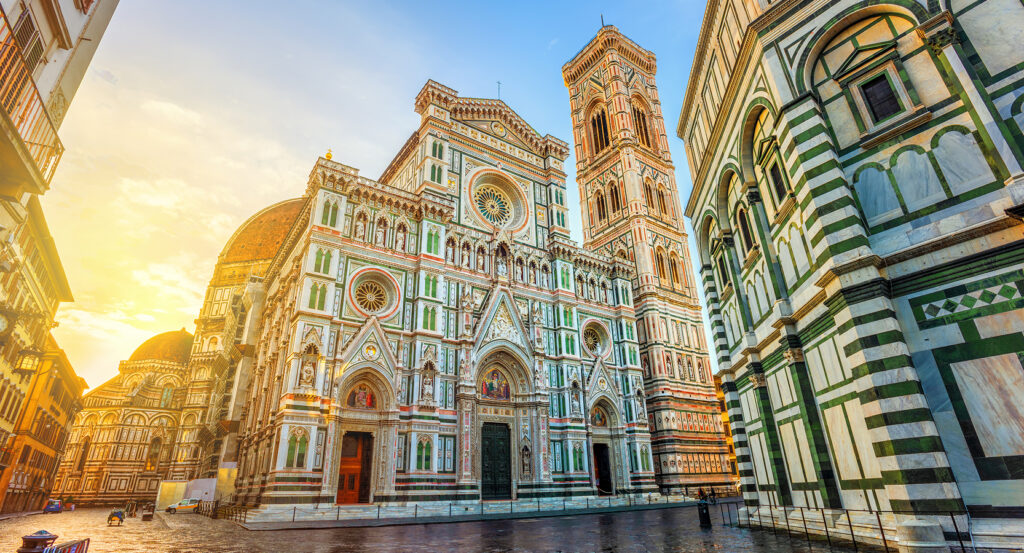
Giotto's Bell Tower is best known for embodying the evolution of Florentine Gothic architecture after construction began in 1334 under Giotto di Bondone, whose revolutionary vision established the tower's elegant proportions and richly sculptural decorative program before his death in 1337, with Andrea Pisano continuing the project from 1337 until 1348 and Francesco Talenti completing the campanile in 1359 while increasing its height to 84.7 meters and introducing the expansive observation terrace that defines the structure today. Built entirely of white Carrara, green Prato, and red Siena marble harmonizing with Cathedral of Santa Maria del Fiore and Battistero di San Giovanni, the tower represents one of the finest achievements of Italian Gothic architecture through its refined vertical composition, polychrome façades, and carefully integrated sculptural decoration. The exterior originally featured relief panels designed by Giotto and Andrea Pisano illustrating the origins of human civilization through astronomy, agriculture, music, craftsmanship, and the liberal arts, alongside hexagonal panels and sixteen larger-than-life statues, many later replaced with replicas while the originals were preserved inside Opera del Duomo Museum. Visitors climb 414 steps without elevators to reach the summit, where uninterrupted views extend across Brunelleschi's revolutionary dome, Palazzo Vecchio, Basilica of Santa Croce, the Tuscan hills, and Florence's UNESCO World Heritage historic center. The tower forms an indispensable component of the cathedral complex administered by the Opera di Santa Maria del Fiore, whose stewardship since 1296 coordinated one of Europe's most ambitious artistic enterprises by bringing together Giotto, Pisano, Talenti, Brunelleschi, Ghiberti, Donatello, Luca della Robbia, Michelangelo, and generations of artists, engineers, and craftsmen whose collective achievements transformed Florence into the artistic capital of Renaissance Europe. Today the campanile remains one of the world's finest surviving Gothic bell towers while continuing to demonstrate the extraordinary relationship between architecture, sculpture, mathematics, engineering, and religious symbolism that defined fourteenth-century Florence.
Every elevation reveals an increasingly sophisticated discussion between architecture and sculpture as relief panels, marble inlays, tracery, niches, and carefully calculated proportions guide the eye upward with exceptional elegance. Original decorative programs celebrated both divine order and human knowledge, illustrating how medieval Florence understood science, craftsmanship, labor, and faith as interconnected expressions of creation. Continuous conservation preserves the intricate marble surfaces while allowing visitors to appreciate the astonishing technical precision required to construct one of Europe's greatest campanili nearly seven centuries ago. Every step demonstrates how artistic imagination, structural innovation, and civic ambition combined to produce one of Italy's supreme achievements in Gothic architecture.
How Giotto's Bell Tower fits.
Giotto's Bell Tower works as the culmination of an exploration through Duomo's extraordinary cathedral complex.
Begin at Battistero di San Giovanni, where centuries of Florentine religious history and Ghiberti's celebrated bronze doors establish the artistic significance of the cathedral precinct before ascending Giotto's Bell Tower for one of the city's finest panoramas. Continue to Opera del Duomo Museum, where the original sculptures, reliefs, and masterpieces created for the cathedral complex reveal the artistic achievements seen from above. Conclude at Cathedral of Santa Maria del Fiore, where Brunelleschi's revolutionary dome provides a fitting finale celebrating the engineering, architecture, and artistic brilliance that transformed Florence into the birthplace of the Renaissance. The progression moves naturally from sacred origins to panoramic perspective before concluding through one of history's greatest architectural achievements, revealing why Duomo remains the spiritual and artistic heart of Florence.
Where your story begins.
Foresyte Travel reveals places that feel extraordinary long before you arrive.
Enjoy editorial crafted for luxury travelers.
Foresyte may earn a commission when you book.