Why Prater matters.
Prater is a former imperial hunting ground where Leopoldstadt's recreational heritage meets the public reforms of Joseph II, Vienna's nineteenth-century entertainment industry and the landscaped Danube floodplain that shaped the city's eastern districts.
Extending southeast from Praterstern toward the Danube Canal and the former river meadows near Freudenau, the park occupies a broad section of Leopoldstadt, where amusement grounds, tree-lined avenues, woodland and open grassland follow the terrain of Vienna's historic floodplain. The Wurstelprater occupies its northwestern section, concentrating mechanical rides and entertainment establishments near the principal transport approaches. The Hauptallee runs through the grounds as a straight, tree-lined promenade extending several kilometers toward the southeast. Meadows and wooded paths preserve substantial areas of the former riparian landscape. The result is a public recreational district combining historic amusement facilities with the surviving landscape of an imperial hunting estate.
What defines Prater.
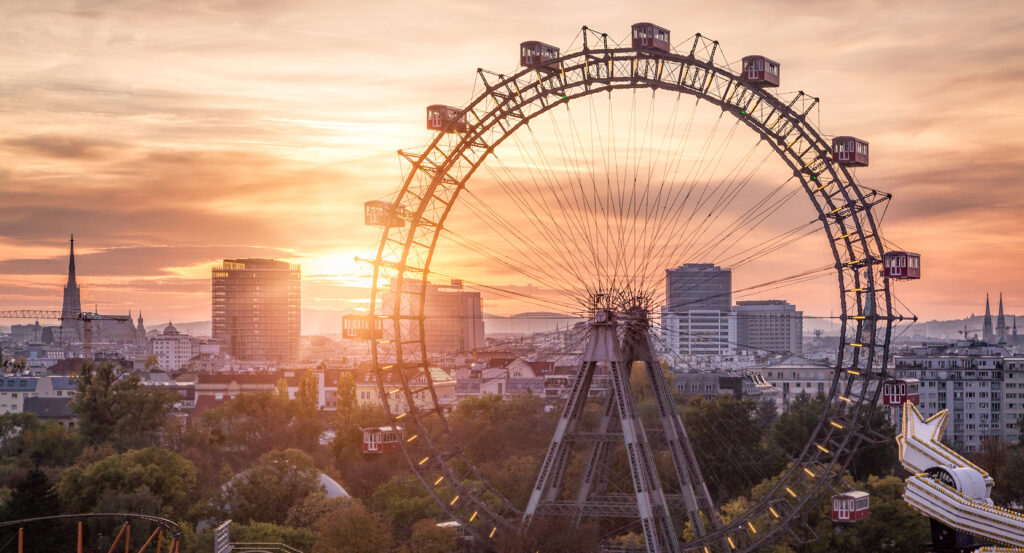
Prater is best known for its transformation from an imperial hunting reserve into a public park and for the development of Vienna's principal amusement district. The area's origins lie in the Danube floodplain, where river channels, wooded islands and meadows formed part of the landscape surrounding medieval Vienna. The Prater entered Habsburg possession during the sixteenth century and developed into a hunting ground reserved for the imperial household. Emperor Maximilian II strengthened its association with court recreation, and subsequent rulers maintained restrictions on public access. The construction of the Hauptallee during the seventeenth century established a formal route through the hunting grounds. In 1766, Joseph II opened the Prater to the public, permitting recreation within an estate previously associated with imperial privilege. The decision encouraged the establishment of refreshment businesses and entertainment facilities near the principal entrances. Inns, coffeehouses, performers and fairground operators gradually concentrated in the area that became the Wurstelprater. During the nineteenth century, Vienna's population growth increased demand for accessible recreational grounds beyond the densely built historic center. The Danube regulation works of the 1870s altered the surrounding river landscape and strengthened the area's relationship with expanding urban infrastructure. The Vienna World's Fair of 1873 occupied extensive grounds within the Prater, introducing exhibition buildings, transport improvements and international displays of industrial production. Although the fair encountered financial difficulties, its construction substantially changed the northern parkland. In 1897, the Wiener Riesenrad opened as part of celebrations associated with Emperor Franz Joseph I's fiftieth year on the throne. The Ferris wheel became a permanent feature of the amusement district and survived the destruction of much of the surrounding fairground during the Second World War. Postwar reconstruction restored entertainment facilities and reinforced the Prater's role in Vienna's public recreational life.
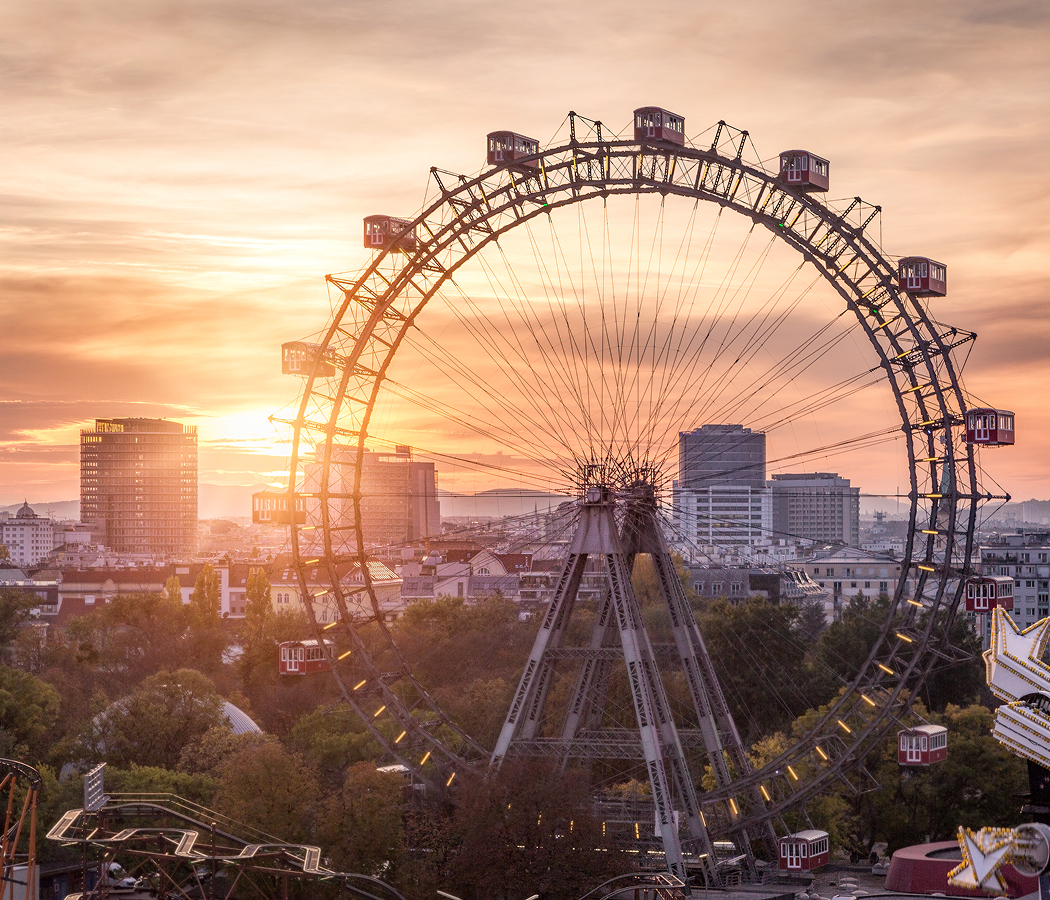
Walter Basset's engineering enterprise developed the Wiener Riesenrad as a steel observation wheel measuring 65 meters in height. British engineer Hubert Cecil Booth contributed to its design, and the structure originally carried thirty passenger cabins. Wartime damage destroyed the cabins and affected the wheel's mechanical equipment; reconstruction reduced the number of passenger carriages to fifteen. The surviving wheel operates through a system of steel spokes, supporting members and powered machinery that rotates the cabins above the amusement grounds. Its elevated position provides views across Leopoldstadt, the Danube corridor and Vienna's historic center. The surrounding Wurstelprater contains a concentration of amusement businesses operating on individual premises within the larger recreational district. Roller coasters, carousels, shooting galleries and mechanical rides continue the area's historical association with commercial entertainment. The Liliputbahn, introduced in 1928, carries passengers along a narrow-gauge railway through sections of the park. Its route connects the amusement district with wooded areas farther southeast, preserving a twentieth-century form of recreational transportation. The Schweizerhaus developed from the Prater's historic refreshment establishments into a restaurant associated with Viennese beer-garden dining. Its outdoor seating and kitchen service connect the amusement grounds with the city's tradition of seasonal public recreation. The Hauptallee provides a separate recreational setting through its long, level route beneath mature chestnut trees. Runners, cyclists and walkers use the avenue as a principal route through the landscaped grounds. The adjoining Prater meadows preserve open spaces associated with the Danube's former floodplain, including grassland and wooded areas. The park's distinct sections maintain the relationship between mechanical entertainment, public dining and the recreational use of a historic river landscape.
How Prater fits.
Prater works as the imperial recreation centerpiece for a Vienna outing connecting the city's nineteenth-century exhibition architecture, Danube engineering and the institutional development of Leopoldstadt.
Begin at the Rotunde site, the former location of the principal exhibition building constructed for the Vienna World's Fair of 1873. Designed under the direction of Scottish engineer John Scott Russell, the Rotunde incorporated an immense iron dome above a circular exhibition hall. Its diameter exceeded 100 meters, making it among the largest domed structures of its period. The building survived the fair and accommodated exhibitions and public events for decades before being destroyed by fire in 1937. The surrounding exhibition precinct subsequently underwent redevelopment, preserving the area's association with international trade fairs and public gatherings. Continue to the Donaukanal, the regulated waterway following the southern edge of Leopoldstadt. The channel originated as an arm of the Danube and became an important element of Vienna's river transportation and flood-management infrastructure. Nineteenth-century engineering projects reinforced its banks and improved navigation through the expanding city. Bridges connect Leopoldstadt with the historic center, establishing crossings associated with commercial transport and urban growth. The waterfront contains substantial retaining walls, pedestrian routes and buildings developed during successive phases of metropolitan expansion. Conclude at Augarten, the Baroque garden occupying a historic estate in northern Leopoldstadt. Emperor Charles VI commissioned its formal landscaping during the eighteenth century, introducing geometric avenues and garden arrangements associated with courtly recreation. The grounds opened to the public in 1775, becoming an important example of Vienna's expanding public garden culture. The Augarten Porcelain Manufactory occupies part of the estate, continuing a craft tradition associated with Viennese decorative arts. Two reinforced-concrete antiaircraft towers constructed during the Second World War remain within the grounds, preserving a later layer of the district's history. The progression moves from international exhibition architecture through Danube infrastructure and culminates at an imperial Baroque garden, connecting Prater with the recreational and urban development of Vienna.
Where your story begins.
Foresyte Travel reveals places that feel extraordinary long before you arrive.
Enjoy editorial crafted for luxury travelers.
Foresyte may earn a commission when you book.