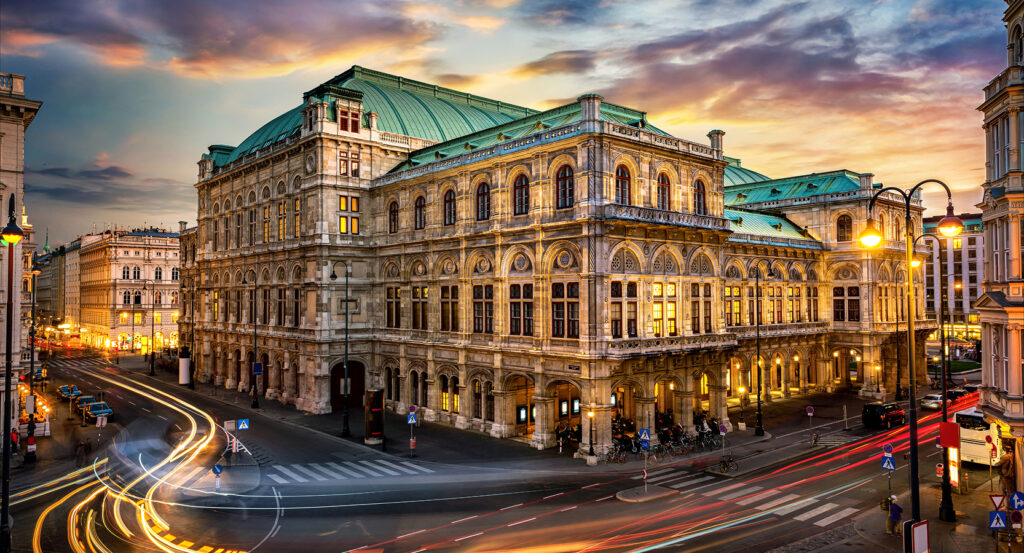
Why Vienna State Opera matters.
Vienna State Opera is a nineteenth-century Neo-Renaissance opera house where Innere Stadt's imperial performing-arts heritage meets the Habsburg monarchy's Ringstrasse expansion, Vienna's operatic institutions and the musical careers that established the city as a center of European opera.
Standing on Opernring at the southern edge of Vienna's historic center, the opera house occupies a prominent corner beside Kärntner Straße and Operngasse, where its arcaded façade faces the Ringstrasse boulevard and its auditorium extends into the adjoining urban block. The exterior combines limestone masonry, Renaissance-inspired arches and sculptural decoration. A recessed loggia distinguishes the principal façade above the entrance arcade. The building's western side connects with the landscaped approaches to the Ringstrasse. The result is a purpose-built opera house whose architectural arrangement preserves the ceremonial ambitions of nineteenth-century Vienna and the technical requirements of staged musical performance.
What defines Vienna State Opera.
Vienna State Opera is best known for its international operatic repertory, its association with major conductors and singers, and its position among the principal institutions of Viennese musical life. Its institutional origins lie in the Habsburg court opera, whose performances developed through the imperial theaters of Vienna. During the eighteenth century, court patronage supported Italian opera, German-language musical theater and the work of composers associated with the imperial capital. The nineteenth-century demolition of Vienna's fortifications created the opportunity to construct new cultural institutions along the Ringstrasse. Emperor Franz Joseph I authorized the development of a dedicated opera house as part of the boulevard's architectural program. Architects August Sicard von Sicardsburg and Eduard van der Nüll designed the building in a Neo-Renaissance style suited to the representational ambitions of the imperial court. Construction began in 1861, creating one of the earliest major public buildings on the Ringstrasse. The opera house opened on 25 May 1869 with Mozart's Don Giovanni, attended by Franz Joseph and Empress Elisabeth. Initially known as the Vienna Court Opera, the institution became associated with the development of European operatic performance and orchestral practice. Gustav Mahler served as director from 1897 to 1907, introducing reforms in musical preparation, stage production and ensemble discipline. His collaboration with stage designer Alfred Roller contributed to changes in theatrical lighting, scenic composition and the relationship between music and visual presentation. Following the collapse of the Habsburg monarchy in 1918, the institution adopted the name Vienna State Opera. During the twentieth century, conductors including Richard Strauss, Clemens Krauss and Karl Böhm shaped its artistic development. An Allied bombing raid in March 1945 destroyed substantial portions of the auditorium and stage facilities. Reconstruction preserved surviving sections of the historic building and introduced a redesigned auditorium and technical infrastructure. The opera house reopened on 5 November 1955 with Beethoven's Fidelio, conducted by Karl Böhm, marking a major cultural event in postwar Austria.
Gustav Mahler's reforms established a performance tradition centered on detailed musical preparation and close coordination between orchestra, singers and stage production. The Vienna State Opera Orchestra supplies the instrumental ensemble for the house's performances, drawing upon musicians whose professional activities also connect with the Vienna Philharmonic. The orchestra occupies a recessed pit between the stage and auditorium, supporting the balance between instrumental sound and unamplified operatic voices. The reconstructed auditorium contains a horseshoe-shaped seating arrangement with multiple tiers of boxes and galleries. Its red-and-gold decorative scheme preserves the ceremonial character associated with European opera-house interiors. The main stage incorporates extensive machinery for moving scenery, adjusting stage levels and coordinating complex productions. Rehearsal facilities support the preparation of a repertory that changes frequently across the performance season. The institution's programming includes operas by Mozart, Wagner, Verdi, Puccini and Richard Strauss alongside works from other periods. Mozart's Le nozze di Figaro and Die Zauberflöte occupy important positions within the German-language and Viennese operatic traditions. Wagner's large-scale music dramas place substantial demands on orchestral coordination, vocal endurance and scenic production. Verdi's operas connect the repertory with nineteenth-century Italian dramatic and musical conventions. The Vienna State Ballet also performs at the house, maintaining the institution's relationship with staged dance. The annual Vienna Opera Ball transforms the auditorium and stage into a ceremonial ballroom through the installation of a temporary floor over the seating area. The event preserves traditions of formal dancing and public ceremony associated with Viennese society. The building's performance spaces, orchestra and repertory maintain the relationship between musical interpretation, theatrical production and the institutional history of opera in Vienna.
How Vienna State Opera fits.
Vienna State Opera works as the performing-arts centerpiece for a Vienna outing connecting the Ringstrasse's cultural architecture with the city's musical collections and nineteenth-century concert institutions.
Begin at the Albertina, the former Habsburg residential palace occupying an elevated position above Albertinaplatz. Its origins are associated with the eighteenth-century residence of Duke Albert of Saxe-Teschen and Archduchess Maria Christina. The institution's graphic collection developed through Albert's extensive acquisition of drawings and prints, forming one of Europe's major collections of works on paper. Its holdings include drawings by Albrecht Dürer, whose Young Hare and Praying Hands occupy important positions within the history of European graphic art. The palace's ceremonial rooms preserve decorative features associated with Habsburg residential architecture. Continue to the House of Music, the museum devoted to Vienna's musical history and the scientific principles of sound. Occupying a building associated with Archduke Charles and the nineteenth-century musical establishment, the institution incorporates exhibitions devoted to composers, orchestral performance and acoustics. Its displays examine the development of sound through interactive installations and historical objects. The museum also explores the relationship between the Vienna Philharmonic and the city's orchestral institutions. Its exhibitions connect the musical careers of composers associated with Vienna to the performance traditions of the city's concert halls and theaters. Conclude at the Musikverein, the concert building constructed for the Gesellschaft der Musikfreunde in Wien and opened in 1870. Architect Theophil Hansen designed the building in a historicist style incorporating classical architectural references. Its principal auditorium, the Goldener Saal, is distinguished by gilded decoration, caryatid figures and proportions associated with its acoustic characteristics. The Vienna Philharmonic performs its annual New Year's Concert in the hall, maintaining an internationally recognized concert tradition. The building also accommodates chamber music and orchestral performances associated with Vienna's musical institutions. The progression moves from Habsburg art collecting through musical history and acoustics and culminates at the Musikverein's orchestral concert tradition, connecting Vienna State Opera with the city's principal cultural institutions.
Where your story begins.
Foresyte Travel reveals places that feel extraordinary long before you arrive.
Enjoy editorial crafted for luxury travelers.
Foresyte may earn a commission when you book.