Why St. Stephen's Cathedral matters.
St. Stephen's Cathedral is a medieval Gothic cathedral where Innere Stadt's Habsburg heritage meets the ecclesiastical ambitions of the Babenberg dynasty, the architectural patronage of Austria's rulers and the religious institutions that shaped Vienna's development into an imperial capital.
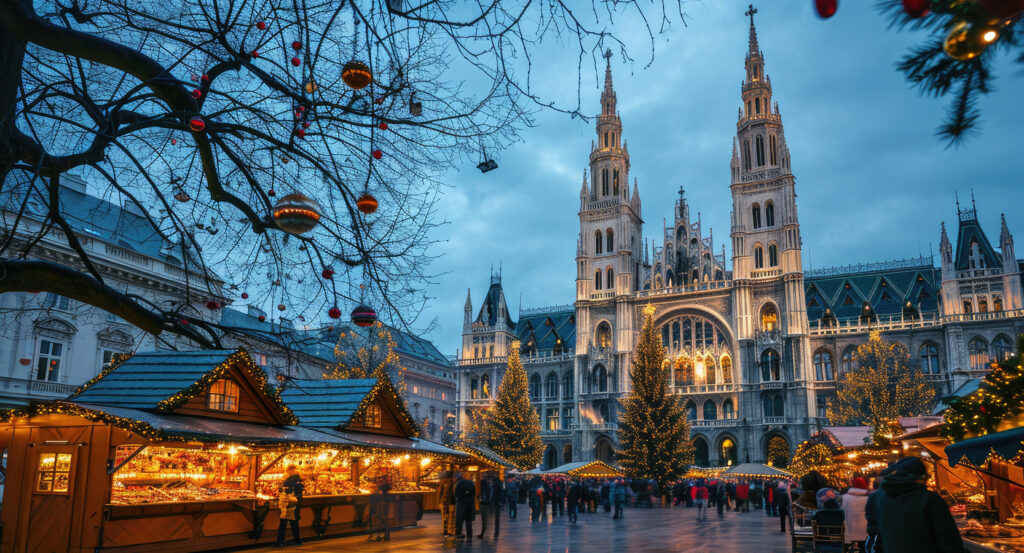
Standing on Stephansplatz at the center of Vienna's historic street network, the cathedral occupies the site of a twelfth-century parish church between the Graben and Rotenturmstraße, where its limestone walls, steeply pitched tiled roof and southern spire rise above the surrounding commercial buildings. The exterior incorporates pointed windows, carved portals and substantial buttresses developed through successive medieval construction campaigns. A patterned roof of glazed ceramic tiles carries heraldic designs associated with Austria and Vienna. Four towers distinguish the building's silhouette, including the completed southern spire and the shorter northern tower. The result is a cathedral whose surviving architecture preserves the transition from Romanesque parish church to the principal ecclesiastical institution of Habsburg Vienna.
What defines St. Stephen's Cathedral.
St. Stephen's Cathedral is best known for its Gothic architecture, 136-meter southern tower and historical association with the Habsburg dynasty and the Archdiocese of Vienna. Its origins extend to the twelfth century, when the Babenberg rulers supported the construction of a substantial parish church outside the earliest fortified settlement. The Romanesque church was consecrated in 1147, establishing a religious foundation dedicated to Saint Stephen. During the thirteenth century, the building underwent substantial reconstruction, producing architectural elements that survive in the western façade. The Riesentor, or Giant's Door, developed as the principal Romanesque entrance, incorporating carved stone ornament and a recessed portal. The adjoining Heidentürme preserve the western towers associated with this early architectural phase. During the fourteenth century, Duke Albert II supported the construction of a larger Gothic choir, expanding the church's capacity for religious ceremonies. The Albertine Choir was consecrated in 1340, establishing a substantial eastern section incorporating high vaults and pointed windows. Duke Rudolf IV initiated further expansion in 1359, commissioning the construction of a new Gothic nave and the foundations of the southern tower. Rudolf's architectural patronage formed part of his broader efforts to strengthen Vienna's political and ecclesiastical standing within the Habsburg territories. Construction of the southern tower continued through successive generations and reached completion in 1433. The cathedral became the seat of the newly established Diocese of Vienna in 1469, following papal authorization under Emperor Frederick III. During the sixteenth century, the building acquired additional liturgical furnishings and funerary monuments associated with the Habsburg court. The diocese was elevated to an archdiocese in 1722, strengthening the cathedral's institutional position within Austrian Catholicism. A major fire in April 1945 destroyed the medieval timber roof structure and caused extensive damage to the interior. Reconstruction restored the building's principal architectural features, and the cathedral reopened for worship in 1952.
Anton Pilgram's sculptural and architectural contributions distinguish the cathedral's late Gothic interior through elaborate stone carving and complex structural ornament. The pulpit, traditionally associated with Pilgram, incorporates a projecting stone structure supported by carved figures and decorated with portraits of the four Doctors of the Western Church. Its intricate tracery and sculptural details preserve the craftsmanship of late medieval Viennese workshops. The Pilgram organ loft contains a carved self-portrait associated with the architect, positioned beneath the supporting stonework. The high altar, completed during the seventeenth century, introduces a Baroque composition incorporating marble columns and a substantial painted representation of the martyrdom of Saint Stephen. Tobias Pock contributed to its decorative program, connecting the cathedral's medieval architecture with the artistic patronage of Counter-Reformation Vienna. The Wiener Neustädter Altar preserves a fifteenth-century winged altarpiece incorporating painted panels and gilded sculpture associated with late Gothic religious art. The tomb of Emperor Frederick III occupies the southern choir, distinguished by a substantial red marble sarcophagus and an elaborate sculptural program. Niclas Gerhaert van Leyden developed the monument's principal design, and construction continued through the work of subsequent sculptors. The cathedral's catacombs contain burial chambers associated with Vienna's ecclesiastical institutions and members of the Habsburg dynasty. The Ducal Crypt preserves remains of Austrian rulers and relatives connected with the medieval ducal household. The Pummerin bell, cast in 1951 from metal associated with its predecessor, hangs within the northern tower and serves important ceremonial functions. Its predecessor was cast in 1711 using bronze from Ottoman artillery captured during the siege of Vienna in 1683. The cathedral's towers, chapels and funerary spaces preserve the relationship between religious worship, dynastic commemoration and the artistic traditions of Vienna's medieval and early modern periods.
How St. Stephen's Cathedral fits.
St. Stephen's Cathedral works as the medieval ecclesiastical centerpiece for a Vienna outing connecting the city's early religious institutions, Habsburg court patronage and surviving architectural fabric of the historic center.
Begin at Peterskirche, the Baroque church occupying a compact square near the Graben. Its religious origins are associated with Vienna's medieval parish network, although the surviving building developed through an eighteenth-century reconstruction. Construction began in 1701, and the church's architectural program incorporated contributions associated with Johann Lukas von Hildebrandt. Its oval interior contains a substantial dome decorated with frescoes by Johann Michael Rottmayr. Gilded altars, sculptural ornament and painted architectural surfaces preserve the decorative traditions of Austrian Baroque Catholicism. The church's position within the surrounding streets connects its religious functions with the commercial development of Central Vienna. Continue to the Hofburg Imperial Palace, the former principal residence of the Habsburg rulers and the administrative center of the Austrian monarchy. Its architectural development began during the thirteenth century and continued through successive imperial reigns. The complex incorporates Gothic, Renaissance, Baroque and nineteenth-century additions organized around courtyards and ceremonial entrances. The Imperial Apartments preserve residential interiors associated with Emperor Franz Joseph I and Empress Elisabeth. The palace also contains the Imperial Treasury, whose collections include the Austrian Imperial Crown and objects associated with the Holy Roman Empire. Conclude at Michaelerkirche, the historic parish church standing beside the northeastern entrance to the Hofburg. Its origins extend to the thirteenth century, and its surviving structure incorporates Romanesque, Gothic and Baroque architectural elements. The western façade was remodeled during the eighteenth century, introducing classical ornament to the medieval building. Its interior contains funerary monuments, religious sculpture and chapels associated with Vienna's aristocratic families. The church's crypt preserves burial chambers and coffins connected with the city's early modern population. The progression moves from Baroque parish architecture through Habsburg imperial residence and culminates at a medieval church associated with the court precinct, connecting St. Stephen's Cathedral with the religious and dynastic institutions of historic Vienna.
Where your story begins.
Foresyte Travel reveals places that feel extraordinary long before you arrive.
Enjoy editorial crafted for luxury travelers.
Foresyte may earn a commission when you book.