
Why Runyon Canyon Park matters.
Runyon Canyon Park is a rugged urban preserve where Hollywood Hills' steep residential character meets chaparral slopes, ridgeline trails and expansive views across the Los Angeles basin.
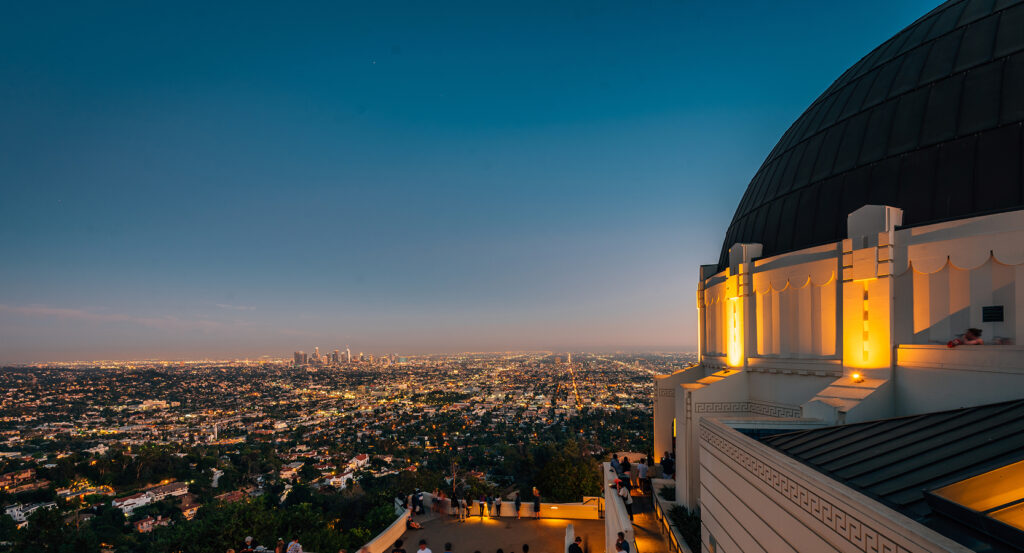
Set above North Fuller Avenue near Franklin Avenue and extending north toward Mulholland Drive, the park occupies a deep canyon and surrounding ridges at the eastern end of the Santa Monica Mountains. Dirt roads and narrower trails climb rapidly through exposed hillsides, native vegetation and eroded folds in terrain, creating pronounced changes in elevation across a relatively compact 160-acre landscape. Ascending the canyon drives the encounter as routes divide between gentler interior grades and steeper ridge approaches before reaching elevated ground overlooking Hollywood. Open slopes and successive overlooks deepen that spatial sequence, shifting the field of view from nearby hillside neighborhoods toward Downtown, the San Gabriel Mountains and the broader metropolitan basin. The result is an urban preserve whose steep topography places substantial mountain terrain directly against Hollywood, compressing canyon, ridge and metropolis into a landscape traversed almost entirely on foot.
What defines Runyon Canyon Park.
Runyon Canyon Park is best known for preserving 160 acres of Santa Monica Mountains terrain after a succession of private owners gave the canyon associations with nineteenth-century Los Angeles, Hollywood filmmaking and early celebrity estates. Greek-born George Caralambo received a 160-acre federal patent in 1867 following his service with the United States Army Camel Corps, and his property entered Los Angeles lore when Tiburcio Vásquez was captured at Caralambo's home in 1874. Civil engineer and Los Angeles Athletic Club co-founder Alfredo Solano subsequently acquired the canyon, holding it until his widow Ella Brooks Solano sold most of the property to Carman Runyon in 1919. Runyon and his wife Ellen Hunt used the land for riding and hunting and built a bungalow near the present Fuller Avenue entrance, attaching the family name permanently to the canyon. Irish tenor John McCormack purchased the estate in 1930 after working there during production of Song o' My Heart, using his earnings from the film to acquire the property and construct a mansion called San Patrizio. McCormack remained until 1938, after which the canyon passed through another sequence of owners and development proposals as the open hillside became increasingly exceptional within urbanizing Hollywood. The park's modern history rests on ground that moved from federal patent to private estate and filmmaking location before becoming contested open space within one of Los Angeles' densest central districts.
The decisive preservation campaign unfolded after decades of proposals threatened to replace the canyon's open slopes with private development. Neighborhood opposition intensified during the late 1970s and early 1980s, with residents of adjoining Outpost Estates organizing against construction in the canyon and pressing for permanent protection of the hillside. Los Angeles created the Runyon Canyon Acquisition Trust Fund by ordinance in 1982, establishing a dedicated financial vehicle through which public and donated money supported acquisition. When Adad Development placed the property on the market in 1984, the Santa Monica Mountains Conservancy raised $4 million and the City of Los Angeles contributed another $1.6 million toward the purchase. Public ownership converted land subjected to two decades of development conflict into a city park protected in perpetuity, and a master plan developed with neighborhood and activist participation subsequently directed that the canyon retain its urban-wilderness character. Preservation continued beyond the original acquisition as adjoining parcels remained vulnerable to construction. The Trust for Public Land acquired another 14.9 acres for $8.75 million in 2017 on behalf of Los Angeles and the Mountains Recreation and Conservation Authority, preventing proposed houses from interrupting established trails and extending the protected open-space network. Runyon Canyon represents an incremental conservation project in which municipal finance, state involvement, neighborhood organizing and later land acquisition preserved a substantial mountain landscape inside Central Los Angeles.
How Runyon Canyon Park fits.
Runyon Canyon Park works as the anchor for a daytime sequence through the Hollywood Hills, tracing how estate architecture, experimental domestic design and postwar steel construction transformed steep terrain into three radically different visions of Los Angeles hillside living.
Begin at Wattles Mansion and Gardens, where Omaha banker Gurdon Wattles purchased Hollywood acreage in 1905 and commissioned Myron Hunt and Elmer Grey to create the winter estate known as Jualita. Completed in 1907, the two-story residence combined stucco walls, a low-pitched tile roof, projecting timber and large arches with a terraced landscape positioned between Hollywood Boulevard and the foothills. Wattles developed the surrounding property through gardens inspired by travel in Japan and Mexico, including Japanese, Italian rose and formal Spanish gardens, a palm court and orchards; the elevated site simultaneously opened southward toward Los Angeles and westward toward the Pacific. The city acquired the property in 1968, preserving a rare intact estate from Hollywood's pre-film period before municipal designation followed in 1993. Continue to Samuel Freeman House, commissioned by Samuel and Harriet Freeman after encountering Frank Lloyd Wright's architecture at Hollyhock House and completed in 1924 on an exceptionally steep site. Wright's $10,000 commission ultimately cost $23,000 and used 12,000 cast concrete textile blocks, with the house presenting a single level toward Glencoe Way before dropping another two stories down the hillside. Large windows, balconies and terraces expanded the compact interior toward the surrounding terrain, and the Freemans subsequently turned the residence into an artistic and political salon sustained for decades. Their 1986 donation transferred the house to the University of Southern California School of Architecture after 61 years of residence, preserving one of Wright's four Los Angeles textile-block houses within the educational institution responsible for its continuing restoration. Conclude at Stahl House, where Buck and Carlotta Stahl worked with Pierre Koenig on a precarious promontory that other architects had rejected, producing Case Study House #22 in 1960. John Entenza's Arts & Architecture Case Study House program had begun in 1945 to investigate replicable postwar housing through modern industrial construction, and Koenig answered that premise with an L-shaped steel-and-glass residence whose cantilevered living area projects above the hillside. The steel frame rose in a single day, and commercially available plate glass opened the house toward a 270-degree panorama stretching across Los Angeles. Julius Shulman's 1960 nighttime photograph of two women seated inside the illuminated glass room transformed the modest family residence into one of the defining images of Southern California Modernism, making architecture, hillside and metropolitan light inseparable in the public imagination. The progression moves from Hunt and Grey's terraced retreat for a Midwestern banker through Wright's concrete-block experiment descending a difficult slope into Koenig's steel-and-glass pavilion suspended above the city, tracing half a century in which Hollywood Hills architecture increasingly treated extreme topography as a source of architectural invention.
Where your story begins.
Foresyte Travel reveals places that feel extraordinary long before you arrive.
Enjoy editorial crafted for luxury travelers.
Foresyte may earn a commission when you book.





































































































