
Why Mulholland Drive matters.
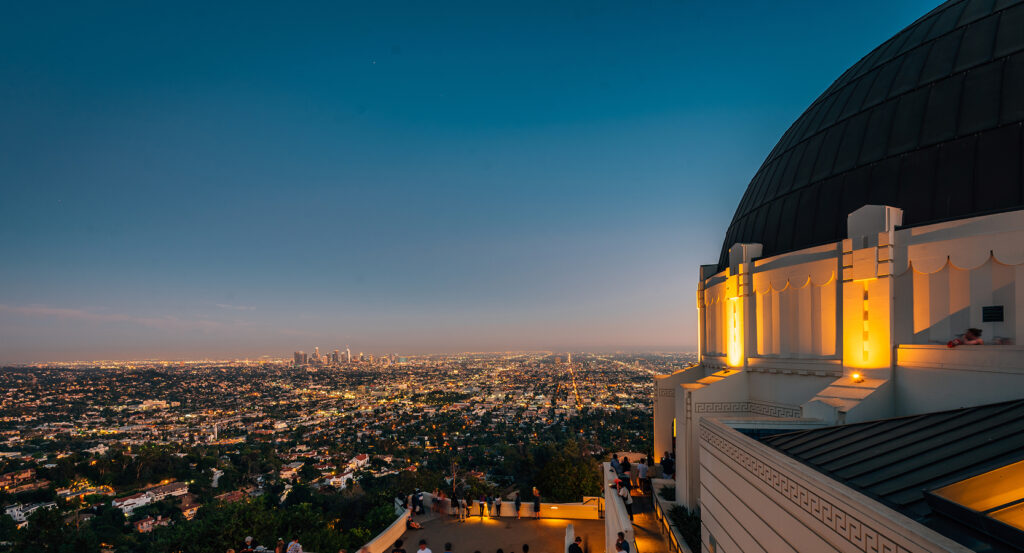
Mulholland Drive is a storied corridor where the Hollywood Hills' cinematic character meets Santa Monica Mountains topography, early automobile-era engineering and a ridgeline route conceived to reveal Los Angeles from above.
Running through the Hollywood Hills between Cahuenga Pass and the western Santa Monica Mountains, the mountain corridor follows the crest through a succession of bends above Hollywood, Studio City, Sherman Oaks, Bel Air and Encino before its paved roadway gives way to an unpaved western section. Steep slopes fall toward the Los Angeles Basin on one side and the San Fernando Valley on the other, allowing the orientation of the road to shift repeatedly between mountain walls, canyon openings and long metropolitan views. Traveling west carries the roadway through Laurel Canyon, Coldwater Canyon, Beverly Glen and Sepulveda Pass, with tight curves and short straight sections tracking the irregular contours of the range. Eight miles west of Interstate 405 remain unpaved, preserving a dramatic physical break between the engineered eastern road and the less altered ridgeline approaching Woodland Hills. The result is a corridor whose winding alignment, steep canyon edges, alternating basin views and sustained relationship with the mountain crest turn the Santa Monica Mountains into the organizing geography of Central Los Angeles.
What defines Mulholland Drive.
Mulholland Drive is best known for converting the crest of the Santa Monica Mountains into one of Los Angeles's defining automobile routes during the explosive metropolitan expansion of the 1920s. William Mulholland conceived a scenic road along the range as early as 1913, linking his vision of metropolitan growth with public access to the mountains above the city. Planning resumed in 1921 under the working name Skyline Drive, with engineer DeWitt Reaburn directing a project originally envisioned around a 200-foot right of way. Construction began in 1923 and advanced simultaneously from several points, confronting steep slopes and irregular mountain terrain as crews carved the road across the ridge. William Mulholland, Moses Sherman, Los Angeles Times publisher Harry Chandler, Harvey Van Norman and Board of Public Works commissioner Arthur Eldridge were among the civic and business figures associated with the undertaking. The route opened as Mulholland Highway on December 27, 1924, extending 24 miles from Cahuenga Pass to Calabasas; opening-day celebrations included an air circus, rodeo, parade, dance and a program at the Hollywood Bowl. Mulholland christened the road with Los Angeles Aqueduct water, linking the dedication ceremonially to the engineering project that had made his name synonymous with the city's expansion. The eastern portion received the Mulholland Drive name in 1939, completing the transition from a mountain highway conceived during the automobile boom into the ridgeline street associated with the Hollywood Hills.
Public preservation reshaped the road's meaning during the closing decades of the twentieth century as development pressure intensified across the Santa Monica Mountains. Federal planning for the Santa Monica Mountains National Recreation Area envisioned the Mulholland corridor as a unifying route between parklands, with scenic overlooks, trail access points and protected views incorporated into the larger recreation system. Los Angeles completed environmental review for a scenic parkway plan in 1985, seeking a low-volume mountain road accompanied by recreational facilities. The city adopted the Mulholland Scenic Parkway Specific Plan in 1992 after concern grew over the loss of mountain views and open terrain to development. Public agencies expanded the roadside system in parallel: Universal City Overlook and the overlook above the Hollywood Bowl were built in 1984 for the Los Angeles Summer Olympics, Stone Canyon Overlook followed in 1994 and another overlook above Studio City was completed in 1996. Conservation acquisitions also protected substantial adjoining mountain acreage, including 31 acres in Benedict Canyon in 1993 and 60 acres near Coldwater Canyon the following year. The road that had opened the ridgeline to metropolitan expansion became a principal axis for protecting the same mountain scenery that its original builders had sought to make publicly accessible.
How Mulholland Drive fits.
Mulholland Drive works as the anchor for an outing connecting an environmental organization occupying a former mountain fire station, an outdoor theater born from a religious pageant and a natural amphitheater that became the summer home of the Los Angeles Philharmonic.
Begin at Coldwater Canyon Park, where the Los Angeles Fire Department operated Mountain Patrol Station 1 during the 1920s and crews cut trails and fire roads across hills then patrolled on horseback. A surviving tower beside the nursery once held fire hoses for drying, preserving a physical remnant of the property's original purpose. Andy Lipkis entered the story after learning as a fifteen-year-old camp counselor in 1970 that air pollution was damaging Southern California forests; the California Conservation Project followed in 1973 and prepared 10,000 trees for planting around Arbor Day in 1974. Los Angeles permitted the organization to establish a nursery at the mountain station, and TreePeople took over the grounds in 1977 when 45 acres became Coldwater Canyon Park. Continue to The Ford, whose origin reaches to Christine Wetherill Stevenson, the Pittsburgh Paint Company heiress who helped purchase 60 acres at Daisy Dell before leaving that venture and acquiring 29 acres across Cahuenga Pass for her Pilgrimage Play. Bernard Maybeck designed the original wooden amphitheater in 1920 around the canyon landscape, and Stevenson wrote, directed, designed costumes for and acted in the production. Fire destroyed the wooden theater in 1929; architect William Lee Woollett designed its concrete replacement with forms inspired by ancient Judaic architecture, and the new building opened in 1931. Los Angeles County received the property in 1941, and the venue received John Anson Ford's name in 1976 after the former county supervisor's long support for the arts. Conclude at Hollywood Bowl, where the Theatre Arts Alliance purchased 59 acres for $47,500 in 1919 and the Los Angeles Philharmonic first performed on March 27, 1921 during an Easter sunrise service attended by more than 800 people. The orchestra began its first official summer season there in 1922, initiating a relationship that has continued for more than a century. Successive shells became architectural experiments: Allied Architects produced the 1926 version, Lloyd Wright designed a pyramidal shell in 1927 and a nine-panel wooden design in 1928, then Allied Architects returned with a $50,000 semicircular Transite shell in 1929 that remained for 74 years. Frank Gehry modified that structure in 1970 with acoustic tubes, extending a sequence in which architecture repeatedly altered the performance environment inside the natural bowl. The progression moves from a mountain fire station converted into a center for urban forestry through Stevenson's canyon theater and culminates in an amphitheater where successive architectural experiments accompanied the rise of Los Angeles as a major center for orchestral and popular performance.
Where your story begins.
Foresyte Travel reveals places that feel extraordinary long before you arrive.
Enjoy editorial crafted for luxury travelers.
Foresyte may earn a commission when you book.





































































































