
Why Hollywood Bowl matters.
Hollywood Bowl is a storied open-air amphitheater where the Hollywood Hills' canyon landscape meets orchestral performance, sweeping terraced seating and a concentric white shell recognized across Los Angeles.
Set along Highland Avenue near Cahuenga Boulevard and just below the ridges of the Santa Monica Mountains, the amphitheater occupies Bolton Canyon, the natural depression historically called Daisy Dell, within an 88-acre Los Angeles County park. Myron Hunt reshaped three acres of hillside in 1926 for a balloon-shaped auditorium of curving seating sections, arcing concrete stairways and cross-cutting promenades, with the underlying steel structure remaining substantially rooted in his original construction. The steeply ascending house concentrates thousands of seats toward a stage backed by the canyon wall, preserving the topographic enclosure that preceded permanent construction. Fourteen picnic areas spread through the larger grounds, carrying the public realm beyond the auditorium into wooded slopes that remain undeveloped across nearly half of the property. The result is an amphitheater in which Hunt's terraced geometry, steep canyon walls, extensive parkland and focused stage axis bind large-scale performance architecture directly to the Hollywood Hills.
What defines Hollywood Bowl.
Hollywood Bowl is best known for developing from an undeveloped canyon into the Los Angeles Philharmonic's summer home through an unusually civic campaign for outdoor music. The Theatre Arts Alliance acquired 59 acres in 1919 before reorganizing as the Community Park and Art Association, with secretary Artie Mason Carter becoming the central organizer, fundraiser and advocate for symphonic concerts at the site. Carter persuaded Los Angeles Philharmonic founder William Andrews Clark Jr. to provide the orchestra for an Easter Sunrise Service on March 27, 1921, drawing between 5,000 and 10,000 people into the canyon by candlelight after Pacific Electric streetcars began carrying attendees toward Hollywood before dawn. Alfred Hertz conducted the Los Angeles Philharmonic on July 11, 1922 for the first season of Symphonies Under the Stars, with tickets priced at 25 cents and simple wooden benches lining the slopes. The founders transferred the property to Los Angeles County in 1924, beginning a public partnership with the orchestra that reached its centennial in 2024. Architectural experimentation accelerated soon afterward: Allied Architects produced a semi-elliptical shell in 1926, Lloyd Wright followed with a pyramidal design in 1927, and Wright's successful 1928 version used nine adjustable wooden panels that workers assembled and dismantled in a single day. Allied Architects replaced it in 1929 with a $50,000 semicircular Transite shell intended as a temporary structure, yet that version remained for 74 years and supplied the Bowl's familiar twentieth-century silhouette. Los Angeles County designated the Hollywood Bowl Performance Arts Center County Cultural Landmark No. 1 in 2000, recognizing a public institution whose physical development had become inseparable from nearly eight decades of Los Angeles music history.
The 2004 reconstruction opened another architectural chapter by replacing the long-lived 1929 shell after decades of attempts to improve stage acoustics. Hodgetts + Fung developed the concept, Gruen Associates acted as executive architect, Jaffe Holden Acoustics handled acoustic design and Fisher Dachs Associates directed theater planning and lighting. The $25 million project encompassed 28,500 square feet and was completed between the end of the 2003 season and June 2004, an exceptionally compressed construction interval dictated by the summer calendar. A 124-foot prefabricated shell was craned into place, expanding the performance area by 30 percent so the full Los Angeles Philharmonic fit beneath its enclosure. Fisher Dachs incorporated a 50-foot turntable and capacity for as many as 200 lighting fixtures, permitting large productions and rapid changes between acts. The suspended acoustic halo uses adjustable fiberglass and aluminum elements to return sound toward musicians and carries theatrical lighting above the orchestra. Frank Gehry had pursued an earlier acoustic intervention in 1970 through Sonotubes and later suspended fiberglass spheres beneath the previous shell, making the 2004 reconstruction the latest phase in a design problem explored by several generations of architects and acousticians. The present shell preserves the concentric visual profile associated with its predecessor yet integrates substantially greater stage capacity, acoustic control, production infrastructure and technical flexibility into the Bowl's century-old canyon auditorium.
How Hollywood Bowl fits.
Hollywood Bowl works as the anchor for a Hollywood outing connecting outdoor theater, the origins of the motion-picture industry and Los Angeles astronomy.
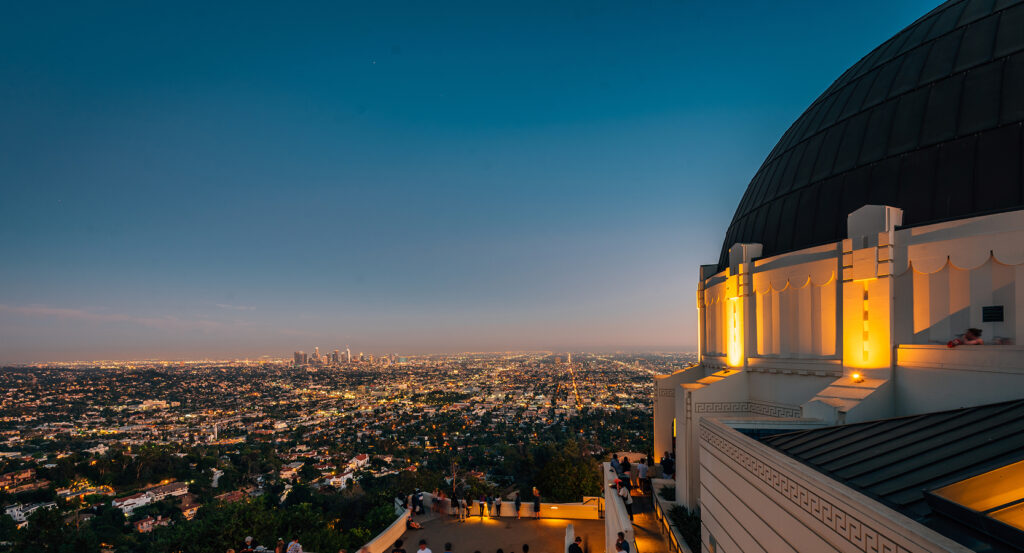
Begin at The Ford, whose history diverged from the Bowl's earliest development after arts patron Christine Wetherill Stevenson pursued a dedicated setting for her Pilgrimage Play. Stevenson acquired 29 acres across Cahuenga Pass, and architect Bernard Maybeck designed the original wooden amphitheater in 1920 with the surrounding landscape governing the composition. A 1929 brush fire destroyed that structure; architect William Lee Woollett designed its concrete successor with forms derived from ancient Judaic architecture, and the rebuilt theater opened in 1931. The property passed to Los Angeles County in 1941, and the venue received the John Anson Ford name in 1976, honoring the county supervisor whose arts advocacy shaped Los Angeles cultural institutions. Continue to Hollywood Heritage Museum, housed inside the 1901 Lasky-DeMille Barn, the oldest surviving motion-picture production building in Hollywood. Burns & Revier used the structure as a studio beginning in 1912 before the Jesse L. Lasky Feature Play Company occupied it in 1913; Lasky's company merged with Adolph Zukor's Famous Players in 1916, contributing directly to the corporate lineage of Paramount Pictures. Hollywood Heritage rescued and restored the barn after forming in 1980, opened the museum in 1985 and preserved Cecil B. DeMille's association through a recreated office containing furnishings from Paramount and personal objects tied to the director. Conclude at Griffith Observatory, where architect John C. Austin and astronomer Russell W. Porter developed a public astronomy institution funded through Griffith J. Griffith's bequest and opened in 1935 on the southern slope of Mount Hollywood. Its three copper-clad domes crown an Art Deco building centered on astronomical observation and public science, with the Zeiss refracting telescope in the eastern dome giving generations of Angelenos direct access to the night sky. The progression moves from Stevenson and Maybeck's early experiment in canyon theater through the Lasky-DeMille Barn's foundational role in Hollywood filmmaking and culminates with Griffith's civic investment in public astronomy, joining three distinct cultural ambitions that reshaped the hills above Hollywood.
Where your story begins.
Foresyte Travel reveals places that feel extraordinary long before you arrive.
Enjoy editorial crafted for luxury travelers.
Foresyte may earn a commission when you book.





































































































