
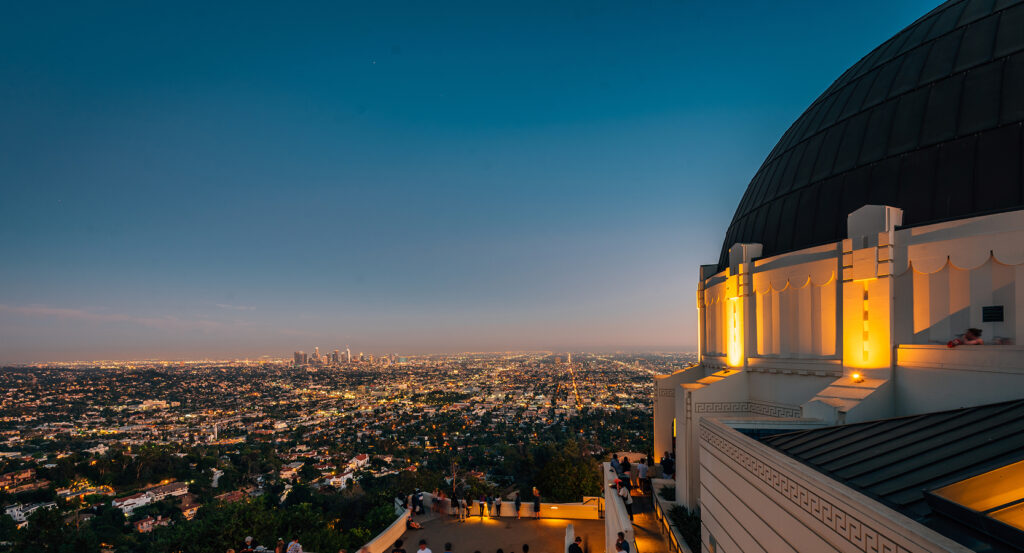
Why Highland Avenue matters.
Highland Avenue is a storied corridor where Hollywood's entertainment character meets early foothill settlement, a historic gateway to Cahuenga Pass and an urban axis extending from the Santa Monica Mountains into the residential plain of Central Los Angeles.
Running through Hollywood between Hollywood Hills and Hancock Park, the southbound corridor follows the eastern base of the Santa Monica Mountains from Cahuenga Boulevard across Franklin Avenue, Hollywood Boulevard, Sunset Boulevard, Santa Monica Boulevard, Melrose Avenue, Beverly Boulevard and 3rd Street before reaching Wilshire Boulevard and continuing into Mid-City. At its northern approach, Highland emerges from the constricted terrain below Cahuenga Pass, where steep slopes and curving streets compress the roadway before it descends into Hollywood's regular street grid. Between Franklin and Sunset, the avenue assumes a denser metropolitan scale as apartment buildings, hotels, entertainment properties and commercial structures rise close to a roadway carrying the visual weight of the hills directly behind it. South of Melrose, that intensity recedes into long residential blocks where mature palms, landscaped medians and lower buildings stretch across the flatter basin toward Wilshire, creating a striking physical contrast with the mountain threshold only a few miles north. The result is a corridor whose changing topography, building scale, vegetation and transition from mountain pass to metropolitan plain compress several distinct geographies of Central Los Angeles into a single north-south line.
What defines Highland Avenue.
Highland Avenue is best known for carrying the name of Highland Mary Price, an Illinois-born woman whose family settled in Hollywood before the district became a center of the entertainment industry. Highland Mosby married Missouri-born blacksmith Thomas Walter Price in 1887, and the couple moved to Hollywood the following year, joining a community still dominated by farms, orchards and scattered houses. They lived along the road that subsequently received her name and adopted a daughter, Myrtle Francis. Highland Price died from a brain tumor on April 10, 1901 at age 35. Four days before her death, neighboring landowner Mary Moll had requested that the county name the street for Price in exchange for allowing the roadway to cross Moll's strawberry farm. The route subsequently became one of early Hollywood's principal north-south streets, extending toward the natural opening through the Santa Monica Mountains at Cahuenga Pass. That geography gave Highland importance far beyond the agricultural properties through which it initially passed as movement increased between Hollywood and the San Fernando Valley. Hollywood incorporated as an independent municipality in 1903, consolidated with Los Angeles in 1910 and entered a period of explosive growth as motion-picture production concentrated nearby. By the 1920s, the former farm road named for a blacksmith's young wife had become a major metropolitan artery running directly through the expanding entertainment district.
The intersection with Hollywood Boulevard developed through a separate sequence that transformed Highland into one of the district's most consequential crossroads. The Hollywood Hotel opened at the northwest corner on December 19, 1902, when its eastern frontage faced Prospect Avenue and much of the surrounding community remained lightly developed. Developer Myron Hunt expanded the property after Almira Parker Hershey acquired it, and the hotel became closely associated with the actors, producers and financiers gathering in Hollywood during the motion-picture industry's early ascent. Prospect Avenue received the Hollywood Boulevard name in 1910, fixing the intersection at the center of a district whose commercial ambitions accelerated dramatically during the following two decades. Meyer & Holler completed the 13-story First National Bank Building on the northeast corner in 1928, using Gothic-derived vertical ornament to give Hollywood's growing financial sector one of its earliest high-rise statements. The original hotel survived until 1956, when demolition erased the sprawling property that had occupied the northwest corner for more than half a century. Farther south, another enduring element appeared in 1928 when queen palms and Mexican fan palms were planted in Highland's median between Melrose Avenue and Wilshire Boulevard. The palms extended the avenue's metropolitan design far beyond the entertainment center and created a formal landscaped procession through Hancock Park, where their repeated vertical forms remain among the corridor's most distinctive physical features.
How Highland Avenue fits.
Highland Avenue works as the anchor for an outing connecting early film-industry housing, an immense storage tower created during Hollywood's production boom and an Egyptian Revival clubhouse built by veterans from the entertainment business.
Begin at Highland-Camrose Bungalow Village, a hillside cluster developed between 1916 and 1923 near Highland and Camrose avenues. Taylor Brothers and Lee Campbell designed the Craftsman residences as modest housing during the period when Hollywood's rapidly expanding film industry was drawing workers into neighborhoods surrounding the studios. Small wood-frame bungalows occupy irregular hillside ground connected by stairs, walkways, stone walls and landscaping, producing a compact residential composition markedly different from the larger apartment buildings that subsequently filled Central Hollywood. Fifteen bungalows survived when a proposed 220-unit development threatened the property during the 1980s, prompting an intense preservation campaign. Municipal cultural recognition followed in 1985, and the Highland-Camrose complex entered the National Register of Historic Places in 1989. Several buildings were subsequently adapted as offices associated with the neighboring performing-arts community, preserving a rare concentration of early working-class Hollywood housing. Continue to Hollywood Storage Company Building, completed in 1925 at 1025 North Highland Avenue for developer Charles E. Toberman. Morgan, Walls & Clements designed the 14-story reinforced-concrete tower, giving a utilitarian storage operation the scale and architectural ambition of a Hollywood high-rise. The building cost $750,000 and opened in June 1926 as the tallest structure in Hollywood, its height making it a conspicuous marker above a district still dominated by low commercial buildings. Its fire-resistant concrete construction protected stored property that included costumes and film-production equipment, tying the warehouse directly to the expanding entertainment economy surrounding it. Radio station KMTR later exploited the tower's height for broadcasting equipment, adding another entertainment technology to the building's history. Bekins acquired the property in 1939, extending its storage use across subsequent decades. Conclude at American Legion Post 43, whose Hollywood chapter grew from World War I veterans connected with the motion-picture industry. Cecil B. DeMille, Walter Long and Adolph Menjou belonged to the early membership, and the organization developed into one of the American Legion's most prominent entertainment-industry posts. Architects Eugene and Joseph Weston designed its 1929 Highland Avenue clubhouse in an Egyptian Revival mode, giving the three-story, 30,000-square-foot building a grand entrance enriched with military emblems and exoticized ornament. The clubhouse opened on July 4, 1929 and incorporated a substantial theater alongside meeting and social spaces. Membership later included Gene Autry, Humphrey Bogart, Clark Gable, Mickey Rooney and numerous other entertainment figures, with Hollywood veterans participating in film work connected to the armed forces during World War II. The progression moves from Craftsman housing created during Hollywood's formative production years through Toberman's towering repository for a growing film economy and culminates in a veterans' clubhouse built by figures inside that industry, connecting domestic life, production infrastructure and entertainment-community institution building along Highland Avenue.
Where your story begins.
Foresyte Travel reveals places that feel extraordinary long before you arrive.
Enjoy editorial crafted for luxury travelers.
Foresyte may earn a commission when you book.





































































































