
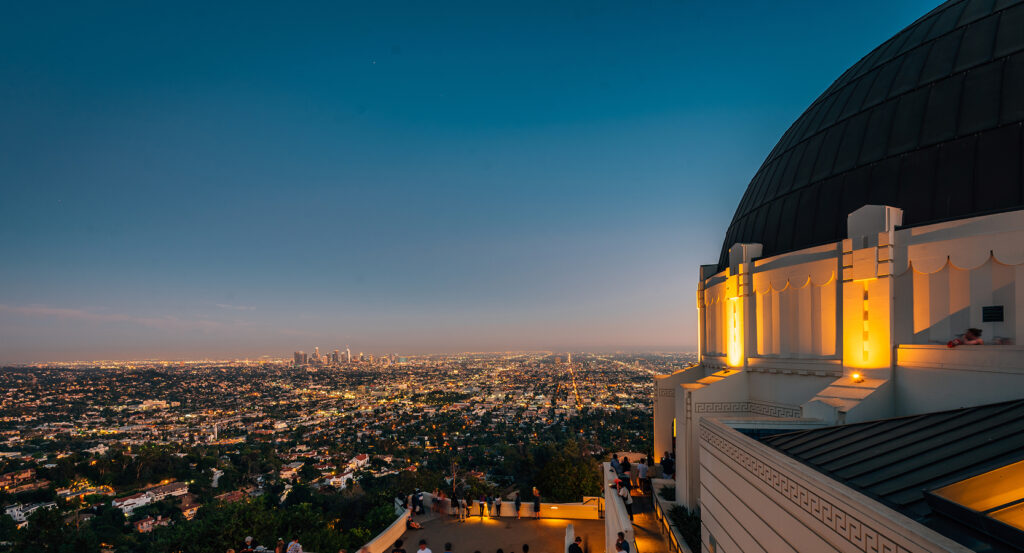
Why San Fernando Valley matters.
San Fernando Valley is an expansive enclave where Los Angeles's suburban character meets a mountain-ringed basin, former agricultural plains and a constellation of communities shaped by twentieth-century metropolitan expansion.
Positioned between the Santa Clarita Valley, Crescenta Valley, and the Los Angeles Basin, the neighborhood occupies a broad interior basin enclosed by the Santa Susana Mountains, San Gabriel Mountains and Santa Monica Mountains, with passes and canyon corridors providing critical connections through the surrounding relief. Long east-west boulevards cross a predominantly low-rise landscape whose residential grids, commercial corridors and industrial districts spread across terrain interrupted by washes, foothills and increasingly steep peripheral streets. Ventura Boulevard supplies the primary encounter across the southern Valley, tracing the base of the Santa Monica Mountains through a continuous sequence of communities whose centers repeatedly change architectural scale and street character. Sepulveda Boulevard creates a secondary north-south passage across the basin, linking flatter central districts with the mountain approaches that visually contain the Valley on nearly every side. The result is a region whose enormous horizontal scale, sharply bounded geography and succession of distinct communities created one of Los Angeles's most consequential experiments in metropolitan expansion.
What defines San Fernando Valley.
San Fernando Valley is best known for its transformation from immense ranch holdings and dry agricultural ground into a network of planned towns whose growth became inseparable from Los Angeles's early twentieth-century expansion. Isaac Lankershim and his partners purchased the southern half of the Valley from Pío Pico in 1869 for $115,000, creating the Lankershim Ranch and developing cattle, sheep and large-scale wheat production across the property. Isaac Newton Van Nuys became a central figure in the enterprise, and the Van Nuys-Lankershim operation eventually controlled tens of thousands of acres across the southern basin. Harry Chandler joined Hobart Johnstone Whitley, Van Nuys, James Boon Lankershim and other investors in 1909 to acquire 47,500 acres through the Los Angeles Suburban Homes Company for $2.5 million. The immense tract extended across nearly the entire southern half of the Valley and supplied ground for three planned towns: Van Nuys, Marian, later Reseda, and Owensmouth, later associated with Canoga Park and West Hills. Van Nuys opened for lot sales on February 22, 1911, with transportation and new roads incorporated into the development strategy. A 20-mile electric railway extended westward from Lankershim through Van Nuys and Marian to Owensmouth, and Sherman Way crossed the tract as a broad paved boulevard during an era when such infrastructure remained unusual across rural Los Angeles. Completion of the Los Angeles Aqueduct in 1913 fundamentally altered the economic possibilities of the basin by bringing Owens Valley water through the northern Valley, supporting irrigated orchards and intensive agriculture across ground previously dominated by dry farming. Access to city water subsequently encouraged large portions of the Valley to join Los Angeles, producing the metropolitan geography that still distinguishes incorporated Los Angeles neighborhoods from independent Burbank and San Fernando.
World War II and the postwar industrial boom redirected the Valley from its agricultural economy toward manufacturing, aerospace and mass suburban development on an enormous scale. Lockheed had established a major Burbank production presence by 1928, and wartime expansion turned its facilities into one of Southern California's critical aircraft centers, producing P-38 Lightning fighters and other military aircraft as employment surged across the eastern Valley. General Motors purchased Panorama Ranch ground in 1945 and opened its $12 million Van Nuys Assembly Plant on December 1, 1947, placing more than one million square feet of automobile production amid fields that soon gave way to surrounding development. Chevrolet trucks joined passenger cars including the Bel Air, Impala and Del Ray on its production lines, and the factory became a major industrial anchor for the growing northern Valley. Hughes Aircraft, Litton Industries, Northrop and Rocketdyne expanded the technological economy during the Cold War and space race, connecting the region with missile development, aviation and the American space program. Automobile manufacturing remained another pillar, with the Van Nuys plant later producing the Nova, Camaro and Monte Carlo and reaching 5,130 workers in 1979. Freeway construction reinforced the postwar spatial shift as residential subdivisions spread across former agricultural ground and employment centers dispersed beyond the older town cores. The industrial contraction beginning late in the twentieth century closed or reduced many of these immense production operations, yet the streets, commercial centers and extensive postwar housing surrounding their former sites preserve the physical scale of the era when aerospace, automobiles and suburban growth remade the Valley together.
How San Fernando Valley fits.
San Fernando Valley works as the anchor for an outing connecting the Spanish colonial complex that gave the basin its enduring name, a grand Chicana mural spanning California history and an automobile collection built through one family's extraordinary commitment to restoration.
Begin at Mission San Fernando Rey de España, founded by Father Fermín Lasuén on September 8, 1797, after Francisco Reyes relinquished his interest in the selected ground and his house supplied temporary shelter for the missionary. An adobe chapel blessed in December 1806 suffered damage during the 1812 earthquake, leading to completion of another church in 1818; the wider compound developed through Indigenous labor into a center producing olives, dates, wheat, barley, corn and beans alongside cattle, sheep and horses before secularization in 1834 dismantled the mission system. Eulogio de Celis purchased more than 116,000 acres of former mission land from the Mexican government in 1846, carrying the property into the rancho era whose subsequent divisions reshaped the basin. Continue to The Great Wall of Los Angeles, conceived by Chicana artist Judith F. Baca and created in the Tujunga Wash between 1974 and 1984 with the Social and Public Art Resource Center. Stretching a half mile along the concrete channel, the mural develops California history through Indigenous, Latino, Asian American, African American and other communities whose experiences had received limited representation in conventional historical imagery. Hundreds of young people participated in its creation under artists and historians working with Baca, turning a flood-control channel into an immense chronological composition whose scale became inseparable from the landscape of the eastern Valley. Conclude at The Nethercutt Collection, created from J.B. and Dorothy Nethercutt's passion for historic automobiles after J.B. purchased a 1936 Duesenberg Convertible Roadster for $5,000 and a 1930 DuPont Town Car for $500 in 1956. Restoration of the DuPont consumed eighteen months and more than $65,000 before the car won Best of Show at the Pebble Beach Concours d'Elegance in 1958, initiating a collecting enterprise whose founder ultimately became a six-time Pebble Beach Best of Show winner. More than 200 restored American and European automobiles now form the heart of the collection alongside mechanical musical instruments, with a 1937 locomotive and railcar extending its mechanical scope beyond road transport. The progression moves from the colonial institution that gave the Valley its name through Baca's vast reinterpretation of California history and culminates in Nethercutt's exacting preservation of transportation engineering, joining three radically different chapters of the basin's cultural development.
Where your story begins.
Foresyte Travel reveals places that feel extraordinary long before you arrive.
Enjoy editorial crafted for luxury travelers.
Foresyte may earn a commission when you book.





































































































