
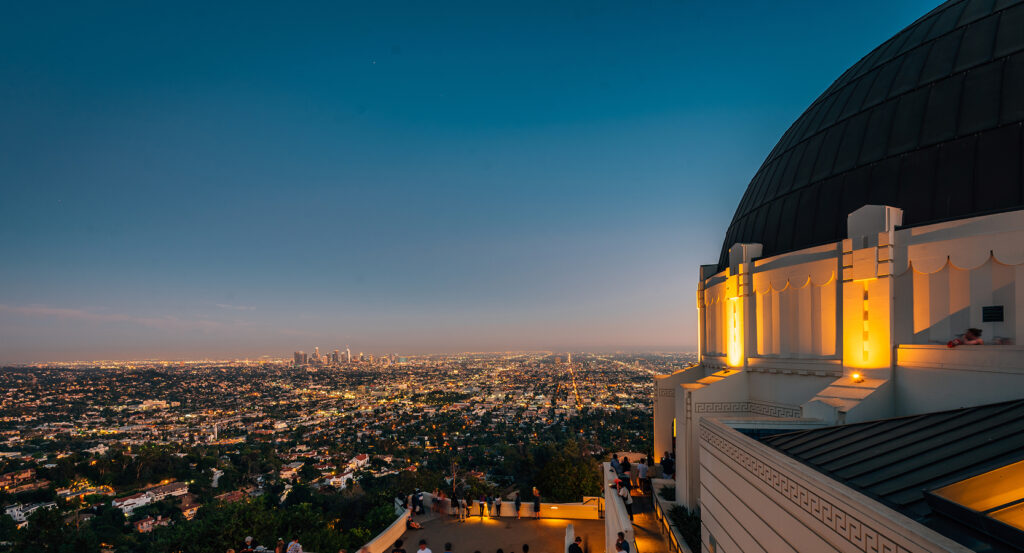
Why Hancock Park matters.
Hancock Park is a stately enclave where Central Los Angeles's metropolitan character meets broad residential avenues, mature tree cover and an unusually intact district of large early twentieth-century houses positioned between Hollywood and the Wilshire corridor.
Positioned between Windsor Square, Larchmont Village, and Fairfax, the neighborhood occupies level ground in the Central Los Angeles basin, where long north-south streets intersect a disciplined rectangular grid extending between Melrose Avenue and Wilshire Boulevard. Large detached residences, deep lawns, mature canopy trees and substantial corner parcels create a consistently spacious physical scale across blocks lying only a short distance from some of the city's densest commercial corridors. Rossmore Avenue supplies the primary encounter through a broad residential axis whose substantial houses and apartment buildings form an architectural gateway between Hollywood and the streets approaching Wilshire. Highland Avenue creates a secondary passage along the western side, where extended residential blocks reinforce the district's unusually generous dimensions before commercial development intensifies beyond its edges. The result is a neighborhood whose coherent street scale, mature landscape and concentration of substantial residences preserve one of the clearest physical expressions of Los Angeles prosperity during the city's explosive interwar expansion.
What defines Hancock Park.
Hancock Park is best known for developing during the 1920s across the eastern portion of Rancho La Brea, transforming Hancock family land into one of Los Angeles's most architecturally distinguished residential districts. Major Henry Hancock acquired the Rancho La Brea property in 1863, and the land subsequently passed through the family to his son G. Allan Hancock, whose business interests included the oil deposits beneath portions of the former rancho. Less productive oil acreage began entering residential subdivision during the late 1910s as metropolitan Los Angeles expanded rapidly west of its established center. Hancock planned an affluent residential community around the golf course created on leased family land in 1919, and house construction advanced westward from Rossmore Avenue beginning in 1920. He required five-inch concrete streets, an unusually substantial specification for the period, and much of that original pavement survived long after the subdivision filled. Residential lots carried fifty-foot front setbacks, side driveways frequently passed through porte cocheres to rear garages and the resulting parcels supported houses substantially larger than contemporary Los Angeles residential construction. Stiles Clements, Roland Coate, Elmer Grey, Hunt & Burns, Gordon Kaufmann, Clarence J. Smale, Gene Verge and Paul Revere Williams belonged to the exceptional group of architects whose work concentrated there during the 1920s and 1930s. Tudor Revival, English Revival, Spanish Colonial Revival, Mediterranean Revival, Monterey Revival and American Colonial Revival houses gave the district exceptional stylistic breadth within a strongly consistent residential scale. Arthur Letts Jr., Howard Hughes, Mae West, William Pereira and other prominent Angelenos occupied houses within the district as Hancock Park became associated with entertainment, architecture and business wealth. About eighty percent of the subdivision had sold by 1930, completing much of the formative development within a single decade of extraordinary metropolitan growth.
Nat King Cole's purchase of a Muirfield Road house in 1948 placed Hancock Park within a defining struggle over racial exclusion in Los Angeles housing. Cole had already become one of America's most successful Black musicians through recordings including “Straighten Up and Fly Right,” “Route 66” and “The Christmas Song” when he and Maria Cole selected the house shortly after their 1947 marriage. White residents organized the Hancock Park Property Owners Association in an effort to prevent the family from occupying the property, first pursuing financial inducements and subsequently subjecting the Coles to threats and intimidation. The confrontation unfolded as the U.S. Supreme Court's 1948 Shelley v. Kraemer decision ended judicial enforcement of racially restrictive housing covenants, dismantling one of the principal legal devices used to segregate affluent residential districts. Nat and Maria Cole moved into the Muirfield Road house in August 1948 and remained despite sustained hostility, placing a nationally prominent entertainer directly inside Los Angeles's broader confrontation with discriminatory housing practices. Later decades brought substantial Jewish settlement to the western side of Hancock Park near Beverly-Fairfax, particularly from the 1980s onward, further changing a district originally developed through exclusionary property restrictions. Hancock Park occupies an important position in Los Angeles history beyond its celebrated houses: the same residential exclusivity that attracted immense wealth during the 1920s also produced a highly visible postwar confrontation over who possessed access to that prosperity.
How Hancock Park fits.
Hancock Park works as the anchor for an outing connecting a women-founded cultural institution, an Art Deco theater rescued from demolition and an automobile-oriented department store that redirected luxury commerce along Wilshire Boulevard.
Begin at Ebell of Los Angeles, founded in 1894 under the leadership of Harriet Williams Russell Strong with a mission centered on women's education in literature, art and science. Successive headquarters preceded the present campus, and Hunt and Eager designed a larger Figueroa Street home in 1905 before Sumner Hunt received the commission for the institution's Wilshire Boulevard complex. The present building opened in 1927 as a Renaissance-inspired campus containing a theater, library, art salon and extensive gathering rooms across three levels. John William Chard created the ironwork installed at the principal entrance in 1928, and the Art Salon followed in 1929 as an early Los Angeles gallery devoted substantially to women artists. Henry Lion designed the Fountain of Honor in 1930 to commemorate relatives of Ebell members killed during World War I. Frances Gumm, later Judy Garland, attracted MGM producer George Sidney's attention on the theater stage in 1934, adding a consequential entertainment chapter to an institution created four decades earlier around women's cultural education. Continue to The Wiltern and Pellissier Building, completed in 1931 at Wilshire Boulevard and Western Avenue through the work of architect Stiles O. Clements of Morgan, Walls & Clements. Blue-green architectural terra cotta covers the exterior, and deeply recessed windows between strong vertical piers visually extend the 150-foot office tower beyond its actual height. G. Albert Lansburgh designed the theater interior around an 80-foot auditorium ceiling dominated by a great sunburst, accompanied by murals and extensive gold-leaf decoration. The theater opened as Warner Brothers' Western Theatre with the premiere of Alexander Hamilton starring George Arliss, drawing Clark Gable, Joan Crawford, Douglas Fairbanks, Loretta Young and James Cagney to the opening celebration. Decline closed the theater in 1979, and impending demolition subsequently made the complex the first major preservation campaign undertaken by the newly formed Los Angeles Conservancy. Rehabilitation returned the building to use and preserved one of the most accomplished surviving Art Deco compositions along Wilshire. Conclude at Bullock's Wilshire / Southwestern Law School, the 1929 department store through which John and Donald Parkinson translated luxury retailing into the automobile age. The five-story Art Deco building placed its principal entrance behind Wilshire beside a parking area and porte cochere, reversing conventional department-store orientation around customers arriving by car. Buff terra cotta, copper spandrels and a verdigris-covered tower rising 241 feet gave the exterior a vertical silhouette, with Lalique lighting and work by more than a dozen artists extending the architectural program through the interiors. Bullock's Wilshire closed in 1993, and Southwestern Law School acquired the property the following year. A ten-year, $29 million rehabilitation returned displaced fixtures and furnishings to the building and adapted the former store for academic use. The progression moves from an institution created by Los Angeles women through Clements and Lansburgh's theatrical Art Deco composition and culminates in the Parkinsons' reinvention of luxury retail for the automobile, tracing the cultural and architectural ambitions that reshaped the Wilshire corridor during Hancock Park's formative decades.
Where your story begins.
Foresyte Travel reveals places that feel extraordinary long before you arrive.
Enjoy editorial crafted for luxury travelers.
Foresyte may earn a commission when you book.





































































































