
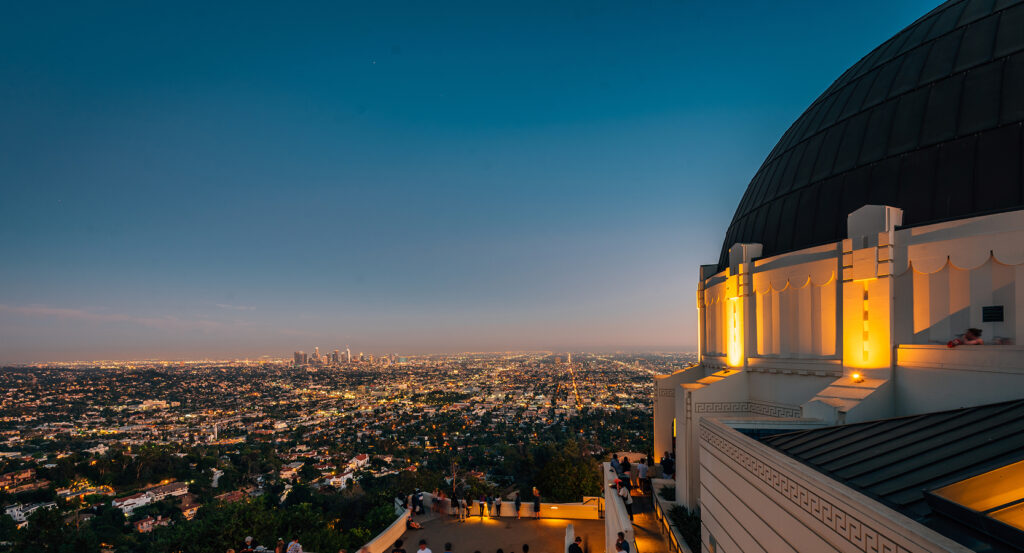
Why Hollywood matters.
Hollywood is a storied enclave where Central Los Angeles's entertainment character meets early streetcar suburbia, dense commercial corridors and a built landscape shaped by the global rise of motion pictures.
Positioned between Hollywood Hills, East Hollywood, and Fairfax, the neighborhood occupies a broad section of the Los Angeles basin extending through Hollywood Boulevard, Sunset Boulevard and Santa Monica Boulevard beneath the eastern Santa Monica Mountains. Dense commercial blocks and apartment districts define the central corridors, shifting into bungalow streets and smaller residential pockets before the terrain rises abruptly along the northern edge. Movement through Hollywood follows a strong east-west structure crossed by Highland Avenue, Cahuenga Boulevard, Vine Street and other north-south routes that connect the basin with passes through the mountains. Taller commercial buildings concentrate around Hollywood Boulevard and Vine Street, creating intermittent vertical clusters above an otherwise low- and mid-rise urban fabric whose development spans more than a century. The result is a neighborhood whose dense boulevards, layered residential streets, mountain backdrop and concentrated commercial core preserve the physical scale of a district repeatedly remade by metropolitan growth and the entertainment economy.
What defines Hollywood.
Hollywood is best known for becoming the geographic center of the American motion-picture industry after beginning as a speculative nineteenth-century townsite far outside Central Los Angeles. Harvey Wilcox purchased a 120-acre tract in the Cahuenga Valley during the 1880s and filed his Hollywood subdivision in 1887 around the intersection of present-day Hollywood and Cahuenga boulevards. The surrounding territory incorporated as the City of Hollywood in 1903 with 700 residents, but inadequate water supplies soon pushed civic leaders toward consolidation with Los Angeles. Hollywood entered Los Angeles in 1910, gaining access to the larger city's water system just as motion-picture producers were beginning to establish permanent operations across Southern California. Nestor Film Company opened a studio in Hollywood in 1911, and additional companies followed as filmmakers exploited abundant sunlight, varied nearby scenery and distance from the East Coast centers of the industry. Production facilities multiplied through the following decade, turning former residential and agricultural parcels around Sunset Boulevard, Gower Street and Vine Street into an expanding concentration of stages, offices and backlots. Hollywood's name detached from its original real-estate meaning and became an international shorthand for American cinema as studios, performers, directors, technicians and associated businesses concentrated within the district. By the 1920s, the transformation had advanced far beyond filmmaking itself, drawing banks, hotels, apartment houses, restaurants and specialized businesses into an urban center whose economy revolved around an industry scarcely present when annexation occurred in 1910.
Commercial construction during the 1920s gave that expanding economy an architectural center along Hollywood Boulevard. Residences that had lined the street during the preceding decades increasingly disappeared as developers pursued a business district capable of competing with Downtown for finance, retail and professional services. C. E. Toberman became a major force in this shift, participating in projects that pushed larger commercial buildings and entertainment properties into the corridor during its most intense building period. The thirteen-story Guarantee Building rose in 1923 as the boulevard's first structure built to the prevailing height limit, followed by the Taft Building in 1924, First National Bank in 1927 and Hollywood Equitable Building in 1929. Retail development advanced simultaneously: I. Magnin opened its first Hollywood branch in 1923, and Dyas completed a Hollywood department store in 1928 that exceeded the scale of its Downtown predecessor. Hollywood Boulevard Association formed that same year as merchants promoted the corridor as an integrated shopping destination. Hotels and apartment hotels multiplied around the business center, accommodating performers, industry workers and newcomers drawn into a district where careers and employment patterns changed rapidly. Office towers, financial institutions and department stores gave Hollywood a concentrated metropolitan skyline before the Depression interrupted the construction boom, leaving the boulevard with one of Southern California's densest surviving collections of 1920s commercial architecture.
How Hollywood fits.
Hollywood works as the anchor for a daytime outing connecting a 1907 winter estate, an extraordinary Japanese-inspired hilltop compound and Frank Lloyd Wright's first Los Angeles commission.
Begin at Wattles Mansion and Gardens, constructed in 1907 as the winter home of Omaha banker and businessman Gurdon Wattles. Architects Myron Hunt and Elmer Grey designed the residence, then known as Jualita, across a 49-acre hillside estate overlooking Los Angeles. Formal gardens occupied the ground behind the house, with terraces, a rose garden and a Japanese garden arranged above extensive avocado and orange groves. Additions during the 1920s expanded the residence as the Wattles family continued occupying a property that remained strikingly large amid the urbanization surrounding it. Portions of the groves became Victory Gardens during World War II, and much of that agricultural acreage later passed to Los Angeles and became Wattles Farm. The family sold the mansion and remaining estate to the city during the early 1970s, preserving the principal house and gardens after most comparable Hollywood estates had disappeared. Continue to Yamashiro, conceived by brothers Adolph and Eugene Bernheimer in 1911 as a hilltop residence for their extensive collection of Asian art. Hundreds of craftspeople worked on the complex before its completion in 1914, creating a ten-room teak-and-cedar mansion around an interior courtyard 250 feet above Hollywood Boulevard. Three hundred steps originally climbed through the estate, whose elaborate grounds incorporated waterfalls, canals, a miniature Japanese village and an immense botanical collection. The brothers spent $2 million on landscaping, filling the terraces with thousands of plant varieties and placing a centuries-old pagoda brought from Japan within the grounds. Their art collection included jades, tapestries, Buddhist objects and Satsuma ware before much of it was dispersed at auction in 1922. The surviving mansion and gardens retain the architectural scale of an intensely personal prewar estate built before dense urban construction reached the slopes below. Conclude at Hollyhock House, commissioned by oil heiress and theater producer Aline Barnsdall after she purchased the 36-acre Olive Hill property for $300,000 in 1919. Barnsdall initially approached Frank Lloyd Wright about a theater, then expanded the project into an arts complex encompassing a cinema, artist residences, shops, guest houses and her own residence. Construction of Hollyhock House ran from 1919 through 1921, with the final cost reaching $150,000 against an original $50,000 expectation. Wright abstracted Barnsdall's favorite flower into cast stone, art glass, furniture and textiles, developing a regional architectural direction distinct from the Prairie work that had established his reputation in the Midwest. Barnsdall donated the house and eleven surrounding acres to Los Angeles in 1927 for a public art park honoring her father, Theodore Barnsdall. The property later became one of eight Frank Lloyd Wright works inscribed together on the UNESCO World Heritage List in 2019. The progression moves from Gurdon Wattles's 1907 winter estate through the Bernheimer brothers' extraordinary Asian art compound and culminates with Barnsdall and Wright's architectural experiment on Olive Hill, connecting three patrons whose ambitions transformed Hollywood hillsides into enduring works of architecture and landscape design.
Where your story begins.
Foresyte Travel reveals places that feel extraordinary long before you arrive.
Enjoy editorial crafted for luxury travelers.
Foresyte may earn a commission when you book.





































































































