
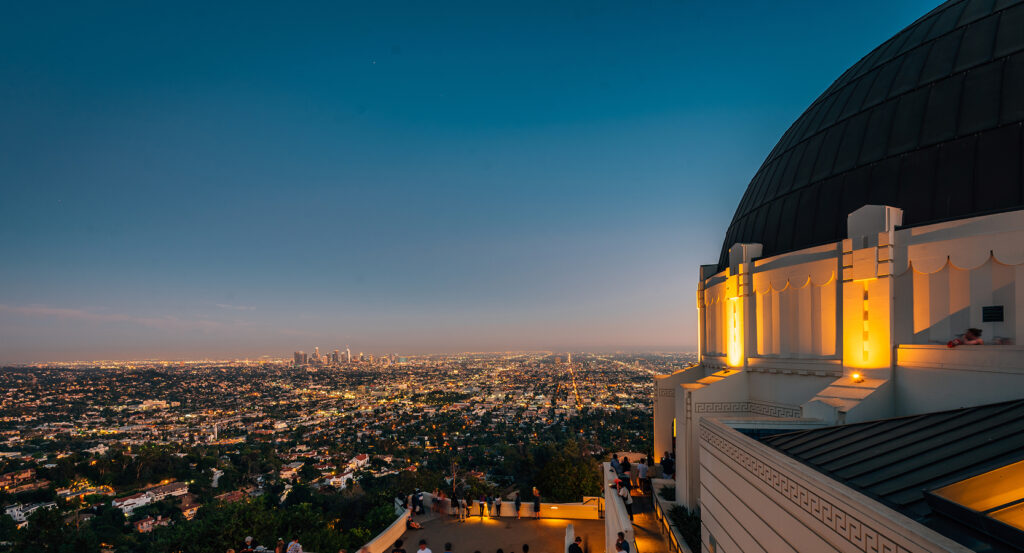
Why Los Angeles County matters.
Los Angeles County is a vast enclave where Southern California's metropolitan character meets Pacific coastline, mountain ranges, inland valleys and desert communities distributed across one of the most geographically varied urban regions in the United States.
Positioned between Ventura County, Kern County, and Orange County, the area occupies 4,084 square miles extending through the Pacific Coast Highway, Interstate 5 and Interstate 10 corridors from Santa Monica Bay and the Palos Verdes Peninsula across the San Gabriel Mountains into the Antelope Valley. Coastal plains support the county's largest continuous urban concentrations before the terrain breaks into the Santa Monica, Verdugo and San Gabriel ranges, dividing the lowlands into distinct basins and valleys. Movement across Los Angeles County repeatedly crosses those geographic barriers through mountain passes and canyon corridors, connecting coastal communities with the San Fernando, San Gabriel and Santa Clarita valleys before settlement thins across the high desert. The Pacific defines an immense western edge, with beaches, coastal bluffs, harbor districts and Santa Catalina Island extending the county's physical range far beyond its inland urban centers. The result is a greater area whose extraordinary geographic scale, mountain partitions, coastal lowlands and separated settlement centers have produced a metropolitan form governed as much by terrain as by urban expansion.
What defines Los Angeles County.
Los Angeles County is best known for expanding from a sparsely settled agricultural territory into the nation's most populous county as railroads, citrus cultivation, petroleum, maritime trade and new industries created successive periods of extraordinary growth. California established the county on February 18, 1850 as one of its original twenty-seven counties, several months before statehood, with Los Angeles already functioning as the principal settlement. Southern Pacific completed its Los Angeles connection in 1880, followed by the Santa Fe six years later, and competition between the two railroads triggered a land boom that generated new towns across the region. Rail access simultaneously widened national markets for Southern California citrus, linking agricultural expansion with the same transportation system driving speculative settlement. County population climbed from 33,381 in 1880 to 101,454 in 1890 and 170,298 by 1900 as communities including Pasadena, Santa Monica, Monrovia, Pomona, Long Beach and Compton became incorporated cities. Henry E. Huntington's Pacific Electric system subsequently connected numerous population centers through an interurban railway network, allowing residential growth to spread well beyond the older Los Angeles core. San Pedro and Long Beach developed into major maritime centers as manufacturing and shipping concentrated around their harbors, and petroleum strikes at Signal Hill and Santa Fe Springs in 1921 added another immense industrial force. Motion-picture production expanded at comparable speed, with Los Angeles companies employing 15,000 people and producing between 60 and 75 percent of American films by 1915. County population reached 504,131 in 1910, 936,455 in 1920 and 2,208,492 in 1930, turning what had been a constellation of agricultural towns into an increasingly interconnected metropolitan region within a single generation.
Aviation supplied another economic force whose influence extended across the county from the South Bay to the San Fernando and Antelope valleys. The Los Angeles County Chamber of Commerce staged the Los Angeles Aviation Meet at Dominguez Field in January 1910, drawing 226,000 people to the first international air show held in the United States. Aircraft manufacturing expanded during the 1920s, and by 1929 Southern California contained 40 percent of all airplanes and pilots licensed by the federal government. Donald Douglas had founded his aircraft company in Santa Monica in 1920, and the company later expanded into El Segundo and Long Beach after winning the 1932 competition that produced its enormously successful DC series. Lockheed concentrated operations in Burbank, Northrop moved to Hawthorne in 1940 and North American established operations near the developing Los Angeles airport, creating an industrial belt of factories, airfields and engineering centers. Lockheed's workforce alone increased from 1,200 employees in 1937 to 53,000 in 1941 as military orders accelerated production. Franklin D. Roosevelt's 1940 call for 50,000 military aircraft pushed Southern California manufacturing into another scale, with aviation becoming the region's largest industrial employer that year and accounting for almost half of Los Angeles County manufacturing jobs. Vultee introduced the aircraft industry's first powered conveyor assembly line at its Downey operation, reducing manufacturing time by 75 percent before merging with Consolidated Aircraft in 1943 to form Convair. Wartime aircraft production and subsequent Cold War aerospace work helped carry industrial employment into communities far removed from the county's older commercial center, reinforcing a polycentric geography already created by railroads, automobiles, ports and suburban construction.
How Los Angeles County fits.
Los Angeles County works as the anchor for a daytime outing connecting a railroad magnate's scholarly estate in San Marino, a transatlantic ocean liner permanently berthed in Long Beach and ancient geological formations rising from the high desert at Agua Dulce.
Begin at The Huntington Library, Art Museum, and Botanical Gardens, where Henry E. Huntington transformed a private San Marino property into an institution joining rare books, art and horticulture. Huntington purchased the estate in 1903 and commissioned Myron Hunt to design a 55,000-square-foot Beaux-Arts residence completed in 1911, followed by a 96,000-square-foot library completed in 1919. William Hertrich began developing the Desert Garden in 1907, eventually building a collection that now extends across ten acres with more than 2,000 species of succulents and desert plants. Henry and Arabella Huntington signed the trust creating their public institution on August 30, 1919, placing their collections and gardens on a permanent foundation dedicated to learning in the arts and sciences. John Russell Pope designed their mausoleum, completed in 1929 after both founders had died, and the institution opened publicly in 1928. Continue to The Queen Mary, launched in Scotland in 1934 before beginning transatlantic service from Southampton on May 27, 1936. The liner shifted into wartime troop transport during World War II, carrying more than 800,000 military personnel and traveling more than 600,000 miles during that phase of its career. Peacetime service ultimately carried 2.2 million passengers before Cunard withdrew the ship in 1967. Long Beach representatives pursued the retired liner, and the city's $3.45 million bid was accepted on July 27, 1967. The Queen Mary departed Southampton for the final time on October 31 and reached Long Beach on December 9, beginning its permanent association with Los Angeles County after three decades on the Atlantic. Conclude at Vasquez Rocks Natural Area and Nature Center, where tilted sedimentary formations preserve a geological history extending tens of millions of years and a human history rooted in the ancestral Tataviam village of Mapipinga. Sediment eroded from surrounding mountains accumulated in an ancient basin before pressure hardened successive deposits into formations thousands of feet thick. Seismic activity later raised those originally horizontal layers toward the northeast at an average angle of fifty degrees, and differential erosion carved the sharply inclined forms visible across the present landscape. Mapipinga once supported more than 200 people, whose descendants belonged to the communities now represented by the Fernandeño Tataviam Band of Mission Indians. Spanish mission expansion forced Tataviam residents from the village between 1802 and 1816, emptying a settlement whose occupation had extended for more than 1,300 years. The present natural area encompasses 945 acres, preserving geology and cultural history within a landscape also familiar through decades of film and television production. The progression moves from Huntington's transformation of private wealth into a scholarly institution through an ocean liner whose global career ended on the county's southern waterfront and culminates among ancient rock formations and Tataviam ancestral ground, revealing the geographic and historical range contained within Los Angeles County.
Where your story begins.
Foresyte Travel reveals places that feel extraordinary long before you arrive.
Enjoy editorial crafted for luxury travelers.
Foresyte may earn a commission when you book.





































































































