
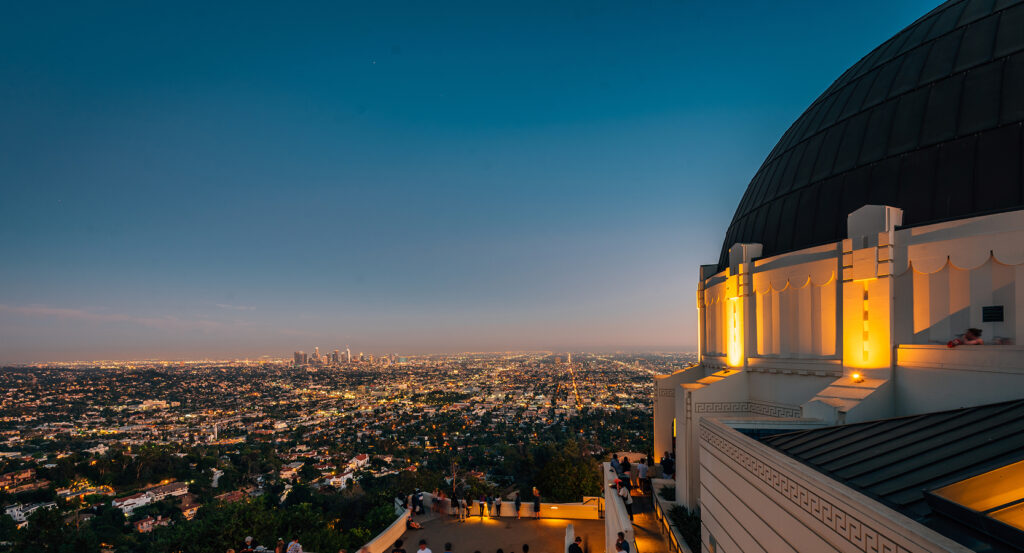
Why Pasadena matters.
Pasadena is a cultivated enclave where the western San Gabriel Valley's foothill character meets nineteenth-century settlement, nationally significant architecture and a civic landscape shaped by winter tourism, horticulture and scientific ambition.
Positioned between Altadena, San Marino, and South Pasadena, the neighborhood occupies the broad alluvial ground beneath the San Gabriel Mountains, extending east from the Arroyo Seco across a gently rising plain whose mature tree canopy, long residential avenues and mountain backdrop give the city an unusually strong relationship with its natural setting. Victorian houses, Craftsman bungalows, Period Revival estates and postwar modern residences stand across districts developed during successive waves of expansion, creating exceptional architectural variety without dissolving the low residential scale of the surrounding streets. Colorado Boulevard supplies the primary encounter through a long east-west corridor where older commercial blocks, institutional buildings and later urban development trace Pasadena's movement from agricultural colony to regional center. Orange Grove Boulevard creates a secondary passage along the western side through former estate territory overlooking the Arroyo Seco, preserving broad setbacks and mature landscapes associated with the city's emergence as a winter refuge for affluent eastern families. The result is a neighborhood whose mountain geography, architectural depth and unusually legible layers of development preserve the physical consequences of Pasadena's transformation from a nineteenth-century settlement into one of Southern California's major cultural centers.
What defines Pasadena.
Pasadena is best known for transforming an agricultural settlement beneath the San Gabriel Mountains into a nationally recognized winter destination whose prosperity reshaped the western San Gabriel Valley during the closing decades of the nineteenth century. A severe Indiana winter in 1872-73 prompted a group of Indianapolis residents to organize an investment venture, and D. M. Berry traveled west before recommending land within Rancho San Pasqual for their California colony. The underlying rancho had passed through a much older chain of occupation and ownership: Hahamogna communities inhabited villages along the Arroyo Seco and neighboring canyons, the San Gabriel Mission controlled extensive territory after its 1771 founding and Manuel Garfias received Rancho San Pasqual from Governor Manuel Micheltorena in 1843. Garfias built an adobe hacienda east of the Arroyo in 1852 before financial difficulties transferred his land to John S. Griffin and Benjamin Wilson in 1859. The newcomers from Indiana acquired part of the property during the 1870s, and Pasadena subsequently expanded through agriculture, real-estate investment and an influx of winter residents drawn from colder eastern states. Railroad competition accelerated Southern California development during the 1880s, driving Pasadena from 1,200 residents into a speculative boom that briefly carried its population far higher before contraction followed. Pasadena incorporated in 1886, and the following decade brought paved streets, electric lighting and substantial residential construction as permanent settlement accompanied the resort economy. The Valley Hunt Club created a midwinter festival in 1890 around flower-covered carriages, polo, foot races, jousting and other competitions intended to display Southern California's winter climate to eastern acquaintances. Growth pushed the celebration beyond the club's capacity, leading to creation of the Tournament of Roses Association in 1895 and giving Pasadena an annual event whose floral performance became internationally associated with the city.
Amos G. Throop opened Throop University in Pasadena in 1891 with 31 students and six faculty members, beginning a second chapter in which the city became deeply connected with American science and engineering. Astronomer George Ellery Hale arrived in Pasadena during the opening years of the twentieth century and joined the school's trustees in 1907, redirecting the small institution toward advanced engineering and scientific research. Chemist Arthur A. Noyes and physicist Robert A. Millikan joined Hale in shaping that transition, and the institution received the California Institute of Technology name in 1920 after passing through the Throop Polytechnic Institute and Throop College of Technology names. Enrollment had reached 359 undergraduates and nine graduate students by that transition, supported by a faculty of 60. Scientific work expanded beyond the campus during the 1930s when Caltech professor Theodore von Kármán supervised a group including Frank Malina and Pasadena rocket enthusiasts conducting propulsion experiments. The group moved its hazardous tests into the Arroyo Seco, where an alcohol-fueled rocket motor was tested on October 31, 1936. Army sponsorship subsequently pushed the work toward jet-assisted aircraft takeoff and missile technology, giving rise to the Jet Propulsion Laboratory. JPL built Explorer 1, launched in January 1958 as the first American satellite to orbit Earth, and transferred from the Army to the newly created NASA later that year under continued Caltech management. Pasadena had moved within seven decades from an agricultural colony founded by Midwestern migrants to a city whose scientific institutions participated directly in the opening of the American space age.
How Pasadena fits.
Pasadena works as the anchor for an outing connecting an Arts and Crafts residence of exceptional completeness, a museum shaped by one of twentieth-century America's most ambitious private collectors and a theater whose influence reached far beyond Southern California.
Begin at Gamble House, completed in 1908 for David and Mary Gamble of the Procter & Gamble family as the supreme surviving collaboration between architects Charles and Henry Greene. The brothers had opened their Pasadena office in 1894, and their partnership with master builders Peter and John Hall after 1904 gave them craftsmen capable of executing the complex joinery, integrated furnishings and extraordinary woodworking demanded by their mature houses. Gamble House survives with architecture, furniture and decorative elements conceived as a unified composition, making it the most complete and original surviving example of Greene and Greene's work and an internationally recognized achievement of the American Arts and Crafts movement. Continue to Norton Simon Museum, whose institutional ancestry begins with the Pasadena Art Institute, founded in 1922 and incorporated in 1924 with ambitions for a museum and art library. The institute acquired 9.5 acres at Carmelita Park before evolving through several institutional forms and eventually occupying the building that opened as the Pasadena Art Museum in 1969. Industrialist Norton Simon entered the institution's history during the 1970s after three decades of collecting that had produced more than 8,000 works spanning European Old Masters, Impressionism, twentieth-century art and sculpture from South and Southeast Asia. Simon's collecting moved from Daumier, Degas, Renoir and Gauguin toward Rembrandt, Picasso, Giacometti and extensive Asian holdings, giving the Pasadena museum an artistic range far larger than its local origins suggested. Conclude at Pasadena Playhouse, founded by theater impresario Gilmor Brown in 1917 after his company began performing in Pasadena. More than 1,000 local residents contributed toward a permanent home, and architect Elmer Grey designed the Spanish Colonial Revival theater that opened in 1925 with interiors by Dwight Gibbs. Brown expanded the operation into a complex encompassing multiple stages, production facilities and a theater college, and his company completed the entire Shakespeare canon. California legislators designated the institution the official State Theatre in 1937, and its school subsequently trained generations of performers and theater practitioners; the Playhouse received the Regional Theatre Tony Award in 2023. The progression moves from Greene and Greene's comprehensive Arts and Crafts design through Norton Simon's far-ranging art collection and culminates in Gilmor Brown's theatrical institution, connecting three disciplines through the unusually concentrated cultural ambition that developed across Pasadena.
Where your story begins.
Foresyte Travel reveals places that feel extraordinary long before you arrive.
Enjoy editorial crafted for luxury travelers.
Foresyte may earn a commission when you book.





































































































