
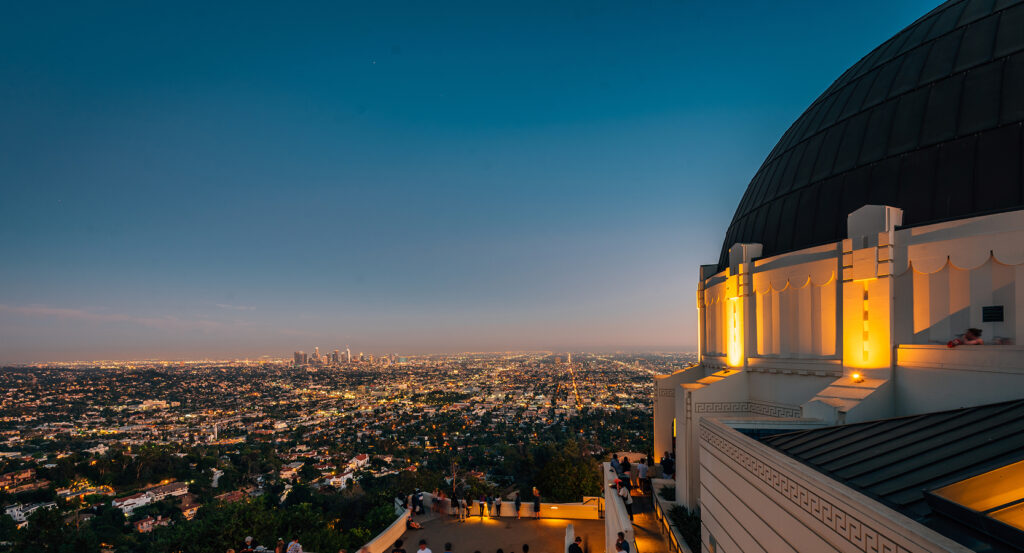
Why Arroyo Seco matters.
Arroyo Seco is a canyon enclave where Northeast Los Angeles's foothill character meets a seasonal watercourse, steep residential slopes and a linear landscape that has shaped settlement and transportation between Downtown and Pasadena for more than a century.
Positioned between Highland Park, Montecito Heights, and Mount Washington, the neighborhood occupies the deeply incised corridor where the Arroyo Seco descends from the San Gabriel foothills toward its junction with the Los Angeles River. Sycamores, coast live oaks, chaparral-covered slopes and exposed channel walls establish a narrow physical basin bordered by houses climbing abruptly above the canyon floor. Movement follows the elongated geography through Figueroa Street, hillside roads and paths that repeatedly cross or parallel the watercourse as residential blocks rise on either side. Bridges, recreation grounds and engineered sections of channel add successive layers to a landscape whose width and elevation shift dramatically between constricted passages and broader flats. The result is a neighborhood whose watercourse, canyon walls, vegetation and hillside development preserve an unusually legible relationship between natural geography and the metropolitan growth that surrounded it.
What defines Arroyo Seco.
Arroyo Seco is best known for forming the geographic spine around which several of Northeast Los Angeles's earliest suburban communities developed during the late nineteenth and early twentieth centuries. Indigenous communities occupied the wider region for thousands of years before the Spanish colonial period divided the canyon surroundings among the Pueblo de Los Angeles, Rancho San Rafael and Rancho San Pascual, placing the arroyo near the boundaries of immense landholdings that preceded American Los Angeles. Rancho San Rafael extended west of the watercourse under José María Verdugo after 1784, and Rancho San Pascual encompassed much of the upper canyon country after Manuel Garfias received the Mexican-era grant in 1843. Andrew Glassell Jr. and Albert Beck Chapman acquired former Verdugo acreage during the nineteenth century, then sold land to George W. Morgan and Albert H. Judson for the Highland Park Tract in 1886 as the Southern California real-estate boom pushed settlement toward the canyon. Railroad competition accelerated that development when the Santa Fe reached Los Angeles in 1887 after the Southern Pacific had established its earlier regional position, giving communities along the corridor increasingly direct transportation to Pasadena and Downtown. Highland Park expanded as a residential suburb across the western slopes, Garvanza developed farther north and houses spread onto the surrounding hills as rail access turned formerly peripheral land into commuter territory. Highland Park joined Los Angeles in 1895, Garvanza followed in 1899 and Hermon, York Valley and part of Annandale entered the city in 1912, progressively incorporating much of the canyon's western residential territory into Los Angeles. Electric streetcars subsequently strengthened Figueroa Street as the principal commercial axis as Queen Anne, Shingle, Craftsman, Mission Revival and Tudor Revival buildings accumulated across the adjoining neighborhoods. The Highland Park-Garvanza architectural concentration eventually grew to encompass 4,000 structures and more than 50 Los Angeles Historic-Cultural Monuments, preserving an exceptional cross section of construction from the 1880s through the 1940s. Arroyo Seco became more than a geographic division between hillsides: the canyon organized a chain of early suburbs whose growth translated railroad expansion, annexation and successive architectural periods into the built form of Northeast Los Angeles.
Automobile engineering reshaped the canyon during the twentieth century through a transportation project that converted the Arroyo Seco into the birthplace of the western urban freeway. Proposals for a road through the corridor appeared by the 1890s, followed by early twentieth-century concepts for landscaped boulevards and a 1924 route approved through the canyon. Construction began in 1931 before the Depression interrupted the project, then resumed later in the decade as California highway engineers pursued a divided roadway linking Pasadena with Los Angeles. Work beginning in 1938 developed alongside the federally assisted Arroyo Seco Flood Control Channel, coupling high-speed transportation with extensive alteration of a watercourse long subject to seasonal flooding. Engineers incorporated grade-separated crossings, divided traffic lanes, landscaped margins and limited access into an six-mile initial section, creating a hybrid between the recreational parkway tradition and the emerging urban freeway. The first section between Fair Oaks Avenue and Glenarm Street opened in 1939, and the completed Los Angeles-Pasadena connection received its formal dedication in December 1940. Its 1940 completion placed the roadway at the front edge of American highway engineering as the first divided-lane, high-speed, limited-access urban road in the western United States. Route 66 shifted onto the corridor that same year, making this modern highway the first portion of the celebrated transcontinental route carried over a limited-access road. Subsequent construction pushed the roadway south toward Downtown and increasingly emphasized transportation capacity over the landscaped qualities of the earlier northern sections. The 8.2-mile corridor became the first component of the freeway network that would fundamentally restructure Los Angeles after World War II, turning the Arroyo Seco from an early suburban watercourse into a prototype for metropolitan transportation across the American West.
How Arroyo Seco fits.
Arroyo Seco works as the anchor for an outing connecting a writer's handcrafted stone residence, a family art-glass workshop and Los Angeles's first purpose-built museum within the creative culture that developed along the canyon.
Begin at Lummis House, where Charles Fletcher Lummis selected a three-acre property beside an immense sycamore in 1895 and began constructing El Alisal several years later. Lummis had reached Los Angeles in 1885 after walking from Cincinnati and subsequently worked as an editor, author and preservation advocate before turning his Arroyo property into a highly personal architectural project. Sumner Hunt assisted with the design, and Lummis used arroyo stone across the residence, incorporating concrete floors, carved wood and railroad poles into a building completed in 1910 after years of work. El Alisal became both his home and a gathering place for artists, writers and cultural figures, giving physical form to the handcrafted artistic culture developing beside the canyon. Continue to Judson Studios, founded in 1897 by English-born painter William Lees Judson and his three sons as Los Angeles expanded into a major market for architectural glass. Judson became the first dean of USC's College of Fine Arts, whose Arroyo campus occupied the site from 1901 until 1920. Fire destroyed the original school building in 1910, prompting architects Train and Williams to design the shingled structure completed the following year. Judson Studios acquired the building after USC consolidated its art program at University Park, turning the former college into the permanent headquarters of a family enterprise now extending through five generations. Frank Lloyd Wright, Greene and Greene and Ernest Batchelder belonged to the creative circle connected with the building, placing the workshop within a broader community of architects and craftspeople working around the canyon. Conclude at Southwest Museum, where Lummis expanded his cultural ambitions from a private Arroyo residence into an institution founded in 1907. He worked with architects Sumner Hunt and Silas Burns on a hillside building overlooking the canyon, drawing from Andalusian, Mission and Moorish precedents for a structure erected between 1912 and 1914. The first phase opened in 1914, followed by a Mayan-themed entrance tunnel and elevator in 1919 and the Caroline Boeing Pool Wing of Basketry in 1942. Its collections eventually exceeded 300,000 objects associated with Indigenous cultures of the American Southwest and beyond, giving Lummis's institution a scale far beyond the personal collection that had filled El Alisal. The progression moves from Lummis's handcrafted domestic architecture through the Judson family's multigenerational glassmaking enterprise and culminates in the museum Lummis conceived above the canyon, connecting residence, workshop and institution across the creative community that made the Arroyo Seco nationally consequential.
Where your story begins.
Foresyte Travel reveals places that feel extraordinary long before you arrive.
Enjoy editorial crafted for luxury travelers.
Foresyte may earn a commission when you book.





































































































