
Why Montecito Heights matters.
Montecito Heights is a topographic enclave where Northeast Los Angeles's early suburban expansion meets the Monterey Hills, steep residential terrain and an unusually intact sequence of hillside building spanning Craftsman-era settlement through postwar modernism.
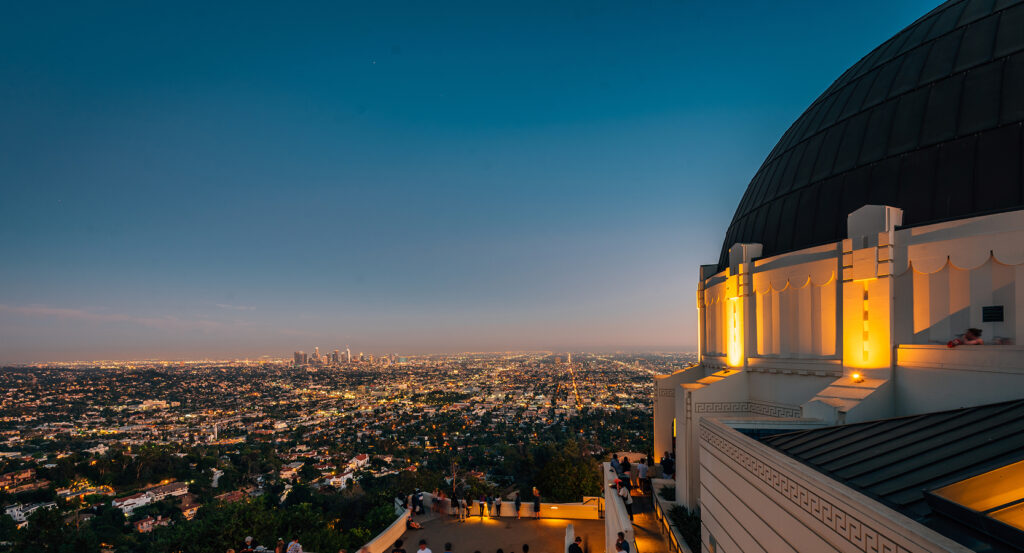
Positioned between Mount Washington, Highland Park, and Lincoln Heights, the neighborhood occupies the Monterey Hills above the Arroyo Seco, where irregular ridges rise abruptly from the flatter transportation corridors below and separate residential streets into small pockets with markedly different elevations and orientations. Craftsman houses, Period Revival residences and compact postwar homes occupy lots that climb across slopes once regarded as difficult building ground, with retaining walls, projecting foundations and hillside stairways making elevation a dominant component of the streetscape. Montecito Drive supplies the primary encounter through curving residential terrain whose bends repeatedly shift sightlines between close hillside construction and long views across Northeast Los Angeles. Griffin Avenue creates a secondary passage along lower ground, tracing the transition between the neighborhood's elevated residential interior and the older corridors extending toward the Los Angeles River. The result is a neighborhood whose staggered development left successive generations of Los Angeles hillside architecture unusually legible across terrain that resisted continuous construction for decades.
What defines Montecito Heights.
Montecito Heights is best known for developing in two widely separated waves after the Monterey Hills repeatedly frustrated the suburban expansion advancing through Northeast Los Angeles during the late nineteenth and early twentieth centuries. Portions of the hills were subdivided during the mid-1870s as landowners sought to extend East Los Angeles, later Lincoln Heights, into adjoining terrain, yet early construction remained concentrated near flatter roads and streetcar routes. Residential subdivision intensified around the turn of the century before the Mutual Home Building Corporation undertook a much larger scheme during the 1910s. Its 1911 promotion, Montecito Above the City, envisioned graded streets, expansive views, a dedicated streetcar and a major summit hotel modeled partly on the development strategy already operating across nearby Mount Washington. The company created 1,200 lots, but neither the proposed railway nor the hilltop hotel materialized, leaving construction far more incremental than the scale of the subdivision suggested. A small number of houses appeared during the 1910s and a larger group followed during the 1920s, yet the steepest ground remained substantially empty. Most of Montecito Heights and Rose Hills entered Los Angeles through the Arroyo Seco Addition in 1912, joining western portions that had already fallen within the original Pueblo de Los Angeles lands. Residential building continued slowly through the middle decades of the century, producing a dispersed collection of Craftsman houses and Period Revival designs across streets whose incomplete occupation still revealed the physical difficulty of the hills.
Postwar engineering opened the steepest parcels to a radically different phase of construction during the late 1950s and 1960s, when cantilevered foundations and elevated structural systems allowed houses to occupy slopes earlier builders had largely bypassed. Montecito Drive contains an especially concentrated surviving group completed between 1961 and 1964 on ground subdivided as Montecito Park in 1908 but left vacant for decades. Twenty-three intact dwellings form the core of that group, predominantly Mid-Century Modern houses with rectangular plans, restrained exterior surfaces and street elevations dominated by garages, carports and entrance courts. One-story examples use flat or low-pitched roofs, and two-story versions shift toward gabled forms as the buildings extend down their parcels. Montecito Construction Company built the houses from designs by John Pugsley or Richard Kearney, giving a single development operation unusual architectural coherence across terrain whose slope otherwise encourages individualized solutions. Their shallow setbacks and full-width footprints create a compact street edge above structures projecting down the hillside, turning the difference between road elevation and residential foundation into a central architectural feature. Custom Mid-Century Modern houses appeared elsewhere across Montecito Heights during the same broad period, extending the neighborhood's postwar construction beyond this concentrated group. The surviving sequence places modest early twentieth-century houses and technically ambitious postwar hillside dwellings within the same neighborhood, making decades of changing Los Angeles construction practice visible through the physical problem that shaped Montecito Heights from its beginning: how to build on the Monterey Hills.
How Montecito Heights fits.
Montecito Heights works as the anchor for an outing connecting Los Angeles's pioneering museum of the American Southwest, a preservation campus assembled from threatened Victorian buildings and an urban conservation center created around native habitat and environmental education.
Begin at Southwest Museum, where journalist, preservationist and collector Charles Fletcher Lummis transformed his fascination with the American Southwest into Los Angeles's first purpose-built museum. Lummis had arrived in Los Angeles in 1885 after walking west from Ohio to accept a position at the Los Angeles Times, and his subsequent collecting and cultural work helped produce the institution that opened on Mount Washington in 1914. Architects Sumner Hunt and Silas Burns designed the commanding hilltop complex, whose collection grew into one of the country's significant holdings of Native American art and cultural objects; the associated Casa de Adobe followed in 1917 as a hand-built interpretation of an early California rancho. The museum later merged with the Autry, placing its historic buildings, twelve-acre campus, archive and extensive collections under the stewardship of the larger institution. Continue to Heritage Square Museum, established in 1969 after Los Angeles preservation advocates secured city-owned ground beside the Arroyo Seco Parkway for historic buildings threatened elsewhere by demolition. The original plan centered on structures endangered by the Bunker Hill Redevelopment Project, and the resulting open-air museum grew into a collection of eight historic buildings transferred from different Los Angeles neighborhoods. The Longfellow-Hastings Octagon House, William Perry House, Hale House, Valley Knudsen House, Palms Depot and Lincoln Avenue Methodist Church preserve markedly different architectural and social fragments of Southern California between the late nineteenth and early twentieth centuries. Heritage Square became both a repository for displaced architecture and an early institutional product of Los Angeles's modern preservation movement. Conclude at Audubon Center at Debs Park, opened in 2003 as the National Audubon Society's first urban center created specifically to engage a Latino community. Its building became the first structure in the United States to achieve LEED Platinum status at the time of construction, making environmental performance part of the institution's educational purpose from its opening. Habitat restoration, native planting, bird conservation and community science subsequently extended that architectural commitment into the surrounding landscape, with staff and volunteers working across the park and Los Angeles River corridor. The progression moves from Lummis's early institutional commitment to Southwestern cultural heritage through the rescue and relocation of endangered Los Angeles architecture and culminates in a twenty-first-century conservation center joining environmental design with stewardship of Northeast Los Angeles habitat.
Where your story begins.
Foresyte Travel reveals places that feel extraordinary long before you arrive.
Enjoy editorial crafted for luxury travelers.
Foresyte may earn a commission when you book.





































































































