
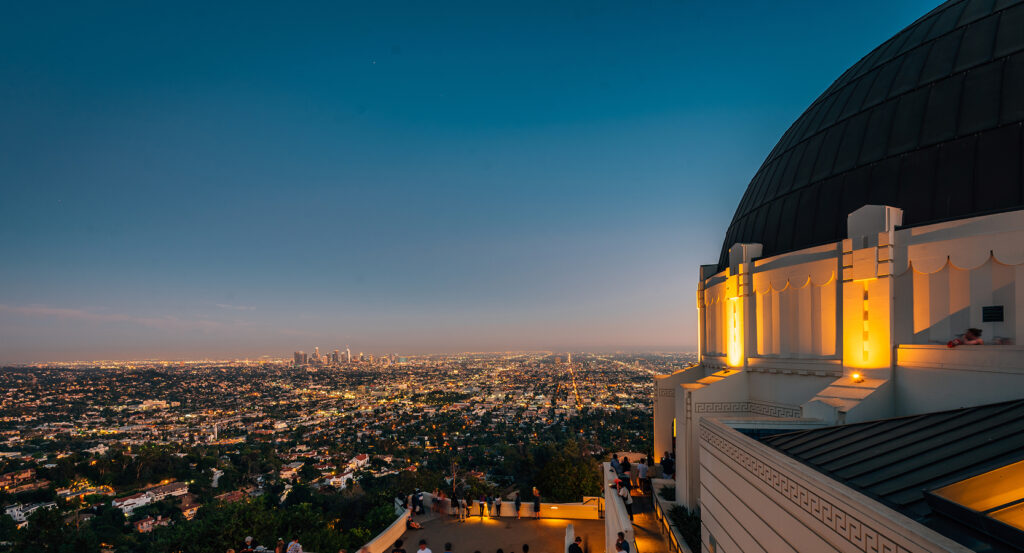
Why Downtown matters.
Downtown is a metropolitan enclave where Central Los Angeles's civic character meets a nineteenth-century business center, among America's great concentrations of prewar commercial architecture and a skyline created through successive eras of finance, entertainment and corporate construction.
Positioned between Chinatown, Westlake, and Boyle Heights, the neighborhood occupies the eastern side of the Los Angeles Basin where the metropolitan plain rises sharply into Bunker Hill before descending toward the Los Angeles River, producing dramatic changes in elevation and building scale across a compact central grid. Beaux-Arts commercial blocks, Art Deco towers, former department stores, industrial buildings and glass skyscrapers compress more than a century of metropolitan construction into adjoining streets, with the strongest prewar fabric concentrated east of Bunker Hill. Broadway supplies the primary encounter through long street walls of historic retail buildings and elaborate theaters, preserving the dimensions of the shopping and entertainment corridor that drew immense crowds during the opening decades of the twentieth century. Spring Street creates a secondary passage through former banking buildings and early high-rises, then the urban scale changes decisively westward as the grid encounters Bunker Hill's towers, plazas and steep grades. The result is a neighborhood whose extraordinary architectural concentration makes Los Angeles's evolution from regional commercial center into a global metropolis physically legible across a few square miles.
What defines Downtown.
Downtown is best known for the extraordinary commercial expansion that shifted the growing city south from its original pueblo and produced the Historic Core during the late nineteenth and early twentieth centuries. Railroad connections accelerated Los Angeles's urban growth during the final quarter of the nineteenth century, and the business district spread south beneath Bunker Hill as increasingly substantial buildings replaced the earlier cityscape. The Bradbury Building appeared at Broadway and 2nd Street in 1893, followed by the Douglas Building at Third and Spring in 1898 as the center acquired larger commercial structures. Broadway emerged as the dominant retail and entertainment corridor during the 1910s, and more than a dozen major movie theaters rose between Third and Ninth streets through the 1930s. G. Albert Lansburgh designed the Palace Theatre, which opened in 1911 as the third Los Angeles home of the Orpheum vaudeville circuit and survives as the oldest remaining original Orpheum theater in the United States. Hamburger's immense 1908 department store occupied six floors and a basement at Eighth and Broadway, drew 75,000 people on opening day and contained fifteen acres of retail space, reinforcing the corridor's emergence as the city's premier shopping district. Bullock's established its Downtown flagship at Broadway and 7th Street in 1907, adding another institution to a commercial concentration that eventually drew thousands beneath vertical neon signs and theater marquees. The Orpheum opened its fourth Los Angeles home in 1926, with a Beaux-Arts auditorium that hosted performers including Mae West, the Marx Brothers, Lena Horne and Jack Benny. Claud Beelman's Eastern Columbia Building followed in 1930, rising thirteen stories in turquoise terra cotta above Broadway and 9th Street after only nine months of construction. Downtown's Historic Core reached maturity through mutually reinforcing systems of rail access, department-store commerce, banking, theater and increasingly ambitious architecture, creating a dense prewar center whose surviving buildings remain one of the strongest physical concentrations of early metropolitan Los Angeles.
Bunker Hill entered a radically different architectural era after voters approved removal of Los Angeles's longstanding building-height restriction in November 1956 and new regulations took effect during 1957. The earlier rule had held most new construction below 150 feet, leaving City Hall dominant above a comparatively uniform center; its repeal opened Downtown to true corporate skyscrapers. City Council approval of the Bunker Hill Redevelopment Project followed in 1959, and property acquisition and demolition began the next year across a district once occupied by Victorian mansions, apartment houses and residential hotels. By 1968, every structure atop the hill had disappeared except two late Victorian residences awaiting relocation, and the cleared territory had been consolidated into twenty-five superblocks. Union Bank Plaza began the new construction era in 1966, its forty stories making it the first building to rise above City Hall. Crocker-Citizens Bank Tower reached forty-two stories in 1969, followed in 1973 by the fifty-five-story Security Pacific Plaza and sixty-two-story United California Bank Building as corporate finance moved into a skyline fundamentally different from the prewar center below. The older Historic Core simultaneously lost businesses and upper-floor tenants as financial institutions relocated westward, leaving substantial portions of its commercial building stock underused by the 1970s. Residential conversion accelerated decades later, giving many surviving office and commercial buildings new functions without erasing the architectural concentration inherited from the prewar city. Downtown contains two radically different vertical cities beside one another: the dense masonry center produced by early twentieth-century commerce and the corporate skyline created after 1957 through height deregulation and the reconstruction of Bunker Hill.
How Downtown fits.
Downtown works as the anchor for an outing connecting rescued Victorian architecture, a state institution devoted to African American art and history and Frank Lloyd Wright's first Los Angeles commission.
Begin at Heritage Square Museum, created through a preservation effort that began in 1969 and ultimately assembled eight historic structures rescued from demolition across different Los Angeles neighborhoods. Hale House moved to the property in July 1970, followed seven months later by the former Johnston Street House, subsequently renamed the Valley Knudsen Garden Residence; the William Hayes Perry residence and John J. Ford House joined the collection during the following years. A fifty-year city lease signed in November 1974 secured the museum's institutional position, and the surviving group now spans domestic, religious, transportation and commercial architecture from Southern California's Victorian era. The Longfellow-Hastings Octagon House and substantially larger William Perry House establish opposite ends of its domestic scale, turning buildings once threatened individually into a concentrated architectural chronology of nineteenth-century Los Angeles. Continue to California African American Museum, founded in 1977 after a multiyear campaign by community activists and cultural leaders created the first African American museum of art, history and culture fully supported by a state. Formal operations began in 1981 under founding director Aurelia Brooks, and Richmond Barthé's bronze bust of civil-rights leader Mary McLeod Bethune became the first acquisition for the permanent collection. CAAM moved into its 44,000-square-foot Exposition Park home in 1984, designed by African American architects Jack Haywood and Vince Proby, and opened there with The Black Olympians 1904-1984, curated by Lonnie Bunch during the Los Angeles Olympic Games. Its permanent holdings now encompass 5,000 objects spanning painting, portraiture, historical objects, print works and contemporary art, with particular emphasis on California and the American West. Conclude at Hollyhock House, the residence Aline Barnsdall commissioned from Frank Lloyd Wright as part of an ambitious arts complex on the 36-acre Olive Hill property she purchased in 1919. Construction between 1919 and 1921 produced Wright's first Los Angeles commission, with stylized hollyhock forms carried through art glass, furniture and ornamental concrete and young architects Rudolph Schindler and Richard Neutra drawn into the project's orbit. Barnsdall transferred the house and eleven surrounding acres to Los Angeles in 1927 for an art park honoring her father, Theodore, and the California Art Club occupied the residence as its headquarters through 1942. Hollyhock House became Los Angeles's first UNESCO World Heritage Site in 2019 as one of eight properties comprising The 20th-Century Architecture of Frank Lloyd Wright. The progression moves from endangered Victorian buildings physically gathered for preservation through a museum created to secure African American cultural history and culminates at Barnsdall and Wright's experimental architectural project, connecting three distinct approaches to preserving and interpreting Los Angeles across successive generations.
Where your story begins.
Foresyte Travel reveals places that feel extraordinary long before you arrive.
Enjoy editorial crafted for luxury travelers.
Foresyte may earn a commission when you book.





































































































