Fun facts about Milan, Italy.
Milan's polished exterior hides a depth of history, craftsmanship, innovation, and quiet beauty that most travelers only skim. Under the glamorous surface, Milan is a city shaped by empires, artists, guilds, secret gardens, and waterways that once powered the entire region.
For centuries was the beating industrial and cultural heart of northern Italy, a crossroads of trade routes dating back to the Roman Empire. Much of its elegance comes from the Visconti and Sforza dynasties, who transformed Milan into a Renaissance powerhouse and attracted geniuses like Leonardo da Vinci. His fingerprints still appear in surprising places, from the engineering of the city's historic canals (the Navigli) to the hidden vineyard he kept near Santa Maria delle Grazie. Milan's fashion legacy, though world-famous, is also deeply rooted: textile guilds from the Middle Ages evolved into global design houses, and entire neighborhoods, Brera, Quadrilatero della Moda, Porta Nuova, emerged as living showrooms for style, architecture, and craftsmanship. Even nature thrives behind Milan's structured façade: countless palazzi hide inner courtyards full of ivy, citrus trees, fountains, and cloistered calm. The city's food culture tells its own story, hearty northern dishes shaped by colder seasons, saffron introduced via medieval trade, veal traditions passed down for generations, and patisserie techniques refined by monks and merchants alike. Modern Milan is equally layered: gleaming skyscrapers built with sustainable innovation, contemporary art spaces carved out of old factories, and one of Europe's most advanced public transit networks humming beneath the streets. To understand Milan is to see past the glamour, to recognize the centuries of reinvention, resilience, and creativity that made it shine.
Five fun facts.
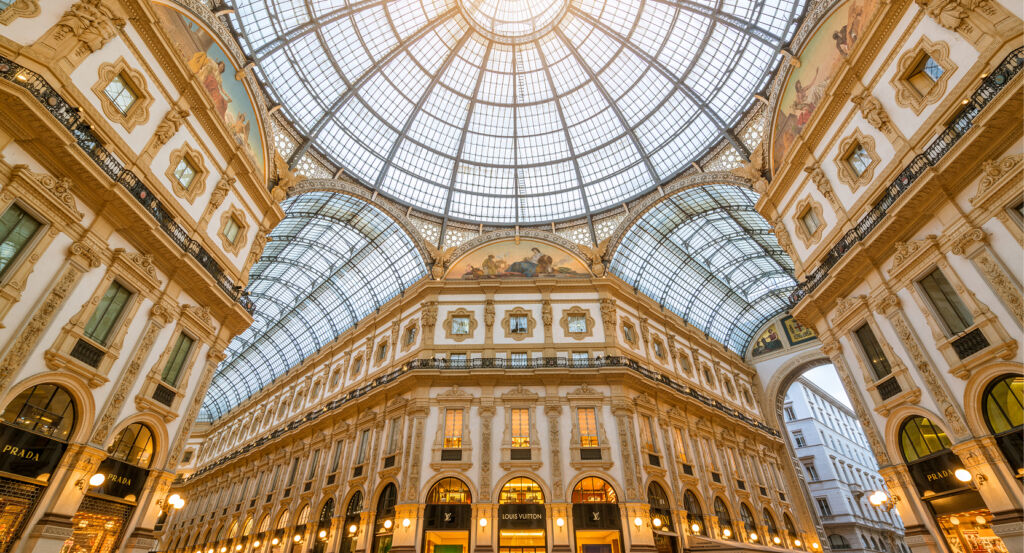
5. Milan is home to the world's oldest shopping mall.
The Galleria Vittorio Emanuele II opened in 1877 and still gleams with glass domes, mosaic floors, and luxury storefronts, a 19th-century temple to commerce and elegance.
4. You can find a vineyard planted by Leonardo da Vinci.
Tucked behind Casa degli Atellani is a quiet vineyard gifted to da Vinci by the Duke of Milan while he was painting The Last Supper. The vines were even replanted with original DNA.
3. Milan has its own hidden canals.
The Navigli canals, once designed with da Vinci's input, were key to Milan's industrial growth. Today, they line up trendy bars, galleries, and weekend flea markets, often skipped by first-time visitors.
2. The Duomo took over 600 years to complete.
Construction began in 1386 and wasn't officially completed until 1965. With 135 spires and 3,400 statues, it's the most ornate labor of devotion Italy's ever seen.
1. Aperitivo hour started here.
The pre-dinner drink-and-snack ritual, now beloved across Italy, began in Milan in the late 18th century, originally promoted by a local vermouth maker to prep the stomach before dining.
Where your story begins.
Start your planning journey with Foresyte Travel.
Experience immersive stories crafted for luxury travelers.