
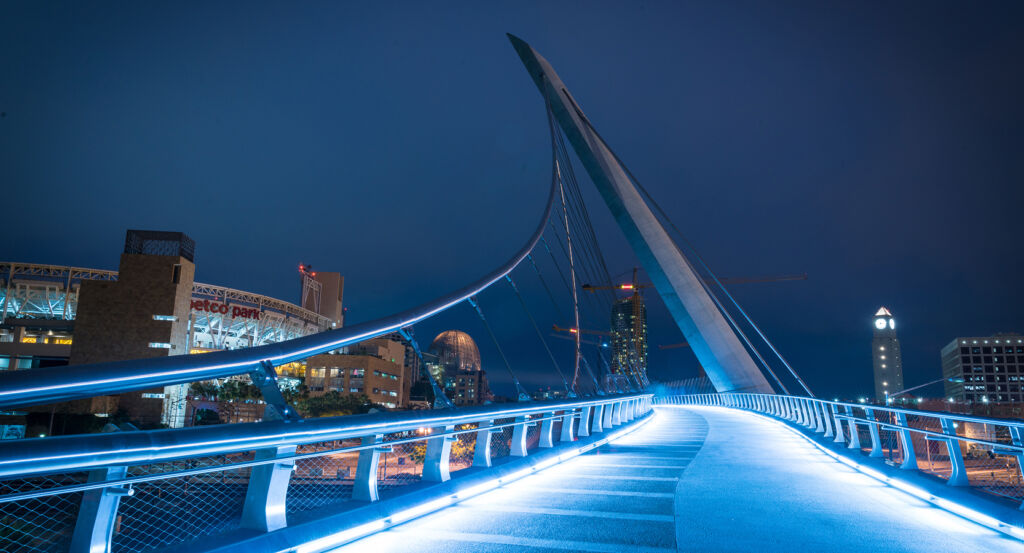
Why you should experience 50th Street in San Diego, California.
50th Street is a rooted corridor where Talmadge's architectural heritage, hillside landscapes, neighborhood traditions, and enduring residential character unfold along one of Central San Diego's defining streets.
Running through Talmadge between Kensington and Oak Park, the corridor follows gently rolling terrain bordered by mature residences, landscaped medians, neighborhood institutions, and established tree canopies that collectively reflect nearly a century of thoughtful community planning. Spanish Colonial Revival homes, California Ranch residences, Mid-century Modern infill, jacarandas, California pepper trees, coast live oaks, and drought-tolerant gardens establish a streetscape where architecture remains closely connected to the neighborhood's distinctive topography. Throughout the corridor, generations of stewardship, architectural preservation, and community pride reinforce an atmosphere shaped by permanence and continuity. The result is an experience defined by mature landscapes, historic craftsmanship, and one of Talmadge's most enduring neighborhood corridors.
What you should know about 50th Street.
50th Street is best known for extending through Talmadge, whose modern character began with the creation of the Talmadge Park subdivision in 1925, named in honor of actresses Norma, Constance, and Natalie Talmadge during one of San Diego's most ambitious residential development campaigns. Construction surrounding the corridor accelerated throughout the 1920s, 1930s, and 1940s, introducing enduring collections of Spanish Colonial Revival, Monterey Revival, Minimal Traditional, and California Ranch architecture distinguished by hand-applied stucco, red clay tile roofs, exposed timber detailing, decorative wrought iron, carved wood entry doors, clinker brick chimneys, and locally quarried stone retaining walls adapted to the neighborhood's rolling hills. The corridor matured alongside Talmadge's carefully planned curvilinear street network, landscaped parkways, and neighborhood commercial services while preserving the cohesive residential character envisioned by its original developers. California sycamores, jacarandas, coast live oaks, Allen's hummingbirds, monarch butterflies, western fence lizards, red-tailed hawks, and native coastal sage scrub continue reinforcing the corridor's ecological identity. Together, these planning milestones, architectural traditions, construction methods, neighborhood design principles, and natural landscapes establish 50th Street as a defining expression of Talmadge's historical evolution.
The Talmadge Gates, completed in 1926, became the neighborhood's defining architectural feature through their elaborate Spanish Colonial Revival design and remain among San Diego's most recognizable examples of period entrance monuments associated with planned residential communities. Nearby L. Frank Baum, author of The Wonderful Wizard of Oz, spent his final years in the surrounding district, adding an enduring literary association to Talmadge's cultural history while the neighborhood continued expanding during the early twentieth century. Original residences lining 50th Street continue displaying decorative tilework, leaded-glass casement windows, exposed beam ceilings, handcrafted wrought-iron fixtures, ornamental plaster detailing, and river-stone masonry that demonstrate the craftsmanship defining Talmadge's principal era of construction. Together, these celebrated neighborhood symbols, cultural associations, and preserved architectural details demonstrate how 50th Street developed within one of San Diego's most cohesive early twentieth-century residential communities.
How to fold 50th Street into your trip.
50th Street works as an exploration of Talmadge's architectural heritage, neighborhood character, and nearby cultural destinations.
Begin at Talmadge Gates, where the neighborhood's signature Spanish Colonial Revival entrance monuments introduce the planning vision that established one of San Diego's most distinctive residential communities. Continue to Kensington, whose walkable commercial district, historic architecture, and independent businesses deepen appreciation for the surrounding area's enduring neighborhood character. Conclude at Mission Trails Regional Park, where dramatic canyons, native landscapes, and panoramic overlooks provide the historical and environmental payoff by revealing the natural setting that shaped eastern San Diego's residential expansion. The progression moves naturally from Talmadge's defining architectural symbol through a neighboring historic district before culminating within one of California's largest urban parks, revealing why 50th Street remains one of Talmadge's most rewarding corridors.
Where your story begins.
Foresyte Travel reveals places that feel extraordinary long before you arrive.
Experience premium editorial crafted for luxury travelers.





































































































