
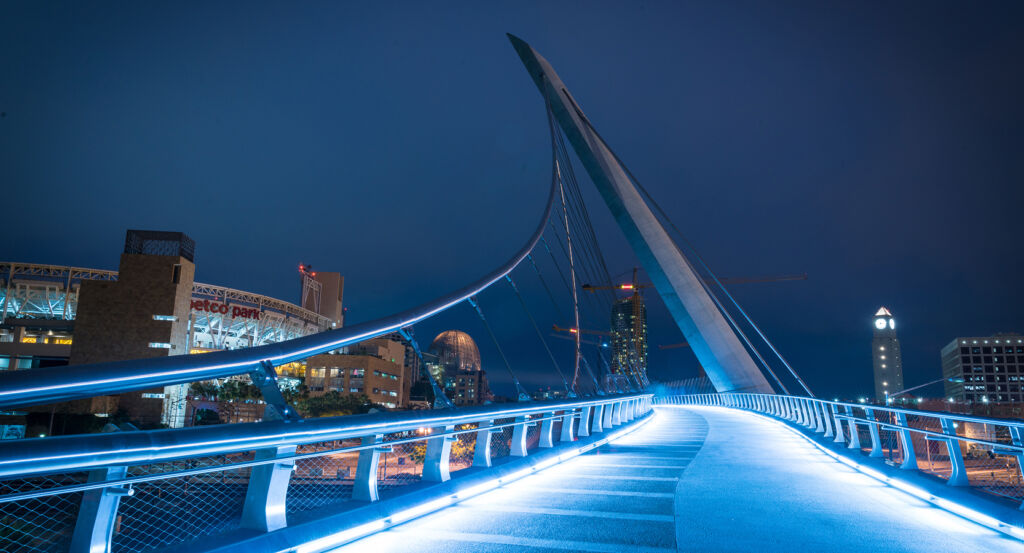
Why you should experience 8th Avenue in San Diego, California.
8th Avenue is a storied corridor where Downtown's urban ambition, architectural legacy, cultural vitality, and civic character converge along one of the city's defining streets.
Running through Downtown between Bankers Hill and the East Village, the corridor connects historic commercial blocks, performing arts venues, residential towers, landscaped plazas, and civic institutions that collectively demonstrate more than a century of continuous urban evolution. Beaux-Arts landmarks, Art Deco towers, Mid-century Modern buildings, Contemporary high-rises, jacarandas, Canary Island date palms, and carefully designed public landscapes establish a streetscape where historic architecture and modern development exist in striking dialogue. Throughout the corridor, commerce, culture, and generations of investment reinforce an atmosphere shaped by San Diego's enduring role as Southern California's waterfront metropolis. The result is an experience defined by architectural richness, urban sophistication, and one of Downtown's most distinguished corridors.
What you should know about 8th Avenue.
8th Avenue is best known for extending through Downtown, whose modern character accelerated after the arrival of the Santa Fe Railway in 1885, the commercial expansion that followed the city's late nineteenth-century land boom, and successive waves of redevelopment that transformed the district into Southern California's principal waterfront business center. Development surrounding the corridor introduced enduring collections of Beaux-Arts, Chicago School, Art Deco, Streamline Moderne, International Style, and Contemporary architecture distinguished by structural steel framing, reinforced concrete construction, glazed terra-cotta ornamentation, limestone façades, curtain-wall glazing, polished granite, and decorative metalwork spanning more than a century of urban construction. The corridor evolved alongside the growth of finance, hospitality, government, performing arts, and corporate headquarters while preserving an exceptional concentration of historically significant commercial buildings within the Gaslamp Quarter Historic District and neighboring downtown blocks. Jacarandas, Canary Island date palms, western gulls, Anna's hummingbirds, monarch butterflies, western fence lizards, and drought-adapted urban plantings continue reinforcing the corridor's environmental character. Together, these transportation milestones, architectural traditions, economic transformations, construction methods, and historic streetscapes establish 8th Avenue as a defining expression of Downtown's historical evolution.
Along the corridor, the San Diego Civic Theatre, completed in 1965 to designs by Harold E. Wagoner, established one of the largest performing arts venues on the West Coast and became the permanent home of the San Diego Opera and Broadway San Diego, reinforcing 8th Avenue's cultural prominence. Nearby Copley Symphony Hall, originally opened in 1929 as the Fox Theatre, introduced an exuberant movie palace designed by Weeks and Day whose Spanish Baroque interiors remain among California's finest surviving theatrical spaces following its restoration as a concert hall. Original commercial buildings surrounding 8th Avenue continue displaying glazed terra-cotta, ornamental cast iron, decorative pressed metal ceilings, marble wainscoting, mosaic tile entrances, and handcrafted bronze storefront detailing that preserve the craftsmanship defining Downtown's principal era of commercial expansion. Together, these celebrated performance venues, distinguished architectural works, and enduring construction traditions demonstrate how 8th Avenue developed within a downtown whose commercial importance is reinforced by an equally remarkable concentration of cultural institutions.
How to fold 8th Avenue into your trip.
8th Avenue works as an exploration of Downtown's architecture, performing arts, and urban heritage.
Begin at Gaslamp Quarter, where meticulously preserved Victorian-era commercial buildings introduce the architectural character that established downtown as Southern California's premier business district. Continue to Petco Park, whose integration of historic warehouse architecture and contemporary ballpark design showcases the city's successful blend of preservation and modern urban development. Conclude at The Rady Shell at Jacobs Park, where San Diego Bay provides the historical and cultural payoff through a performance venue celebrating the city's enduring relationship with its waterfront and artistic life. The progression moves naturally from nineteenth-century commercial architecture through one of downtown's defining contemporary landmarks before culminating beside the harbor that fueled San Diego's growth, revealing why 8th Avenue remains one of the city's defining urban corridors.
Where your story begins.
Foresyte Travel reveals places that feel extraordinary long before you arrive.
Experience premium editorial crafted for luxury travelers.





































































































