
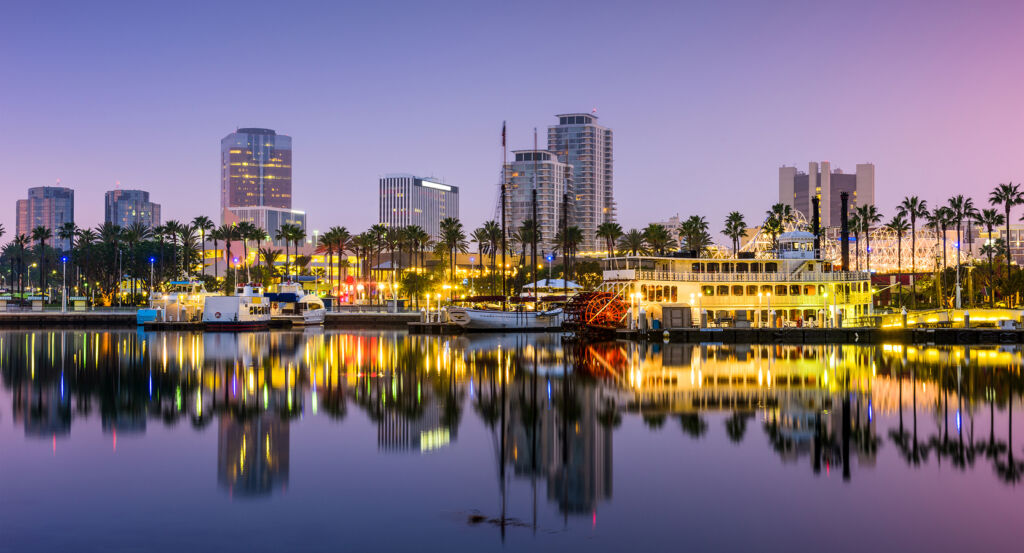
Why you should experience The Queen Mary in Long Beach, California.
The Queen Mary is not a hotel in the conventional sense, it is a threshold between eras, a floating monument where history, scale, and atmosphere converge to create an experience that feels immersive, uncanny, and impossible to replicate anywhere else.
From the moment you approach her, the ship asserts a presence that no modern structure can imitate. Docked permanently yet unmistakably ocean-born, The Queen Mary carries the physical weight of transatlantic ambition, wartime urgency, and old-world glamour in every rivet and corridor. Arrival does not feel like checking in; it feels like boarding. Gangways replace driveways, steel replaces glass, and the horizon of your stay shifts from skyline to superstructure. The ship's sheer mass reorients your sense of proportion. This is not architecture designed to disappear into comfort, it is engineering meant to endure, to move oceans, to carry thousands across uncertainty. Stepping inside, the atmosphere changes. Sound dulls. Light softens. The air feels thicker, quieter, more deliberate. Interiors retain the unmistakable Art Deco language of the 1930s, curved lines, geometric patterns, rich woods, brass accents, yet they are not polished into nostalgia. They feel lived-in, bearing the marks of time. Corridors stretch long and narrow, ceilings vary unexpectedly, and the ship's internal logic reveals itself slowly as you move through it. There is no single axis of orientation; instead, you learn the space by inhabiting it. Guest accommodations are unlike any modern hotel room. Cabins are compact, purposeful, and defined by maritime logic. Beds are comfortable but firm, designed for stability. Furnishings are restrained and functional, emphasizing utility over excess. Windows, portholes rather than panes, frame the harbor, the sky, or nothing at all, reinforcing the feeling that you are enclosed within a vessel rather than a building. This is part of the experience. The Queen Mary does not attempt to disguise her origins. She invites you to adapt to them. Bathrooms reflect the same character: efficient, enclosed, and unapologetically nautical. Water pressure, warmth, and reliability are prioritized over sprawl, reinforcing the sense that this is a ship first and a hotel second. Sound behaves differently aboard The Queen Mary. Instead of the hum of HVAC systems or city traffic, you hear creaks, distant echoes, the subtle movement of steel responding to temperature and tide. At night, the ship settles into a deep, resonant quiet that feels almost sentient. This is not silence, it is presence. Dining aboard The Queen Mary continues the immersion. Restaurants and lounges are set within historic spaces that once hosted royalty, dignitaries, and wartime officers. Meals feel anchored in ritual rather than trend, and even casual dining carries a sense of occasion shaped by surroundings that have witnessed decades of passage. Public spaces, ballrooms, observation decks, promenades, invite wandering. You do not move through The Queen Mary to get somewhere quickly; you move to experience being inside something vast, storied, and self-contained.
What you should know about The Queen Mary.
The Queen Mary's power lies not only in her history, but in how that history remains physically embedded in the ship.
Launched in 1934 and entering service in 1936, The Queen Mary was built as the crown jewel of the Cunard Line, designed to dominate transatlantic travel during an era when ocean liners were symbols of national prestige and technological supremacy. She was not merely a means of transportation; she was a statement. During her early years, she carried heads of state, celebrities, and elite travelers between Europe and North America, embodying speed, luxury, and modernity. When World War II began, her character shifted dramatically. Stripped of civilian finery and painted gray, she became a troopship, earning the nickname “The Grey Ghost”, transporting hundreds of thousands of soldiers across the Atlantic. Her speed and size made her difficult to target, and her role in the war effort was pivotal. After the war, she was restored to passenger service, carrying the marks of both glamour and conflict into the postwar era. What makes The Queen Mary unique today is that these layers were never erased. Instead of being gutted and rebuilt into a generic attraction, much of the ship's original structure, layout, and materiality remains intact. The narrow corridors, low doorways, uneven floors, and complex internal geography are not design choices, they are artifacts of a different engineering philosophy. This authenticity shapes every moment aboard. The ship's famed reputation for hauntings is also rooted in this physical continuity. Because spaces remain largely as they were during wartime and early service, guests move through environments that feel suspended in time. Whether one believes in the paranormal or not, the atmosphere is undeniably charged. Rooms feel watched not because of theatrics, but because they were once occupied by thousands whose lives intersected briefly and intensely within these walls. Another lesser-known aspect of The Queen Mary is how she resists simplification. She is too large to fully know in a single stay. Decks intersect unexpectedly. Stairwells lead to unfamiliar zones. Crew areas, engine rooms, and service corridors hint at systems operating beyond guest view. This complexity creates a sense of depth that modern hospitality rarely allows. The ship's preservation is ongoing and imperfect by necessity. Restoration focuses on structural integrity and experiential continuity. Paint peels. Metal shows age. Wood bears wear. These are not flaws; they are evidence. In a world increasingly obsessed with seamlessness, The Queen Mary stands as a counterpoint, an experience that derives power from texture, history, and the refusal to smooth away time.
How to fold The Queen Mary into your trip.
The Queen Mary works best when you allow it to be the focal point of your stay rather than a novelty you check off quickly.
Begin by giving yourself time to arrive mentally as well as physically. Walk the decks. Learn the ship's orientation slowly. Let the scale reveal itself through movement. Early hours are ideal for exploration, when corridors are quiet and the harbor light shifts across steel surfaces. Midday is well suited for guided tours, museum spaces, and time spent understanding the ship's wartime and civilian history. These experiences deepen your relationship to the environment and make later moments feel richer. Return to your cabin in the afternoon to rest, not because you are tired, but because the ship invites periodic retreat. Sitting inside a porthole-lit room while harbor activity continues outside creates a sense of separation that is both calming and strange. Evenings aboard The Queen Mary should be unhurried. Dine onboard allowing the continuity of place to carry through the night. Afterward, walk the decks as darkness settles. The ship transforms at night. Sound becomes deeper, movement slows, and the sense of inhabiting something vast and self-contained intensifies. This is when The Queen Mary feels most herself. On longer stays, repetition becomes part of the pleasure. Routes become familiar. Landmarks emerge. The ship shifts from maze to environment. When departure day arrives, leaving feels less like checking out of a hotel and more like disembarking. You return to land with altered proportions, modern buildings feel lighter, newer, less anchored. The Queen Mary does not aim to relax you into forgetting where you are. It asks you to remember, history, scale, endurance, and the rare sensation of occupying a place that has outlived its original purpose. Folded thoughtfully into a trip, The Queen Mary becomes more than accommodation. It becomes an encounter, with time, with engineering, and with the quiet gravity of a vessel that still knows exactly what it is.
Where your story begins.
Foresyte Travel reveals places that feel extraordinary long before you arrive.
Experience premium editorial crafted for luxury travelers.





































































































