
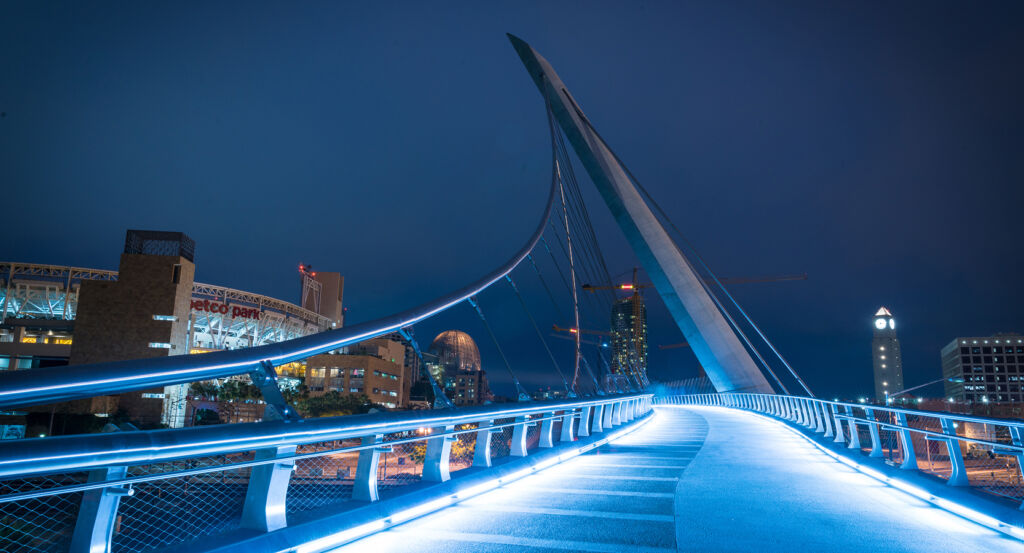
Why you should experience 13th Street in San Diego, California.
13th Street is a ambitious corridor where East Village's industrial foundations, entrepreneurial momentum, architectural evolution, and creative culture continue shaping one of Downtown's most distinctive urban streets.
Running through East Village between Cortez Hill and Barrio Logan, the corridor connects historic warehouse blocks, contemporary residential towers, neighborhood businesses, civic institutions, and public spaces that collectively reflect more than a century of continuous transformation. Early twentieth-century brick commercial buildings, reinforced-concrete warehouses, contemporary high-rise construction, steel detailing, Mexican fan palms, London plane trees, jacarandas, and drought-tolerant landscaping establish a streetscape where San Diego's industrial past and modern skyline evolve side by side. Throughout the corridor, generations of commerce, housing, innovation, and neighborhood investment have cultivated an atmosphere defined by purposeful urban growth. The result is an experience distinguished by architectural contrast, creative energy, and one of East Village's most compelling neighborhood corridors.
What you should know about 13th Street.
13th Street is best known for traversing East Village, whose expansion accelerated during the late nineteenth century as transcontinental rail connections, wholesale distribution, and maritime commerce transformed land beyond San Diego's original downtown into a center of industry and trade. Construction surrounding the corridor intensified between the 1890s and 1930s, producing brick warehouses, produce exchanges, manufacturing buildings, printing facilities, machine shops, and commercial lofts distinguished by reinforced-concrete framing, heavy timber beams, riveted steel members, industrial sash windows, decorative brick corbelling, and elevated loading platforms. The corridor matured alongside produce wholesalers, agricultural distributors, automotive suppliers, food processors, and regional logistics firms while preserving the orthogonal street grid established during downtown's earliest period of expansion. Rock pigeons, Anna's hummingbirds, mourning doves, western gulls, Mexican fan palms, London plane trees, coast live oaks, and native drought-tolerant plantings continue contributing to the corridor's evolving urban ecology. Together, these transportation systems, construction methods, industrial enterprises, architectural traditions, and environmental influences establish 13th Street as a defining expression of East Village's historical development.
The Centre City Development Corporation, established in 1975, coordinated decades of downtown planning, redevelopment, infrastructure investment, and neighborhood revitalization that guided East Village's transition while retaining significant elements of its historic street structure. Structural engineers increasingly specified reinforced-concrete construction throughout the district following the 1906 San Francisco earthquake, reflecting heightened attention to fire resistance and structural durability in commercial buildings. Original buildings bordering 13th Street continue displaying brick pilasters, cast-iron hardware, exposed timber framing, steel industrial sash assemblies, concrete lintels, and recessed freight entrances that demonstrate the durable craftsmanship associated with East Village's warehouse era. Together, these planning initiatives, engineering advancements, and preserved construction techniques demonstrate how 13th Street evolved within one of San Diego's most historically significant industrial districts.
How to fold 13th Street into your trip.
13th Street works as an exploration of East Village's artistic energy, civic spaces, and urban evolution.
Begin at Quartyard, where rotating neighborhood events, independent food vendors, public art, and outdoor gathering spaces introduce the creative momentum that defines East Village while establishing an inviting beginning to the experience. Continue to San Diego Central Library, where nationally recognized architecture, special collections, and expansive public spaces deepen appreciation for the neighborhood's civic and intellectual character before naturally guiding the outing toward its conclusion. Conclude at Gallagher Square, where open green space, public programming, and views framed by the surrounding skyline provide the civic payoff by illustrating how East Village has evolved from an industrial district into one of San Diego's principal public gathering places. The progression moves naturally from creative community life through civic discovery before concluding with a public space that reflects East Village's continuing transformation.
Where your story begins.
Foresyte Travel reveals places that feel extraordinary long before you arrive.
Experience premium editorial crafted for luxury travelers.





































































































