
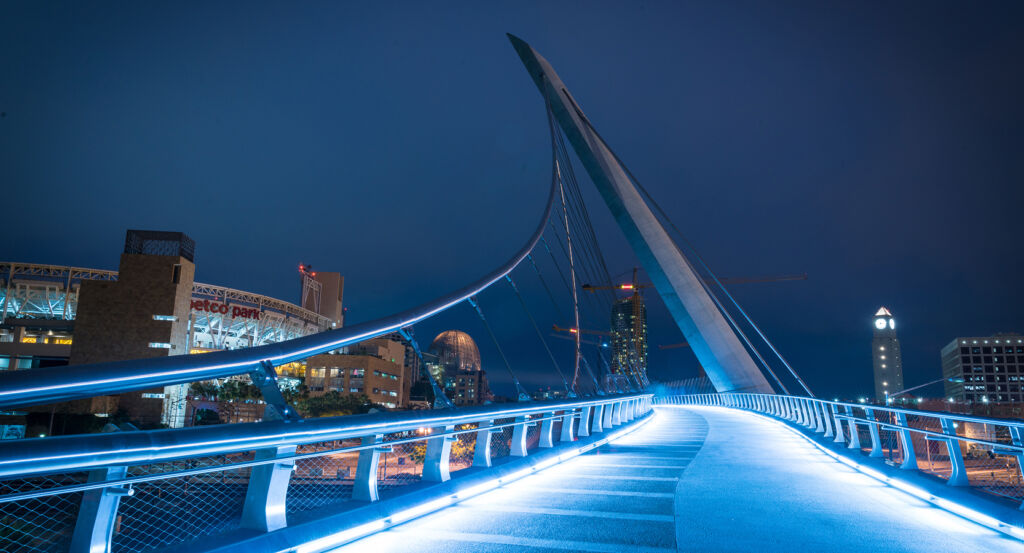
Why you should experience 32nd Street in San Diego, California.
32nd Street is a maritime corridor where Barrio Logan's industrial heritage, artistic identity, waterfront legacy, and cultural resilience define one of San Diego's most historically significant urban streets.
Running through Barrio Logan between Sherman Heights and Logan Heights, the corridor links working waterfront districts, established neighborhoods, maritime facilities, neighborhood businesses, and energetic cultural spaces that collectively reflect more than a century of continuous civic and industrial evolution. Early twentieth-century commercial buildings, California Craftsman residences, Spanish Colonial Revival homes, contemporary adaptive architecture, jacarandas, Canary Island date palms, coast live oaks, and drought-tolerant landscapes establish a streetscape where working industry and neighborhood life remain closely connected. Throughout the corridor, generations of shipbuilding, artistic expression, and community stewardship reinforce an atmosphere shaped by perseverance and cultural continuity. The result is an experience defined by architectural diversity, maritime history, and one of Barrio Logan's most compelling corridors.
What you should know about 32nd Street.
32nd Street is best known for extending through Barrio Logan, whose modern character accelerated after the arrival of the Atchison, Topeka and Santa Fe Railway in 1885, followed by the establishment of major maritime industries and the expansion of the U.S. Navy along San Diego Bay during the twentieth century. Development surrounding the corridor introduced enduring collections of California Craftsman, Spanish Colonial Revival, Art Moderne, Industrial Moderne, and Contemporary architecture distinguished by reinforced concrete construction, structural steel framing, hand-applied stucco, clinker brick masonry, riveted steel fabrication, corrugated metal cladding, and heavy timber industrial construction that reflected the district's dual residential and maritime functions. The corridor matured alongside the growth of National Steel and Shipbuilding Company (NASSCO), naval support facilities, rail freight operations, and waterfront manufacturing while preserving Barrio Logan's longstanding Mexican American cultural character and compact neighborhood street grid. Jacarandas, Canary Island date palms, coast live oaks, western gulls, brown pelicans, monarch butterflies, western fence lizards, and native coastal sage vegetation continue reinforcing the corridor's environmental character beside San Diego Bay. Together, these transportation milestones, industrial achievements, architectural traditions, construction methods, and ecological influences establish 32nd Street as a defining expression of Barrio Logan's historical evolution.
The Chicano Park Steering Committee, established in 1970, became the permanent steward of one of the nation's most significant collections of outdoor Chicano murals while coordinating conservation, documentation, and cultural programming that strengthened the surrounding neighborhood's identity. Nearby NASSCO, founded in 1960, evolved into the largest privately owned shipyard on the West Coast, constructing and repairing commercial vessels along with military support ships that reinforced the maritime economy surrounding 32nd Street for decades. Original industrial and commercial buildings bordering the corridor continue displaying steel sash windows, exposed heavy-timber framing, riveted structural members, brick corbelling, ornamental terra-cotta accents, and reinforced concrete detailing that preserve the craftsmanship associated with Barrio Logan's principal era of industrial expansion. Together, these enduring institutions, nationally significant cultural organizations, and preserved architectural details demonstrate how 32nd Street developed within a neighborhood whose maritime character is inseparable from its cultural legacy.
How to fold 32nd Street into your trip.
32nd Street works as an exploration of Barrio Logan's maritime heritage, public art, and waterfront culture.
Begin at Chicano Park, where internationally renowned murals, grand bridge columns, and community storytelling introduce the cultural character that has shaped Barrio Logan for generations. Continue to Mercado del Barrio, whose locally owned businesses, regional cuisine, and neighborhood gathering spaces deepen appreciation for the community's enduring entrepreneurial spirit. Conclude at USS Midway Museum, where preserved naval engineering, historic aircraft, and San Diego Bay provide the historical payoff by illustrating the maritime traditions that continue defining the surrounding waterfront. The progression moves naturally from Barrio Logan's cultural heart through its neighborhood commerce before culminating with one of San Diego's defining maritime experiences, revealing why 32nd Street remains one of the city's most historically significant corridors.
Where your story begins.
Foresyte Travel reveals places that feel extraordinary long before you arrive.
Experience premium editorial crafted for luxury travelers.





































































































