
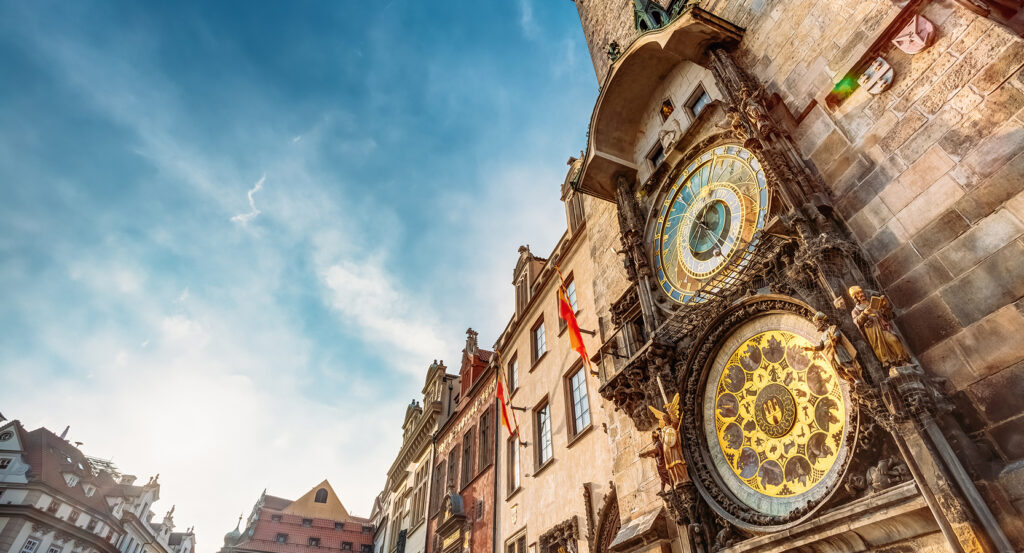
Why you should experience the Orloj Mechanism Exhibition at the Astronomical Clock in Old Town Square of Prague.
The Orloj Mechanism Exhibition is Prague's window into the soul of its most miraculous machine, a glimpse behind the clock face into the gears that have measured six centuries of wonder.
Here, time is no longer abstract; it lives, breathes, and clicks. Tucked within the Old Town Hall Tower, the exhibition reveals the intricate brasswork and counterweights that still drive the Astronomical Clock, entirely by mechanical motion. The scent of oil and aged metal fills the room. Light glances off rotating shafts, flywheels, and cams, each part moving with the grace of something half-alive. It's not just a display; it's an act of reverence toward the artisans who turned faith and physics into harmony. Every tick feels like a heartbeat, every rotation a prayer. To stand among these gears is to witness human genius suspended between art and eternity.
What you should know about the Orloj Mechanism Exhibition.
The exhibition was first opened to the public in the late 1990s, following an extensive restoration of the clock's movement that returned it to full medieval operation after decades of modernization.
It showcases both the original 15th-century astronomical mechanism, designed by Mikuláš of Kadaň and Jan Šindel, and later additions, including the 16th-century calendar dial gearing and the 17th-century figure automata system. Each section of the mechanism operates independently yet synchronously: one set of gears tracks solar and lunar positions; another controls the Apostles' hourly procession; a third regulates the clock's chiming sequence. The exhibition also displays fragments of earlier wooden cogs and damaged components recovered after the 1945 bombing, their charred edges preserved as artifacts of endurance. Few visitors realize that the Orloj's main drive still uses a weight-driven escapement, among the last functioning examples of pre-spring horology in the world. Engineers must manually wind the system each morning, raising the iron weights that descend gradually through the day, powering the clock's eternal choreography. The accompanying diagrams trace the geometry of the astrolabe dial, an instrument that once placed Prague at the cosmic center of creation. The exhibition even includes scale replicas of the apostles' motion cams and the singing rooster's trigger mechanism, illustrating the blend of sacred imagery and mechanical perfection that defines the Orloj's genius.
How to fold the Orloj Mechanism Exhibition into your trip.
After watching the Astronomical Clock perform its hourly procession from the square, step inside the Old Town Hall Tower for a more intimate encounter.
Follow the narrow stairway upward, past the stone archways, until you reach the exhibition chambers. Move slowly, the hum of the machinery fills the space like music. Watch the gears turn in real time as the hour approaches; each click and rotation feels deliberate, measured, eternal. Read the interpretive displays, but spend most of your time simply observing, the rhythm speaks louder than the text. The guides, often clockmakers themselves, will show you the connection between the upper dial's celestial ring and the lower calendar wheel, a union of heaven and earth in brass and steel. Visit near sunset; from the adjoining window, you can see Old Town Square bathed in amber light, the same glow that has touched these gears since 1410. The Orloj Mechanism Exhibition isn't a museum, it's a confession of craft, a sacred machine still alive in the hands of those who refuse to let time forget how to move beautifully.
Where your story begins.
Foresyte Travel reveals places that feel extraordinary long before you arrive.
Experience premium editorial crafted for luxury travelers.





































































































