
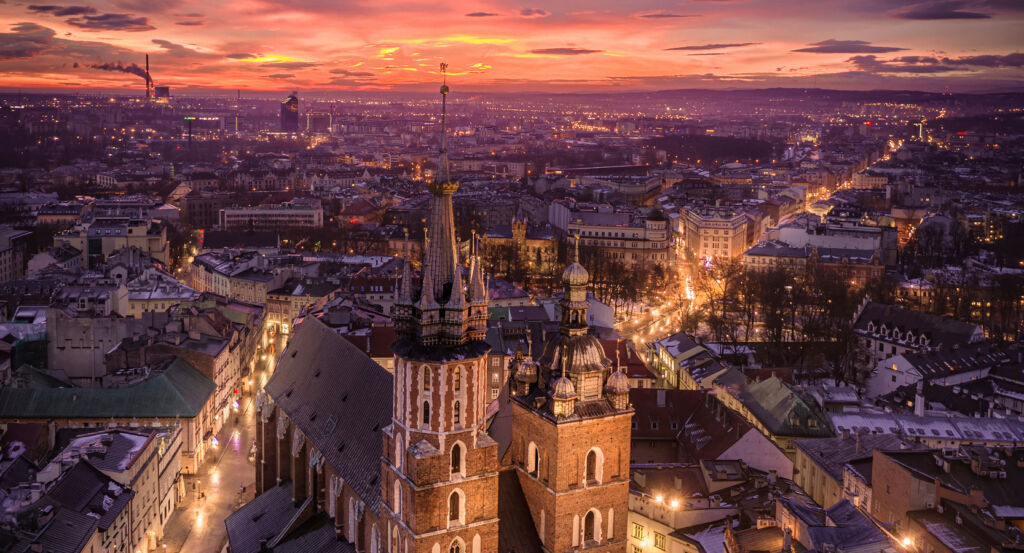
Why you should experience Atrium Hotel in Kraków, Poland.
Atrium Hotel is a quietly architectural Old Town refuge that feels deliberately tucked away, offering a stay defined by enclosure, calm, and a sense of being slightly behind the city.
Set just off Kraków's historic corridors, the hotel occupies a position that rewards travelers who value discretion over frontage. You are close to everything that matters, the Old Town, Planty Park, civic landmarks, yet the hotel itself feels removed from performance. Arrival carries a subtle shift in atmosphere. The street recedes quickly, replaced by an interior that feels inward-facing and composed. The building's defining feature is its relationship to space: instead of expanding outward, it gathers inward. Public areas feel protected, almost cloistered, with sightlines that encourage pause. Seating is arranged to support quiet observation or stillness, not social theater. Lighting is soft but intentional, guiding attention gently. The overall tone is one of containment, not confinement, but shelter. Guest rooms continue this sense of inward calm. Layouts are comfortable and grounded, offering enough space to settle. Beds are designed for uninterrupted rest, supported by an acoustic environment that dampens the Old Town's constant motion into something distant and abstract. The visual language leans neutral and composed, allowing the room to function as a recovery space. Windows often face inner courtyards or quieter streets, reinforcing the hotel's retreat-like quality despite its central location. Bathrooms are practical and thoughtfully arranged, supporting routine. Across the property, the experience feels intentional and quietly protective. Atrium Hotel is ideal for travelers who want to stay central without feeling exposed, those who value the ability to step fully into Kraków and then withdraw cleanly, without friction.
What you should know about Atrium Hotel.
Atrium Hotel is structured around the psychology of withdrawal rather than immersion, and that design choice profoundly shapes how the stay is experienced over time.
Many Old Town hotels rely on insulation alone to manage noise and density. Atrium does something subtler. Its architecture and interior planning create layers between you and the city, reducing physical load before soundproofing even becomes relevant. Movement through the hotel is short and controlled. Corridors do not sprawl. Transitions are quick and predictable. This creates a sense of spatial compression that calms. Materials reinforce this effect. Surfaces are chosen for their ability to absorb rather than reflect, sound, light, and attention. There is little gloss, little shine, and very little visual demand. The result is an environment that the nervous system understands immediately as safe and low-stakes. Lighting avoids dramatic contrast, favoring a steady, warm presence that supports circadian rhythm and resonant regulation. Acoustic conditions further support this inward focus. Exterior sounds are softened into near-absence, not because the city is erased, but because the building holds it at arm's length. Service culture mirrors this containment. Interactions are discreet, efficient, and respectful of privacy. Assistance is available without intrusion, offered with a sense that guests here value quiet competence over engagement. Another understated strength of Atrium Hotel is how it supports mental reset across multiple days. Returning here doesn't feel like re-entry into a managed environment; it feels like stepping behind a curtain. Over time, this changes how you experience Kraków itself. You explore more fully because you know you can retreat completely. Energy is preserved not through luxury, but through protection. Atrium Hotel doesn't attempt to frame Kraków or interpret its meaning. It creates a controlled interior world that allows the city to remain vivid.
How to fold Atrium Hotel into your trip.
Atrium Hotel works as a deliberate counterbalance to Kraków's density, a place you return to often, even briefly, to reset your internal state.
Begin your mornings quietly. Step out when the Old Town is still loosening its joints, letting streets feel architectural. Because the hotel sits just off the main flow, your entry into the city feels intentional. Return midday. One of Atrium's greatest strengths is how effectively it absorbs short pauses. Come back to rest your senses, reorganize your thoughts, or simply sit still for a few minutes before heading out again. Afternoons are ideal for deeper engagement, museums, long walks, or unhurried exploration, knowing your base remains close and psychologically sheltered. Evenings benefit from this structure as well. Dine nearby or farther afield, wander illuminated streets, then withdraw cleanly when the city's energy peaks. The return feels like closing a door rather than collapsing into bed. For longer stays, this rhythm becomes especially powerful. Days feel intentional. The city remains vivid because it never spills into your rest. Business travelers benefit from the hotel's ability to protect focus and decompress the nervous system after full schedules. Leisure travelers gain a rare sense of control over pace and exposure. Anchoring your stay at Atrium Hotel allows Kraków to be experienced in full color, then set aside, completely, whenever you choose. The hotel does not compete with the city or attempt to elevate it through design narrative. It offers something quieter and more strategic: a sheltered interior that keeps your attention intact so the city can be met with clarity, curiosity, and sustained presence.
Where your story begins.
Foresyte Travel reveals places that feel extraordinary long before you arrive.
Experience premium editorial crafted for luxury travelers.





































































































