Top places to stay in Las Vegas, Nevada.
Las Vegas developed at the intersection of Mojave Desert railroad commerce, legalized gambling, and an expanding American entertainment industry, establishing a resort economy that transformed the conventions of modern hospitality. The completion of the San Pedro, Los Angeles and Salt Lake Railroad in 1905 established a transportation junction between Southern California and the interior American West, attracting merchants, railroad employees, and travelers to a settlement organized around Fremont Street. Early accommodation served this transient population through boardinghouses, commercial hotels, and modest establishments associated with the railroad economy. Nevada's legalization of casino gambling in 1931 fundamentally altered the commercial possibilities of hospitality, coinciding with the construction of Hoover Dam and the arrival of thousands of workers in southern Nevada. The state's reduction of its divorce residency requirement to six weeks created another specialized lodging market, with guest ranches accommodating visitors during their mandatory residence. Highway 91 subsequently connected Las Vegas with the expanding automobile culture of Southern California, encouraging resort development beyond the original downtown street grid. El Rancho Vegas opened along the highway in 1941, establishing a roadside hospitality model that combined guest accommodation, casino gambling, dining, swimming pools, and live entertainment within a landscaped property. The Flamingo followed in 1946, bringing a more elaborate conception of resort luxury through the ambitions of Hollywood publisher Billy Wilkerson and the subsequent involvement of Benjamin Siegel. Postwar prosperity, expanding commercial aviation, and investment from organized-crime syndicates accelerated the development of increasingly substantial casino resorts during the 1950s. The Las Vegas Convention Center opened in 1959, connecting the accommodation industry with professional exhibitions, corporate gatherings, and a growing national business-travel market. The emergence of convention tourism broadened the economic foundations of hospitality beyond recreational gambling and entertainment. Howard Hughes entered the casino industry through a series of acquisitions beginning in 1967, contributing to a transition toward institutional investment and more conventional corporate ownership. Nevada's Corporate Gaming Act of 1969 further facilitated participation by publicly traded companies, expanding access to the capital required for increasingly ambitious construction. Kirk Kerkorian's International Hotel, completed that same year, demonstrated the possibilities of large-scale accommodation integrated with major entertainment facilities. During the following decades, the industry's financial structure increasingly depended upon coordinated revenue from gambling, lodging, restaurants, conventions, and entertainment. Steve Wynn's opening of The Mirage in 1989 initiated another period of resort development distinguished by elaborate attractions, substantial construction budgets, and the expansion of leisure facilities beyond the casino floor. The 1990s brought unprecedented investment in destination resorts, supported by international tourism, expanding airline connections, and the growing commercial importance of nongaming activities. Las Vegas developed a hospitality economy in which the hotel became the principal institution organizing the destination's commercial, recreational, and entertainment industries.
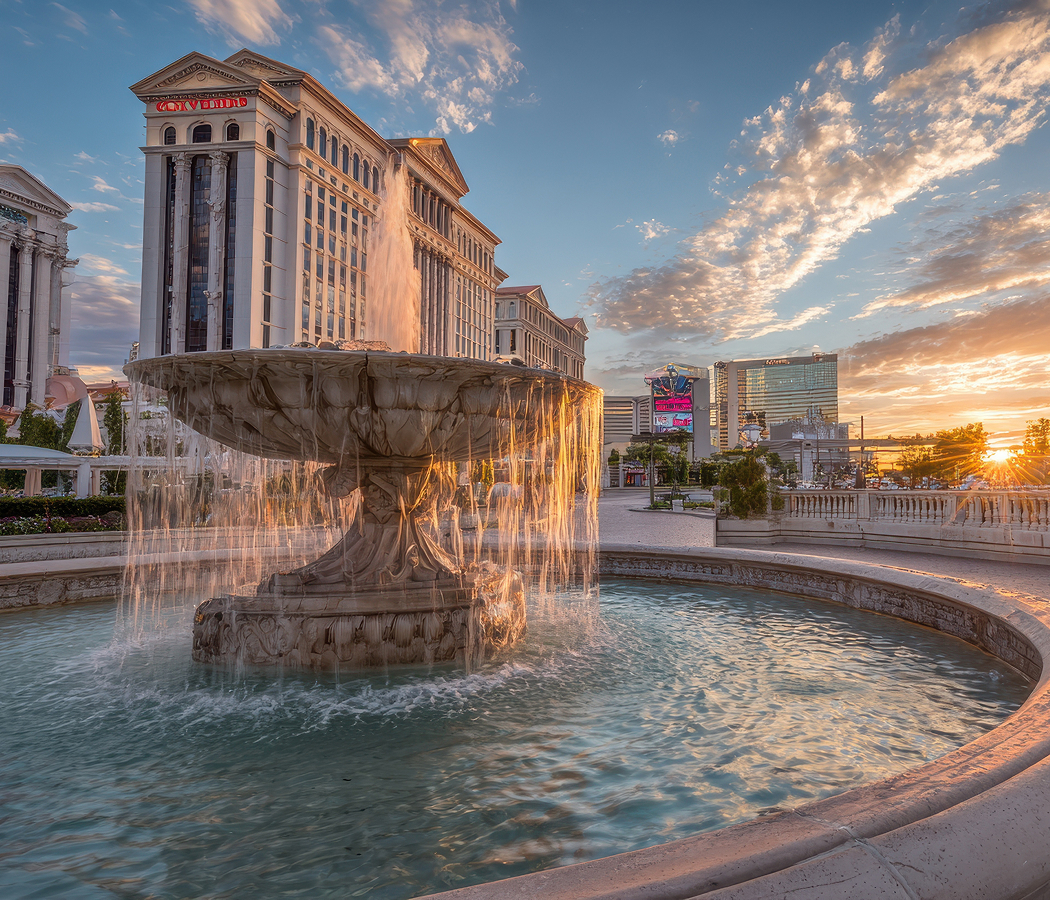
Las Vegas's lodging geography reflects the distinctive relationship between desert topography, automobile infrastructure, land development, and architectural experimentation across the metropolitan valley. The Las Vegas Strip follows Las Vegas Boulevard South through the unincorporated communities of Winchester and Paradise, occupying a corridor whose original roadside configuration encouraged expansive building sites, freestanding structures, and substantial setbacks from the highway. Early resort compounds adopted architectural arrangements associated with Western ranches and Southern California leisure properties, incorporating low-rise accommodation wings, landscaped courtyards, shaded walkways, and outdoor swimming facilities. The Mojave Desert's intense summer temperatures encouraged the development of increasingly extensive climate-controlled interiors, transforming the relationship between hotel buildings and their surrounding environment. Monumental lobbies, enclosed commercial promenades, interior gardens, and interconnected recreational spaces eventually became defining components of the corridor's architectural identity. The northern Strip developed around Sahara Avenue and the approaches to the convention district, where successive construction campaigns produced a mixture of midcentury commercial patterns, high-rise accommodation, and large exhibition facilities. Architect Martin Stern Jr. played a consequential role in the vertical transformation of this landscape, designing major resort towers whose scale and spatial organization helped establish the architectural style of modern casino hospitality. His three-wing configuration for the International Hotel organized accommodation around a central circulation system, connecting substantial guestroom towers with an extensive concentration of public facilities. The Central Strip subsequently became the principal setting for grand resort architecture, distinguished by expansive entrance courts, elaborate landscaping, elevated pedestrian bridges, and enormous building complexes occupying multiple urban blocks. The development of themed architecture during the 1990s introduced elaborate interpretations of European and American urban environments, transforming classical antiquity, Renaissance architecture, and nineteenth-century cityscapes into grand hospitality settings. Roman-inspired colonnades, Venetian canals, Parisian façades, and representations of the New York skyline established a distinctive architectural language in which buildings communicated recognizable cultural identities through their exterior forms. Interior atriums, artificial waterways, painted ceilings, and carefully constructed perspectives extended these compositions into extensive enclosed environments. The southern Strip developed through larger parcels and substantial transportation connections, supporting contemporary high-rise towers, conference facilities, and extensive resort grounds near Harry Reid International Airport. CityCenter, completed principally in 2009, introduced a contrasting architectural direction through the concentration of contemporary buildings within a coordinated mixed-use district. César Pelli's curving glass towers, Helmut Jahn's inclined residential buildings, and Daniel Libeskind's angular retail architecture brought international modernist design into a corridor historically associated with theatrical architectural representation. Its dense arrangement of towers, pedestrian connections, and commercial spaces also marked a departure from the earlier pattern of widely separated roadside structures. East of Las Vegas Boulevard, Paradise Road and the surrounding convention district form a distinct accommodation environment shaped by proximity to exhibition halls, commercial offices, and major transportation routes. The district's buildings emphasize substantial meeting facilities, efficient circulation, and direct relationships with the infrastructure of business travel. Downtown presents a contrasting urban geography, retaining the compact blocks and closely spaced commercial frontages established around the original railroad settlement. Fremont Street's pedestrian environment connects historic casino buildings, restaurants, entertainment facilities, and accommodation within a comparatively concentrated streetscape. Fremont East extends this setting through preserved neon signage, renovated commercial properties, and smaller buildings associated with the city's midcentury development. The nearby Arts District occupies former industrial and commercial blocks south of downtown, where converted warehouses, galleries, restaurants, and independent businesses create a more intimate urban character. Beyond the central tourism corridors, Summerlin extends westward toward the Spring Mountains through master-planned neighborhoods, landscaped golf courses, and residential districts whose lower-density development supports a different form of resort accommodation. Henderson occupies the southeastern Las Vegas Valley, where suburban expansion and proximity to the surrounding desert mountains have encouraged hospitality environments organized around recreation and open space. The Lake Las Vegas district adds an artificial lakeshore and Mediterranean-influenced architecture to this metropolitan geography, with terraced buildings, landscaped promenades, and waterfront settings establishing a distinct relationship between accommodation and the desert landscape. Las Vegas contains several markedly different lodging environments, ranging from compact historic streets and grand entertainment corridors to contemporary architectural districts and spacious residential resort communities. Foresyte may earn a commission when you book.
Foresyte Travel's top five choices.
5. The Cosmopolitan of Las Vegas
The Cosmopolitan of Las Vegas emerged from one of the Strip's most turbulent development histories, beginning as Ian Bruce Eichner's condominium-hotel project before the 2008 financial crisis pushed the unfinished resort into Deutsche Bank's control. The bank completed the property at a total investment exceeding $4 billion, producing an unusually vertical resort on an 8.5-acre parcel where two towers rise directly above a multilevel entertainment complex and underground parking excavated 60 feet beneath the site. Blackstone acquired the property for $1.73 billion in 2014 and subsequently invested hundreds of millions of dollars in its redevelopment before selling the real estate and operations through transactions totaling $5.65 billion in 2022. MGM Resorts acquired the operating business for $1.625 billion, completing a financial arc that carried the Cosmopolitan from foreclosure-era development into one of the most valuable resort transactions in Las Vegas history.
4. The Palazzo at The Venetian Resort
The Palazzo expanded Sheldon Adelson's convention-driven resort model into a second major tower connected directly with The Venetian, creating an immense hospitality complex on the former Sands Hotel site. Las Vegas Sands developed the property during the company's international expansion into Macao, extending a strategy built around concentrating lodging, gaming, retail, dining, entertainment and convention business inside a single destination. The Palazzo became the first resort on the Las Vegas Strip to earn LEED Silver certification for new construction and was recognized as the world's largest green building at the time, making environmental engineering a consequential part of a project constructed at enormous scale. The property also marked another physical expansion of the integrated-resort model Adelson had introduced at The Venetian in 1999, giving the northern Strip one of the largest interconnected resort developments in the United States.
3. The Venetian Las Vegas
The Venetian Las Vegas grew from Sheldon and Miriam Adelson's connection with Venice into a $1.5 billion resort that replaced the Sands Hotel and helped establish the convention-centered integrated-resort model later exported by Las Vegas Sands around the world. Its reconstruction of Venice extends through St. Mark's Square, the Campanile, canals and gondolas, supported by 25-foot Botticino marble columns, Verde St. Denis stone from the Italian Alps, hand-painted ceiling frescoes and an Italian-marble floor derived from the Church of Santa Maria del Rosario. The resort joined those architectural references to the immense Sands Expo and Convention Center, shifting the economics of a major Strip property toward a concentrated combination of hospitality, entertainment and large-scale business travel. The Venetian became more than a themed casino resort: its commercial model supplied the prototype for Adelson's later developments in Macao and helped redirect Las Vegas toward the convention-driven resort economy.
2. Encore Las Vegas
Encore Las Vegas grew from the immediate commercial strength of Wynn Las Vegas into a freestanding resort conceived by Steve Wynn as the second major development on the former Desert Inn property. Wynn Resorts broke ground on April 28, 2006, exactly one year after Wynn Las Vegas debuted and 56 years after the Desert Inn opened on the same site, connecting three generations of Strip development through a single parcel. Roger Thomas directed interiors built around flowering atria, mosaics, gardens and extensive natural light, giving the resort a highly specific visual character across spaces integrated with the neighboring Wynn complex. Encore opened in December 2008 amid the global financial crisis, completing a multibillion-dollar expansion that transformed the former Desert Inn grounds into the two-resort Wynn campus.
1. Wynn Las Vegas
Wynn Las Vegas became Steve Wynn's return to Strip resort development after the 2000 sale of Mirage Resorts, transforming the former Desert Inn property into a $2.74 billion project financed through the newly created Wynn Resorts. The development reorganized more than 200 acres around a bronze-glass tower, golf landscape and an artificial mountain-and-lake composition that concealed much of the resort from Las Vegas Boulevard, turning landscape architecture into a fundamental part of the property's physical conception. Wynn opened the resort on April 28, 2005, exactly five years after acquiring the Desert Inn and on the 55th anniversary of that property's debut, then began developing Encore as demand supported expansion of the site. The project restored Wynn as an independent force on the Strip after his earlier creation of The Mirage, Treasure Island and Bellagio, beginning the resort platform that subsequently expanded through Encore, Wynn Macau and the company's later international developments.
Where your story begins.
Foresyte Travel reveals places that feel extraordinary long before you arrive.
Enjoy editorial crafted for luxury travelers.
Foresyte may earn a commission when you book.