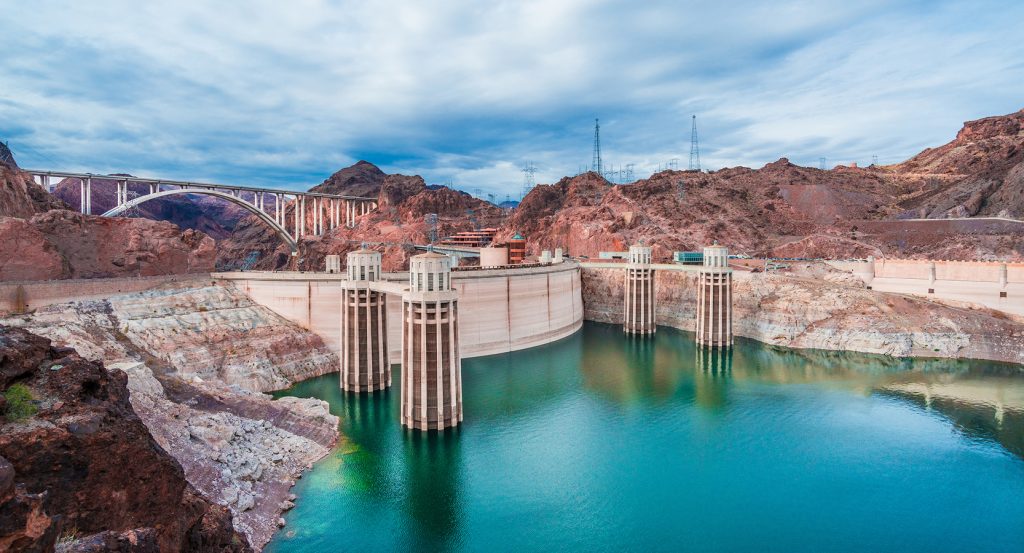
Why Hoover Dam matters.
Hoover Dam is a grand concrete arch-gravity dam where the Lake Mead National Recreation Area's engineering legacy, Colorado River history, national ambition, and twentieth-century infrastructure transformed the American Southwest.
Set along U.S. Route 93 near the Mike O'Callaghan-Pat Tillman Memorial Bridge and just steps from Lake Mead, this immense engineering achievement unfolds through soaring concrete walls, hydroelectric power stations, intake towers, spillways, observation terraces, and dramatic canyon overlooks where the Colorado River carved Black Canyon long before one of America's greatest public works projects reshaped the landscape. Clean geometric lines, Art Deco detailing, immense structural forms, and sweeping desert vistas reflect an era when engineering and craftsmanship advanced together on an unprecedented scale. Innovation, resilience, and precision define every aspect of the structure.
What defines Hoover Dam.
Hoover Dam is best known for being constructed between 1931 and 1936 by the Bureau of Reclamation during the Great Depression, creating a 726-foot-high concrete arch-gravity dam that required 3.25 million cubic yards of concrete while controlling the Colorado River, generating hydroelectric power, supplying water across the Southwest, and forming Lake Mead, the largest reservoir in the United States by capacity when full. More than 21,000 workers contributed to construction during the project's five-year schedule, with peak daily workforces exceeding 5,000 as engineers overcame extreme desert temperatures, unstable canyon walls, and the challenge of diverting the Colorado River through four massive tunnels blasted into Black Canyon. Chief engineer John L. Savage and construction superintendent Frank Crowe introduced innovative cooling systems using more than 580 miles of embedded steel pipe circulating refrigerated water through the concrete, reducing curing time from well over a century to two years. The hydroelectric powerplant contains 17 main turbines capable of producing more than 2,000 megawatts of electricity, supplying communities throughout Nevada, Arizona, and California while supporting millions of residents and extensive agricultural development. The structure also incorporates elegant Art Deco architecture by Gordon B. Kaufmann and sculptural works by Oskar J. W. Hansen, whose Winged Figures of the Republic and terrazzo star map commemorate both the engineering achievement and the people who built it. Designated a National Historic Landmark in 1985 and recognized as a National Historic Civil Engineering Landmark by the American Society of Civil Engineers, Hoover Dam continues supporting flood control, water storage, renewable energy production, and long-term infrastructure research through ongoing structural monitoring, seismic evaluation, concrete analysis, and modernization programs.
Embedded cooling pipes, precisely engineered expansion joints, massive intake towers, and the sweeping arch profile reveal solutions developed specifically for the immense hydraulic pressures and desert conditions found within Black Canyon. Art Deco ornamentation, bronze reliefs, astronomical alignments, and carefully proportioned public spaces elevate the structure beyond its utilitarian purpose, reflecting the confidence and technical ambition that defined one of the largest federal construction projects of the twentieth century. Nearly ninety years after completion, Hoover Dam remains central to water management, electricity generation, and scientific study throughout the American Southwest while standing as one of the most influential achievements in the history of civil engineering.
How Hoover Dam fits.
Hoover Dam works as the centerpiece of an exploration through the Lake Mead National Recreation Area's engineering and desert landscapes.
Begin at Hoover Dam Visitor Center, where exhibits detailing construction, engineering, and Colorado River history establish the context before exploring Hoover Dam. Continue to Mike O'Callaghan-Pat Tillman Memorial Bridge, whose elevated pedestrian walkway provides commanding views across Black Canyon and the full height of the dam. Conclude at Lake Mead, where expansive desert shorelines and panoramic reservoir views provide a memorable finale celebrating the immense scale of one of North America's most significant water management projects. The progression moves naturally from engineering history to panoramic canyon scenery before concluding beside the reservoir that transformed the Southwest, revealing why this section of the Colorado River remains one of the nation's defining engineering landscapes.
Where your story begins.
Foresyte Travel reveals places that feel extraordinary long before you arrive.
Enjoy editorial crafted for luxury travelers.
Foresyte may earn a commission when you book.